How Much Mortgage Can I Afford in Canada? (2026)

Quick answer: In 2026, most Canadian buyers can afford a mortgage of about 4 to 4.5 times their gross household income. A household earning $100,000 with no other debt qualifies for roughly $445,000 on a 25-year amortization, or about $477,000 over 30 years. Your exact limit depends on four things: gross income, monthly debt payments, down payment, and the stress-test qualifying rate your lender applies.
Every federally regulated lender calculates your maximum using the same formulas. This guide walks through them step by step so your estimate matches what a bank will actually approve.
How Much Mortgage Can I Afford Canada by Income?
The table shows estimated maximum mortgages for applicants with no other debt. It assumes a 6.2% stress-tested qualifying rate (a ~4.2% contract rate + 2%) and $350/month for property tax and heat.
| Gross household income | Max mortgage (25-yr) | Max mortgage (30-yr) |
|---|---|---|
| $60,000 | ~$245,000 | ~$263,000 |
| $80,000 | ~$345,000 | ~$370,000 |
| $90,000 | ~$395,000 | ~$424,000 |
| $100,000 | ~$445,000 | ~$477,000 |
| $120,000 | ~$545,000 | ~$584,000 |
| $150,000 | ~$694,000 | ~$745,000 |
Treat these as starting points. Car loans, credit card minimums, condo fees, and higher property taxes all lower the number.
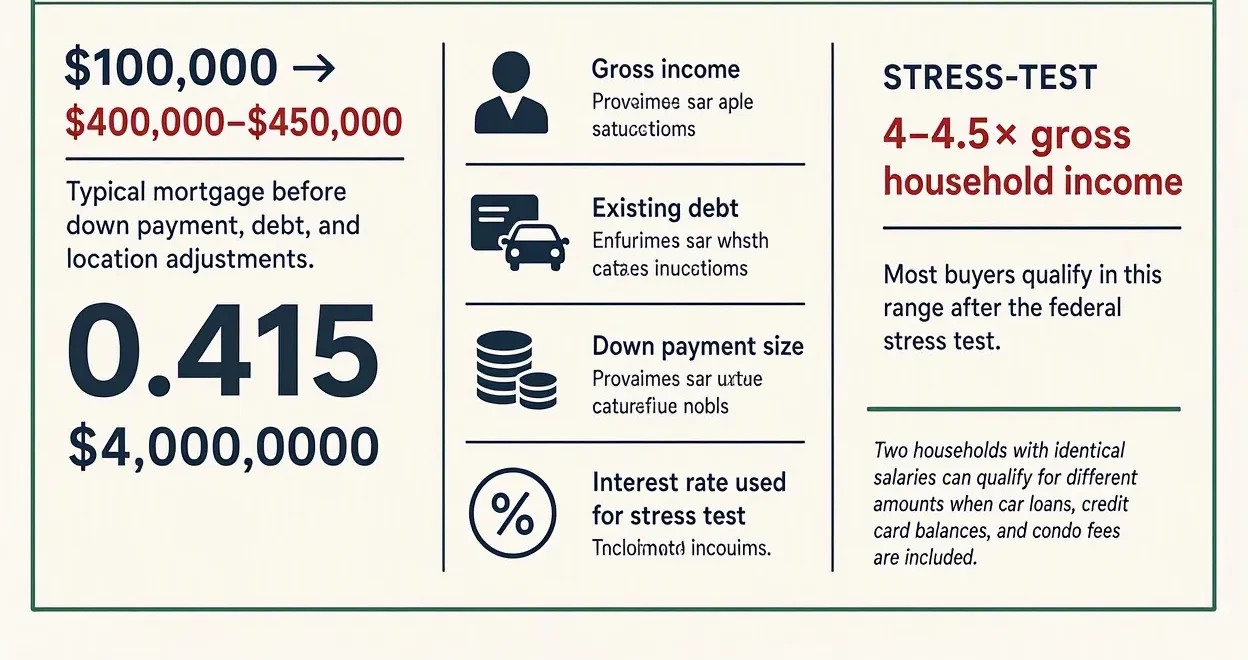
The four inputs that set your limit:
- Gross annual household income
- Monthly debt payments (loans, credit cards, lines of credit)
- Down payment amount
- Stress-tested qualifying rate (not your contract rate)
What Is the Mortgage Stress Test in Canada?
The mortgage stress test requires federally regulated lenders to qualify you at a higher interest rate than the one you’ll actually pay. Your qualifying rate is the higher of your contract rate + 2%, or 5.25%. OSFI sets the rule under Guideline B-20 and confirmed in January 2026 that it stays unchanged.
With 5-year fixed rates in the low 4% range in 2026, contract + 2% is the rule that applies to almost everyone. Compared with qualifying at your contract rate, the stress test typically cuts your maximum mortgage by about 15% to 20%. To get your real number, get pre-approved for a mortgage in Canada.
Renewal exception: Since November 21, 2024, switching lenders at renewal no longer requires a stress test, as long as you don’t increase the loan amount or amortization.
Qualifying rate formula: max(contract rate + 2%, 5.25%)
How Do GDS and TDS Ratios Decide How Much Mortgage You Can Afford?
Lenders cap your borrowing with two debt-service ratios, both calculated at the stress-test rate:
| Ratio | What it covers | Maximum |
|---|---|---|
| GDS (Gross Debt Service) | Mortgage payment + property tax + heat + 50% of condo fees | 39% of gross income |
| TDS (Total Debt Service) | Everything in GDS + all other debt payments | 44% of gross income |
How debt affects you: TDS allows 5 percentage points more than GDS. That gap acts as a small buffer. On a $90,000 income, it works out to about $375/month of other debt with almost no effect on your maximum. Each additional $100/month of debt beyond that buffer cuts roughly $15,000 from your maximum mortgage.
How Much Mortgage Can I Afford on a $90,000 Salary in Canada?
A single applicant earning $90,000 with no other debt can afford a mortgage of about $395,000 on a 25-year amortization, or about $424,000 over 30 years.
How the calculation works:
- Gross monthly income: $7,500
- GDS cap (39%): $2,925 for all housing costs
- Minus $350 property tax and heat: $2,575 left for the mortgage payment
- That payment at a 6.2% qualifying rate over 25 years supports ~$395,000
| Input | Value |
|---|---|
| Gross income | $90,000/year |
| Contract rate / qualifying rate | ~4.2% / 6.2% |
| Other debt | $0 |
| Estimated max mortgage | ~$395,000 (25-yr) / ~$424,000 (30-yr) |
Add an $800/month car payment and the maximum falls to about $330,000 on a 25-year amortization.
How Much Down Payment Do You Need in Canada?
Minimum down payment depends on the purchase price:
| Home price | Minimum down payment |
|---|---|
| Up to $500,000 | 5% |
| $500,000–$1,499,999 | 5% on the first $500K + 10% on the rest |
| $1,500,000 or more | 20% |
A down payment under 20% requires mortgage default insurance from CMHC, Sagen, or Canada Guaranty. The premium (up to 4% of the loan) is usually added to your mortgage balance. Insured mortgages are only available on homes priced under $1.5 million.
Your affordable purchase price = maximum mortgage + down payment. Closing costs are separate and come on top.
Can the RRSP Home Buyers’ Plan Help You Afford More?
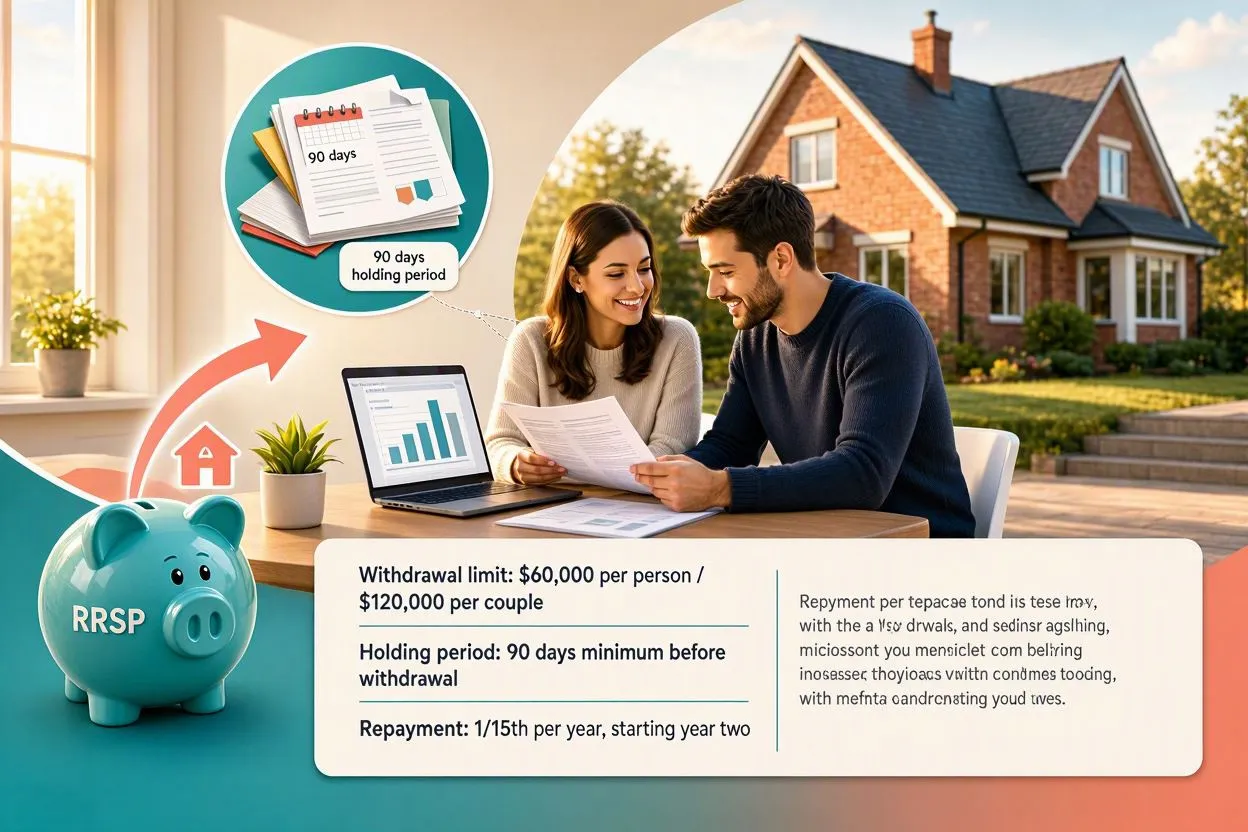
First-time buyers can withdraw up to $60,000 from their RRSP tax-free through the Home Buyers’ Plan (HBP), or $120,000 per couple. A larger down payment raises the price you can afford and can reduce or eliminate CMHC premiums.
- Withdrawal limit: $60,000 per person / $120,000 per couple
- Holding period: contributions must sit in the RRSP at least 90 days
- Repayment: over 15 years. Any missed annual amount is added to your taxable income for that year.
What Other Costs Reduce How Much Mortgage You Can Afford?
- Property tax and heat count in GDS. A home taxed at $400/month leaves less room for the mortgage than one taxed at $250.
- Condo fees: 50% counts toward GDS, but you still pay 100%.
- Closing costs: typically 1.5%–4% of the purchase price (legal fees, land transfer tax, title insurance, adjustments). You need this money in addition to your down payment.
How Can You Qualify for a Bigger Mortgage in Canada?
- Pay down debt: this matters most when your debt payments exceed the TDS buffer.
- Add a co-borrower: a second income raises the base both ratios are measured against.
- Choose a 30-year amortization: available to first-time buyers and new-construction purchases. It adds roughly 7% to your maximum, but you pay more interest overall.
- Increase your down payment: it raises your purchase budget and lowers insurance costs.
- Improve your credit score: a stronger score gets you better rates and more lender options.
Get Your Exact Number
Run your income, debts, and down payment through a GDS/TDS calculator before you speak to a lender. Knowing your stress-tested maximum keeps your home search focused on listings you can actually buy.
FAQs

Johnson
Johnson leads real estate content at Civic Homes, covering home buying, selling, mortgages, renting, and market trends across Canada. He researches provincial rules, mortgage regulations, and city-by-city housing data to explain the Canadian market in plain, practical terms. His guides help buyers, sellers, renters, and investors make smarter housing decisions.
Related Posts