
How to Buy a House in Canada: A Complete Guide for US Buyers
Buying a house in Canada as an American works differently than buying one at home. The mortgage rules are stricter, the tax forms multiply, and a federal law currently blocks most non-Canadians from purchasing homes in major cities. None of that makes the process impossible. It just means you need a clear map before you start.
This guide walks through eligibility, the foreign buyer ban, financing, taxes, and the exact steps to close on a property in Canada in 2026.
Can Americans Buy a House in Canada?
Yes, Americans can buy property in Canada, but a federal law currently restricts most non-Canadians from purchasing homes inside major cities until January 1, 2027.
The Prohibition on the Purchase of Residential Property by Non-Canadians Act took effect January 1, 2023, and Ottawa extended it through 2027 to ease housing affordability pressure. The restriction applies to detached houses, townhomes, and buildings with three or fewer units, if the property sits inside a Census Metropolitan Area (CMA) or Census Agglomeration (CA). Rural land, farmland, commercial real estate, and buildings with four or more units fall outside the ban entirely.
Several groups qualify for exceptions. A US citizen holding a valid work permit with at least 183 days of remaining validity can buy one residential property. Certain international students, recreational property buyers outside major metro areas, and anyone purchasing land for new-home development also qualify. Confirm your exception with a Canadian real estate lawyer before you make an offer, since a mistake here can void the sale.
Canada’s Foreign Buyer Ban: What It Blocks and Who’s Exempt
The ban targets urban residential property, not Canadian real estate broadly. Multi-unit buildings with four or more dwellings, cottages and recreational properties outside CMA or CA boundaries, and commercial buildings remain open to American buyers right now.
Three categories of buyers face no restriction at all: developers purchasing land to build new housing, buyers acquiring property outside a CMA or CA boundary, and permanent residents or Canadian citizens living abroad. A fourth group, temporary residents with sufficient work-permit validity, can buy a single home inside restricted zones.
Provinces layer their own taxes on top of the federal rule where purchases are allowed. Ontario charges a 25% Non-Resident Speculation Tax (NRST) on foreign buyers, and Toronto adds a 10% municipal levy on top of that. British Columbia charges a 20% Additional Property Transfer Tax (APTT) in specified regions. Alberta charges neither surtax, which makes Calgary and Edmonton two of the more accessible entry points for US buyers, even though both cities sit inside CMAs and still fall under the federal ban unless an exception applies.
8 Steps to Buy a House in Canada as a US Citizen
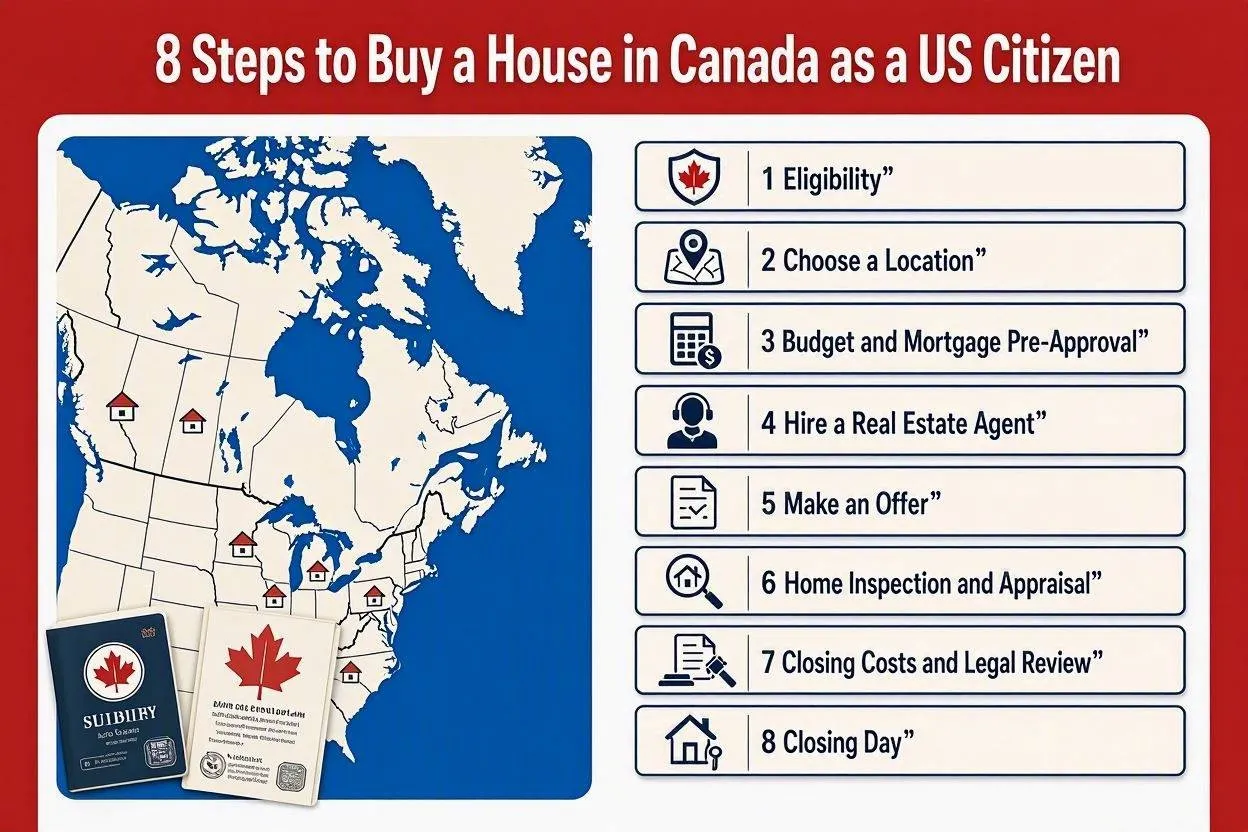
To buy a house in Canada, follow these 8 steps from eligibility check through closing day.
Step 1: Confirm Your Eligibility Under the Foreign Buyer Ban
Check whether your target property sits inside a restricted CMA or CA, and whether you qualify for an exception such as a work permit, student status, or a development purchase. A Canadian real estate lawyer can confirm this before you spend time house hunting.
Step 2: Choose Your Target Location and Property Type
Decide between an urban home, a rural property, a recreational cottage, or a multi-unit investment building, since each category carries different rules and tax exposure. Property type determines whether the federal ban even applies to you.
Step 3: Arrange Financing and Get Pre-Approved
Contact a Canadian bank or mortgage broker and gather two years of income documentation, bank statements, and proof of funds. Most non-resident buyers need a minimum 35% down payment, and pre-approval locks your rate for 90 to 120 days while you search.
Step 4: Hire a Real Estate Agent and a Real Estate Lawyer
Work with an agent who has closed deals with non-resident buyers before, since cross-border purchases involve extra paperwork most domestic agents rarely see. Your lawyer handles title searches, contract review, and the funds transfer at closing.
Step 5: Make an Offer and Submit a Deposit
Your agent drafts an Agreement of Purchase and Sale with conditions covering financing, inspection, and any exception documentation you need to attach. Once the seller accepts, your deposit is typically due within 24 to 48 hours and held in trust.
Step 6: Complete Inspection and Satisfy Financing Conditions
A licensed inspector checks the roof, foundation, electrical systems, and HVAC (heating, ventilation, and air conditioning) equipment for problems that a walkthrough won’t reveal. Your lender finalizes the mortgage once the appraisal and inspection both come back clean.
Step 7: Remove Conditions and Prepare for Closing
Your lawyer completes the title search, arranges title insurance, and confirms your home insurance policy is active before the lender releases funds. Budget an extra 1.5% to 4% of the purchase price for legal fees, transfer taxes, and inspection costs.
Step 8: Close the Deal and Take Possession
Funds transfer, the property title registers in your name, and you receive the keys on closing day, which typically falls 30 to 60 days after your offer is accepted. Set up utility transfers and a Canadian bank account in the weeks that follow, if you haven’t already.
How Much Down Payment Do You Need?
Non-resident buyers typically need a minimum down payment of 35%, compared to as little as 5% for Canadian citizens and permanent residents.
Canadian residents buying a home priced at $500,000 or less can put down just 5%. Homes between $500,000 and $1.5 million require 5% on the first $500,000 and 10% on the remainder, and homes at $1.5 million or above require 20% minimum, since they no longer qualify for mortgage default insurance through the Canada Mortgage and Housing Corporation (CMHC).
Non-residents don’t have access to CMHC-insured low-down-payment mortgages in most cases. Major Canadian banks including RBC, TD, and Scotiabank underwrite non-resident applications at around 35% down when the borrower has no Canadian credit history or local employment record. A borrower with Canadian income or permanent-resident status can sometimes qualify for insured financing starting at 5%.
How Mortgage Financing Works for Non-Residents
Canadian mortgages differ from US mortgages in three main ways: shorter terms, mandatory stress testing, and limited recognition of US credit history.
A US mortgage typically locks a rate for 15 to 30 years. A Canadian mortgage locks a rate for a term of 1 to 5 years, then renews at whatever rate is available, even though the total amortization period can stretch to 25 or 30 years. That structure creates real interest-rate risk over a long holding period, since your payment can jump significantly at renewal if rates have moved.
Every federally regulated lender applies the OSFI (Office of the Superintendent of Financial Institutions) Mortgage Stress Test, which requires you to qualify at the higher of your contract rate plus 2%, or a fixed minimum qualifying rate the regulator sets. A 4% offered rate might require you to prove affordability at 6%, which raises the income threshold well above what the monthly payment alone suggests.
Canadian lenders don’t pull US credit scores. Bring a reference letter from your US bank, two years of tax returns, recent pay stubs, and proof of assets, if your Canadian credit file is thin or nonexistent. Opening a Canadian bank account before you apply speeds up underwriting and helps you avoid foreign exchange fees on your mortgage payments.
Documents You Need Before You Buy
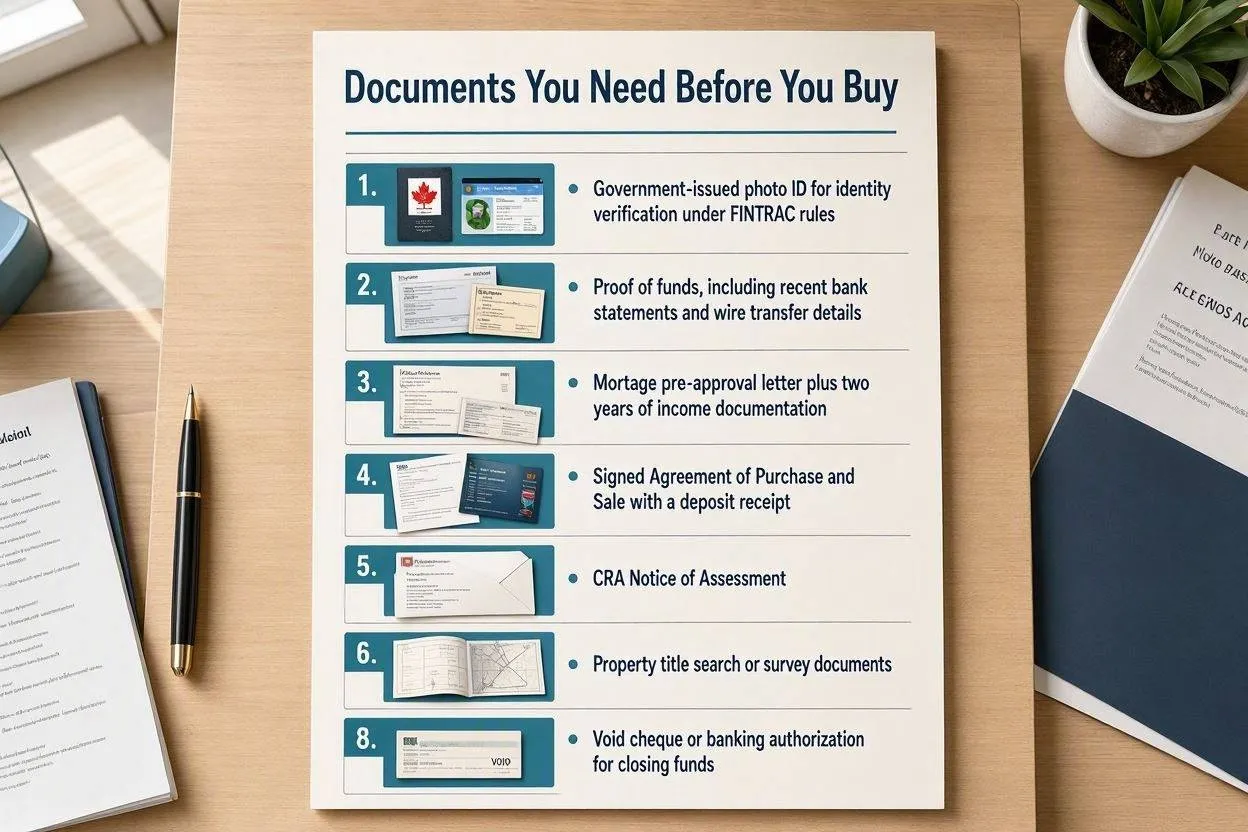
To buy property in Canada as a non-resident, gather these 7 documents before you make an offer:
- Government-issued photo ID for identity verification under FINTRAC (Financial Transactions and Reports Analysis Centre of Canada) rules
- Proof of funds, including recent bank statements and wire transfer details
- Mortgage pre-approval letter plus two years of income documentation
- Signed Agreement of Purchase and Sale with a deposit receipt
- CRA (Canada Revenue Agency) Individual Tax Number (ITN), filed on Form T1261, if you don’t qualify for a Social Insurance Number
- Work permit or residency evidence, if you’re claiming an exception to the foreign buyer ban
- Title and registration documents your lawyer prepares for closing
Taxes and Closing Costs to Budget For
Expect to pay 1.5% to 4% of the purchase price in closing costs, plus provincial land transfer tax and any applicable foreign-buyer surtax.
Ontario charges a land transfer tax on a sliding scale: 0.5% on the first $55,000, rising to 2.5% above $2 million. Toronto adds a separate municipal land transfer tax on top of the provincial rate. British Columbia charges 1% on the first $200,000, 2% up to $2 million, and 3% above that threshold.
Foreign buyers face additional surtaxes in specific provinces. Ontario’s 25% NRST and Toronto’s 10% municipal surcharge apply together on restricted purchases. British Columbia’s 20% APTT applies in specified regions. Alberta and most other provinces charge no equivalent surtax.
Ongoing ownership carries its own costs. Vancouver’s Empty Homes Tax and Toronto’s Vacant Home Tax both run at 3% of assessed value annually, if the property sits vacant without an exemption. British Columbia’s Speculation and Vacancy Tax rose to 3% for foreign owners starting in 2026, up from 2% the year before. The federal Underused Housing Tax no longer requires most non-resident owners to file or pay, following 2024 amendments that took effect for the 2025 tax year onward, though it’s worth confirming your specific ownership structure with the CRA.
Best Canadian Cities for US Buyers in 2026
Property prices in Canada vary sharply by region, and picking the right city matters as much as picking the right house.
- Calgary and Edmonton, Alberta: No provincial land transfer tax and no foreign-buyer surtax, though both cities remain inside CMAs and the federal ban still applies without a qualifying exception.
- Montréal and Québec City, Québec: Outside-centre pricing can run below C$520 per square foot (roughly US$48 per square foot), less than half the rate in Vancouver or Toronto.
- Halifax, Nova Scotia: A smaller Atlantic Canada market with lower entry prices and a 10% Provincial Non-Resident Deed Transfer Tax to budget for.
- Vancouver and Toronto: The most expensive Canadian markets, with city-centre pricing exceeding C$1,100 per square foot (roughly US$800 per square foot) and the heaviest foreign-buyer surtax stack in the country.
US Tax Obligations After You Buy
Owning Canadian property doesn’t end your US tax filing obligations; it adds to them. The US taxes worldwide income, so any rental income or capital gain from the Canadian property counts toward your US return, alongside whatever you already report at home.
The Canada-US Tax Treaty prevents most double taxation, and Form 1116 lets you claim a foreign tax credit for taxes already paid in Canada. If your foreign accounts exceed $10,000 at any point during the year, you must file a Foreign Bank Account Report (FBAR), and assets above certain thresholds require FATCA (Foreign Account Tax Compliance Act) reporting on Form 8938.
Selling the property later triggers a separate requirement. Under Section 116 of Canada’s Income Tax Act, the buyer may need to withhold a portion of the sale proceeds unless the CRA issues a certificate of compliance beforehand. That certificate process can take several months, so start it well ahead of a planned sale rather than after signing an agreement.
Conclusion
Buying a house in Canada as an American means clearing one legal hurdle before the usual financial ones: confirming whether the foreign buyer ban applies to your target property, and whether an exception covers you. Once that’s settled, the process runs through familiar ground, pre-approval, an agent and lawyer, an offer, inspection, and closing, just with a bigger down payment and a shorter mortgage term than you’re used to at home. Get your documentation and Canadian banking relationships in order early, and the rest of the timeline moves fast.
FAQs

Michael Reynolds
Michael Reynolds leads ImmigrationWin’s immigration, visa, and global mobility content division. He specializes in researching immigration policies, visa requirements, application processes, and international relocation pathways for individuals, families, students, and professionals. With extensive experience analyzing immigration regulations and official government guidance, Michael brings a research-driven approach to complex immigration topics and changing visa policies. He is the primary author of ImmigrationWin’s visa guides, immigration resources, and country-specific content, helping readers better understand their options and make informed decisions about their international journey.
Related Posts