

Tenant Rights in Ontario: A Complete Renter’s Guide
Every year, the Landlord and Tenant Board (LTB) processes hundreds of thousands of applications from Ontario renters and landlords, and a large share of those disputes trace back to a tenant who didn’t know a rule existed until it was already broken. A rent notice arrives with the wrong percentage. A landlord shows up unannounced to “check on things.” A repair request sits ignored for three months. None of these situations require a lawyer to sort out, but they do require knowing where the legal lines actually sit.
This guide walks through the rules that come up most often: rent increases, eviction, repairs and maintenance, landlord entry, discrimination, harassment, and the LTB application process itself. It uses the actual sections of the Residential Tenancies Act, 2006 (RTA) that govern each one, updated for the amendments made by Bill 60 (the Fighting Delays, Building Faster Act, 2025) and Bill 97 (the Helping Homebuyers, Protecting Tenants Act, 2023). Most of those changes took effect July 1, 2026.
What Are Tenant Rights in Ontario?
Tenant rights in Ontario come from the Residential Tenancies Act, 2006 (RTA), a provincial law that sets firm limits on rent increases, eviction procedures, repair and maintenance standards, and landlord entry. The Landlord and Tenant Board (LTB), part of Tribunals Ontario, enforces these rules through hearings, orders, and administrative fines. A tenant’s security of tenure applies the same way in a Toronto basement apartment as it does in a Sudbury high-rise, even though local municipal bylaws can pile on extra requirements.
Most renters never read the RTA directly; they learn about tenant rights in Ontario only after a dispute starts, whether that’s a rent notice that looks too high, a maintenance request that goes unanswered, or an eviction notice that arrives without warning. The sections below cover the areas where tenants file the most LTB applications: rent increases, eviction, repairs and maintenance, entry, vital services, air conditioning, discrimination, and harassment.
Who Does the Residential Tenancies Act Protect?
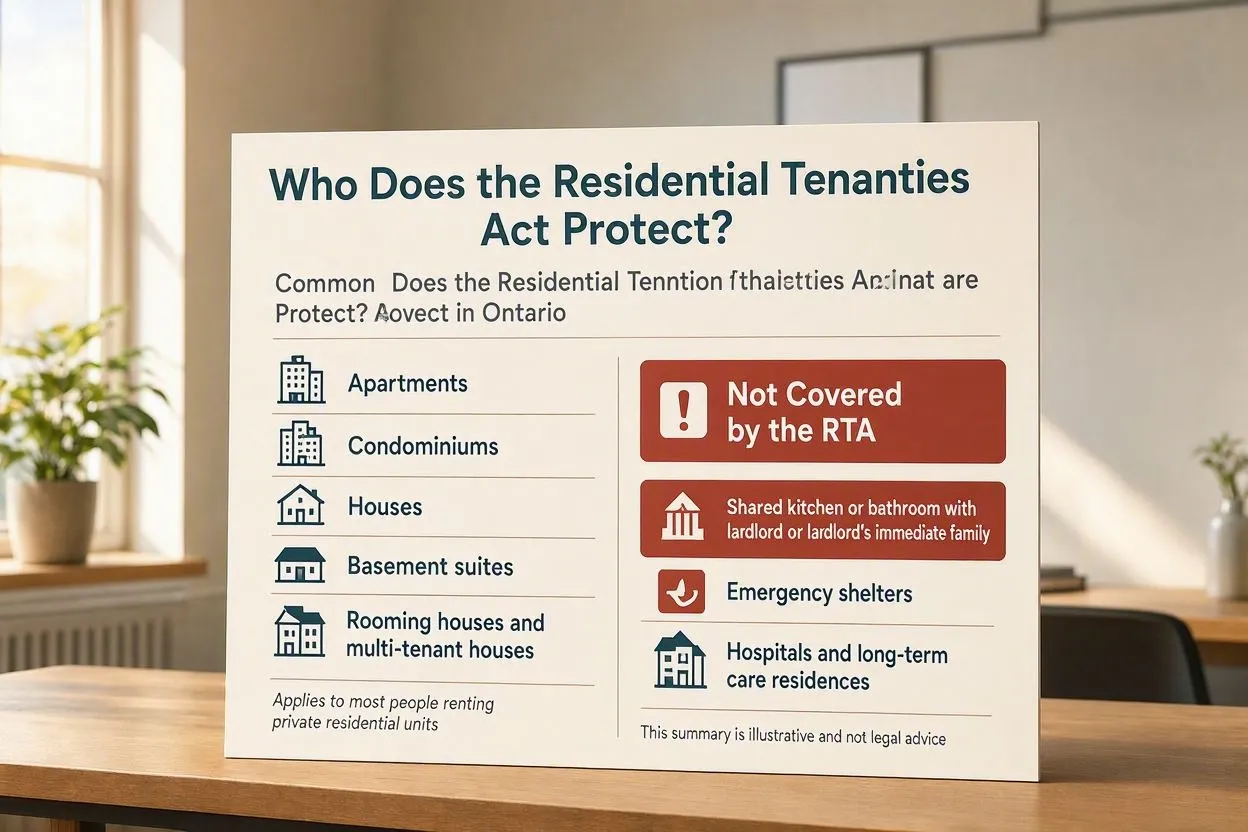
The RTA protects most people renting a private residential unit in Ontario, including apartments, condos, houses, basement suites, and units in rooming houses or multi-tenant houses. It does not apply, however, if a tenant lives in a space that shares a kitchen or bathroom with the landlord or the landlord’s immediate family.
Several categories fall outside RTA protection entirely:
- Emergency shelters
- Hospitals and long-term care facilities
- Prisons
- Student residences and dormitories
- Seasonal or vacation rentals
- Units where the tenant shares a kitchen or bathroom with the landlord
- Co-operative housing (governed by its own rules, not the RTA)
A tenant renting a room in a rooming house or multi-tenant house still has protection, but the specific rules differ from a standard apartment lease. Toronto’s multi-tenant housing bylaws, for instance, add licensing and fire-safety requirements that don’t exist in a typical single-unit rental. Anyone unsure whether a specific arrangement counts as a residential tenancy should check with the LTB directly rather than assume coverage either way.
How Much Can a Landlord Raise the Rent in Ontario?
A landlord can raise the rent by the provincial guideline amount once every 12 months, and the 2027 guideline is set at 1.9%. The increase can take effect 12 months after a tenant moves in or 12 months after the last increase, whichever came later, and a landlord must give at least 90 days’ written notice on the proper LTB form (Form N1 or N2, depending on the type of increase) before the increase takes effect. A tenant who receives less notice, or none at all, can dispute it at the LTB within 12 months of the date the higher amount was first charged.
The guideline doesn’t apply to every unit. New buildings first occupied after November 15, 2018, and most new basement apartments, fall outside the standard cap. An Above Guideline Increase (AGI) works differently: a landlord seeking more than the guideline amount must apply directly to the LTB with evidence such as a major capital repair (a new roof or boiler, say) or an extraordinary municipal tax hike, and a tenant can dispute that application at a scheduled hearing.
Automatic rent reductions work in the tenant’s favour: under section 131 of the RTA, if a landlord’s property taxes drop by more than 2.49% from one year to the next, tenants become entitled to an automatic rent reduction, and the municipality sends notice of the adjustment to both parties (landlords by mid-September, tenants by mid-December, taking effect December 31).
What Are a Tenant’s Rights During an Eviction?
A tenant cannot be forced out of a rental unit without a written eviction notice and a hearing before the Landlord and Tenant Board. Receiving a notice doesn’t mean a tenant has to leave immediately; the landlord must first apply to the LTB (typically using Form L1 for rent arrears or L2 for other grounds), and the tenant keeps the right to attend a hearing and explain their side before any eviction order gets issued.
Under Bill 60, the timeline for non-payment evictions moved faster: a landlord can now serve a Form N4 (Notice to End a Tenancy Early for Non-payment of Rent) with a termination date as early as 7 days after the notice is given, down from the previous 14-day grace period. If the tenant doesn’t pay in full within that window, the landlord can apply to the LTB for an eviction hearing.
The maximum fine for violating eviction procedures and other offences under section 236 of the RTA increased on July 1, 2026, to $100,000 for an individual landlord and $500,000 for a corporation (up from $50,000 and $250,000). That penalty increase exists because bad-faith evictions and “renovictions” have been a persistent problem in Ontario’s rental market. Note that this cap applies to court-prosecuted offences, not to the compensation or rent abatements the LTB itself can order.
Eviction for Personal Use (Form N12)
A landlord who wants to move into a unit, house a family member there, or sell the property to a buyer who plans to occupy it must compensate the tenant. The compensation equals one month’s rent or an offer of a comparable alternative unit, unless the landlord gives at least 120 days’ notice and ends the tenancy at the end of a lease term or rental period. In that scenario, Bill 60 removed the compensation requirement entirely. A landlord who skips the compensation where it’s still owed has handed the tenant grounds to challenge the eviction at the LTB.
Bad Faith Evictions
A landlord must act honestly when citing personal use, renovation, or demolition as grounds for eviction. If the LTB later determines the landlord acted in bad faith, the board can order compensation covering up to 12 months of the tenant’s former rent, the rent difference between the old and new unit for up to a year, and reasonable moving expenses. LTB decisions have found that a landlord who claims personal use to evict a tenant and then quickly re-lists the unit for rent has created strong evidence of bad faith.
Renovation and Demolition Evictions (Form N13)
A landlord evicting a tenant for renovation, repair, or demolition must also compensate the tenant, and the tenant gets the right of first refusal to move back in once the work finishes. The tenant must notify the landlord in writing, before moving out, that they want to return and must provide a forwarding address. A tenant denied this right of first refusal has two years to file a compensation claim with the LTB.
Can a Landlord Enter a Rental Unit Without Notice?
No. A landlord must give a tenant at least 24 hours’ written notice before entering a rental unit for most reasons, and the entry must happen between 8 a.m. and 8 p.m. A landlord who enters without following this rule has committed an illegal entry under the RTA, regardless of intent.
Exceptions exist for genuine emergencies, such as a fire, a flood, or a gas leak, where a landlord can enter without notice at any hour. A landlord can also enter without notice if the tenant agrees at the time of entry. Outside those two situations, written notice must specify the date, the time, and the reason for entry; a vague window, such as “sometime this week,” doesn’t meet the legal standard. LTB and Divisional Court decisions have found that an entry-notice window measured in hours rather than a specific time is too vague to satisfy the RTA, and have awarded rent abatements to tenants over improper notice.
What Repairs Is a Landlord Responsible For?
A landlord must keep a rental unit and the residential complex in good repair, meeting all applicable health, safety, housing, and maintenance standards, even if the tenant knew about the problem before signing the lease. This duty covers a broken refrigerator, a clogged drain, a leaking pipe, or a pest infestation involving cockroaches or mice, and it holds regardless of what the tenancy agreement says about the unit’s condition at move-in.
Tenants carry one repair responsibility of their own: fixing damage caused by themselves or their guests. A tenant whose guest breaks a window during a party bears that specific repair cost, separate from the landlord’s general maintenance obligations.
How to Handle an Unresolved Repair Problem, Now That Bill 60 Has Changed the Rules
A tenant facing an unresolved maintenance issue has two real paths, and which one gets used actually matters now.
The first, and the more reliable one, is filing a Tenant Application about Maintenance (Form T6) directly with the LTB. This can be done online through the Tribunals Ontario Portal, and it lets a tenant ask for a rent abatement, an order compelling repairs, or reimbursement for repair costs paid out of pocket. The LTB can award up to $35,000 through a T6; anything above that has to go to court.
The second is raising the problem as a defence at a non-payment eviction hearing. This used to be the tenant’s fallback if rent went unpaid and the landlord applied to evict. Not anymore, or at least not automatically. As of July 1, 2026, Bill 60 says a tenant can’t raise a maintenance issue for the first time at the hearing itself. To raise it there, the tenant has to have already given the landlord and the LTB advance written notice of the issue, or pay 50% of the rent arrears the landlord is claiming. The stated goal was to stop last-minute delay tactics. The side effect is that a tenant who’s behind on rent and hasn’t documented a complaint in advance may simply lose the ability to raise it as a shield at the hearing.
That makes withholding rent as informal leverage over a repair riskier than it used to be. It still gives the landlord grounds to apply for eviction over arrears, and now a tenant who hasn’t filed a T6 or given advance notice risks having the maintenance issue thrown out of the hearing altogether, or needing to scrape together 50% of the disputed arrears just to get heard on it. The safer path hasn’t really changed, it’s just more urgent: document the problem in writing, with photos and dated messages, request repairs formally, keep paying rent on schedule where possible, and file a Form T6 as soon as the landlord fails to act. Don’t wait for an eviction notice to bring it up.
What Are a Tenant’s Rights to Heat, Water, and Other Vital Services?
A landlord cannot shut off heat, hot water, cold water, electricity, or gas, even when a tenant owes rent. These are classified as vital services under the RTA, and section 21 prohibits a landlord from withholding or deliberately interfering with their supply. Heat rules carry specific numbers, though the exact standard varies slightly by source and municipality. The RTA sets a minimum indoor temperature of 20°C (68°F) during the heating season defined in provincial regulation. Toronto’s Indoor Temperature Standards bylaw, which replaced the city’s older heating bylaw on June 1, 2026, requires 21°C (69.8°F) from October 1 through May 15 and caps summer indoor temperatures where cooling is provided. So a tenant in Toronto gets the benefit of a stricter local standard, while a tenant elsewhere defaults to the provincial minimum.
A landlord can temporarily shut off vital services to complete repairs, provided the shutoff lasts only as long as necessary and advance notice goes out where possible, but a landlord cannot use a vital service disruption as leverage over unpaid rent under any circumstance. The LTB has repeatedly ordered rent abatements in cases where a landlord cut water or electricity to pressure a tenant into leaving.
Can a Tenant Install Their Own Air Conditioner?
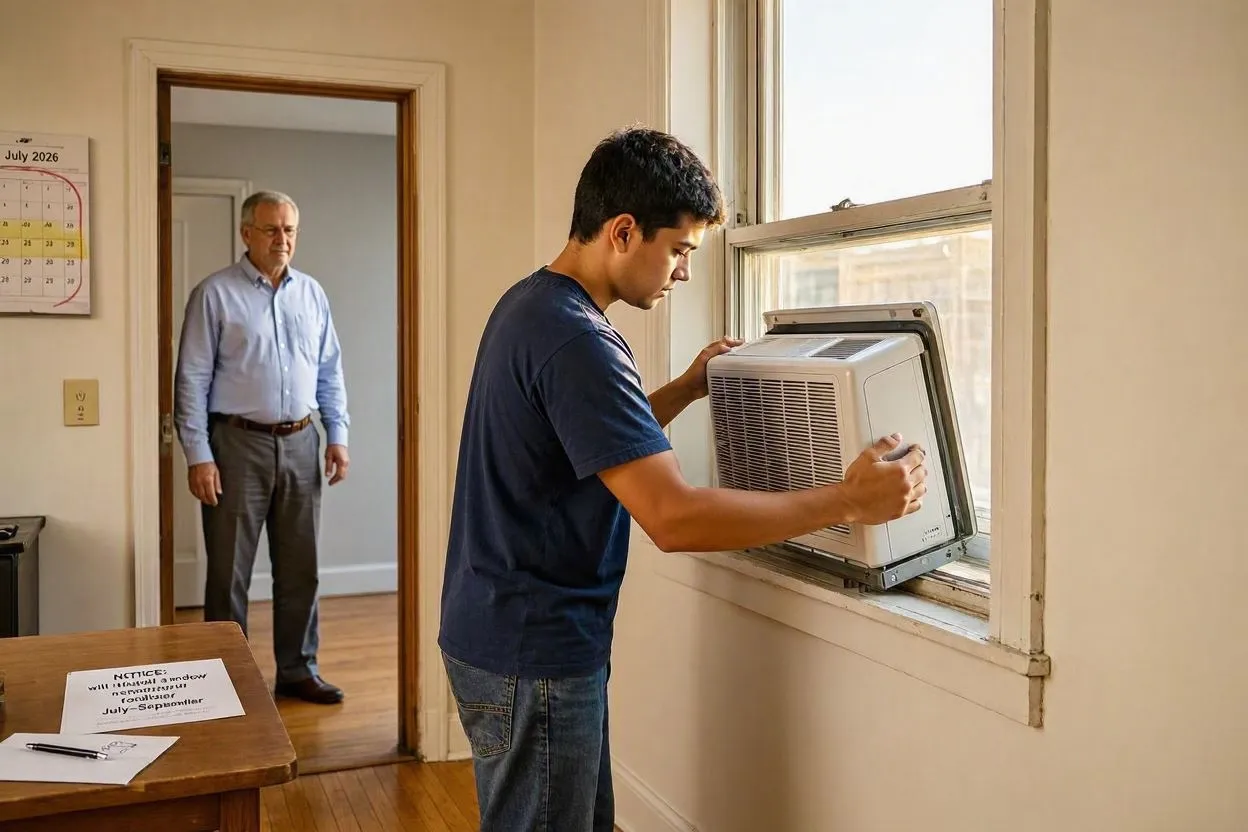
Yes. As of July 1, 2026, a tenant can install a window or portable air conditioner under section 36.1 of the Residential Tenancies Act, provided the tenant meets the following conditions. A landlord cannot block the installation, even if the lease contains a no-air-conditioning clause.
The conditions are:
- The tenant notifies the landlord in writing before installation, including for what months they intend to use it.
- If the landlord provides electricity as part of the tenancy agreement, the tenant provides energy-efficiency and anticipated-usage information.
- The air conditioner causes no damage to the unit or residential complex.
- The installation is secure and safe.
- The installation and use comply with municipal property-standards bylaws and any other applicable law.
A landlord who pays for electricity can charge a seasonal rent increase to cover the actual or reasonably estimated cost of running the air conditioner. The increase applies only to the months of actual use, so a tenant running the unit from July through September pays the increase for those three months, not the full year, and the rent has to come back down once the unit is no longer in use for the season.
Can a Tenant Sublet or Assign Their Unit?
Yes, subject to landlord consent. A tenant who wants to move out temporarily and have someone else live in the unit and pay rent can sublet, while a tenant who wants to permanently transfer the lease to someone else can request an assignment. In both cases:
- The tenant must ask the landlord’s consent in writing.
- A landlord cannot unreasonably withhold consent, and must respond within a reasonable time.
- If a landlord refuses an assignment, the tenant can end the tenancy early instead by giving the notice otherwise required to terminate.
- Subletting doesn’t end the original tenant’s obligations to the landlord. If the subtenant doesn’t pay, the original tenant is still on the hook.
Are Landlords Required to Pay Interest on a Rent Deposit?
Yes. A landlord who collects a rent deposit (see below) has to pay the tenant annual interest on it, calculated at the current rent increase guideline percentage. A landlord who never pays this interest still owes it. It just sits there accumulating, and a tenant can claim it later, including at the end of the tenancy.
What Discrimination Protections Do Tenants Have?
A landlord cannot refuse to rent to someone, or treat a tenant differently, based on race, ethnic origin, religion, sex, sexual orientation, gender identity, family status, marital status, disability, receipt of public assistance, or age. The Ontario Human Rights Code sets these protections, and they apply throughout the tenancy, not only at the application stage.
A landlord can legally ask about income, employment, rental history, and references, and can request permission for a credit check. A landlord cannot ask whether an applicant is pregnant or plans to have children; questions like these violate the Human Rights Code even when phrased casually during a viewing. A landlord who refuses a family with children, citing noise concerns alone, has discriminated against them based on family status. Kids have a legal right to make a reasonable amount of noise in a home.
A tenant who experiences housing discrimination can file a complaint with the Human Rights Tribunal of Ontario or contact a community legal clinic for support.
What Counts as Landlord Harassment Under Ontario Law?
Landlord harassment includes any vexatious comment or conduct that the landlord knows, or ought reasonably to know, is unwelcome to the tenant. Section 23 of the RTA prohibits a landlord from harassing, obstructing, coercing, threatening, or interfering with a tenant, and the LTB judges the cumulative pattern of conduct rather than one isolated incident, weighing intent and reasonableness rather than discomfort alone.
| Landlord Conduct | Counts as Harassment? | Legal Basis or Outcome |
| Repeated late-night door-knocking, mocking, and false police complaints | Yes | Breach of section 23; courts and the LTB have awarded damages for mental distress plus a separate rent abatement in comparable cases |
| Threatening to cut off a vital service to pressure a tenant | Yes | Breach of section 23; grounds for a T2 application and possible rent abatement |
| Serving a legitimate eviction notice in good faith | No | Landlord exercising a legal right under the RTA |
| Contacting a tenant about unpaid rent using reasonable language | No | Reasonable communication, not interference with reasonable enjoyment |
Retaliatory eviction is also prohibited. A landlord cannot serve a valid-looking eviction notice in retaliation for a tenant exercising their rights, whether that’s filing a T6 maintenance application, joining a tenant association, or reporting a bylaw violation. A tenant who believes an eviction notice is retaliatory can raise that directly at the LTB hearing.
What Is a T2 Application and When Should a Tenant File One?
A T2 application, formally called an Application About Tenant Rights, lets a tenant ask the LTB for an order against a landlord who has violated specific legal rights. Grounds include illegal entry, changing locks without providing a key, withholding a vital service, substantial interference with reasonable enjoyment of the unit, and harassment. (Maintenance and repair failures specifically go through the T6 application described above, not T2.)
A tenant has one year from the date of the alleged breach to file, though an ongoing issue, such as a vital service that stays cut off for months, resets the clock to the date the service gets restored. Remedies available through a successful T2 application include a rent abatement of up to 100% of rent for the affected period, compensation for damaged property, an administrative fine against the landlord of up to $25,000, and an order barring the landlord from repeating the conduct against any tenant in the building.
A tenant filing a T2 or T6 application should document dates, times, and the names of everyone involved before the hearing. Evidence such as text messages, entry-notice copies, photos, or temperature logs carries significant weight at the LTB.
What Happens If a Landlord Doesn’t Provide a Standard Lease?
A tenant entitled to a standard lease who doesn’t receive one can request it in writing, and the landlord then has 21 calendar days to provide it. Most private residential landlords, from individual owners to large property management companies, must use Ontario’s standard lease template for new tenancies.
If the landlord still hasn’t complied 21 days after the tenant’s written request, the tenant gains the right to withhold one month’s rent. If 30 more calendar days pass without the landlord providing the lease, the tenant can keep that withheld month permanently. A tenant cannot withhold more than one month’s rent under this rule, and must resume regular rent payments once the 30-day window closes, regardless of whether the landlord ever complies.
Care homes, mobile home park sites, land lease communities, and most social or supportive housing fall outside the standard lease requirement entirely.
Where Can Tenants Get Help With a Landlord Dispute?

A tenant with an unresolved landlord dispute can contact the Landlord and Tenant Board directly at 1-888-332-3234, file most applications online through the Tribunals Ontario Portal, or reach out to a community legal clinic for free assistance. Legal Aid Ontario’s Client Service Centre, reachable at 1-800-668-8258, connects tenants with clinics that offer representation at no cost for qualifying renters.
Local resources fill gaps that provincial services can’t always cover quickly. A tenant in Toronto can contact the Federation of Metro Tenants’ Associations at 416-921-9494 or the Centre for Immigrant and Community Services for support in multiple languages. A newcomer to Canada facing a language barrier can also access Settlement.org’s tenant rights materials, translated into Dari, Pashto, Russian, and Ukrainian.
Understanding tenant rights in Ontario before a dispute escalates saves both time and money. Tenants who document problems early, use the correct LTB form (T6 for maintenance, T2 for harassment or illegal entry, N-series forms are what landlords serve), and act before an eviction notice arrives are generally in a stronger position than those who wait.
Conclusion
Tenant rights in Ontario rest on a single piece of legislation, the Residential Tenancies Act, 2006. But the practical protections it creates touch nearly every part of renting: rent increases capped at 1.9% for 2027, eviction only through an LTB order, 24 hours’ written notice before entry, vital services a landlord can never legally cut off. Bill 60 sped up several LTB timelines in 2026: faster non-payment evictions, shorter review windows, and that new 50%-arrears rule for raising maintenance issues at a hearing. Together, those changes make documenting problems early, and filing a Form T6 before an eviction notice ever shows up, more important than it used to be. The Landlord and Tenant Board, at 1-888-332-3234, is still the first call for any tenant unsure whether a landlord’s conduct has crossed a legal line.
FAQs

Michael Reynolds
Michael Reynolds leads ImmigrationWin’s immigration, visa, and global mobility content division. He specializes in researching immigration policies, visa requirements, application processes, and international relocation pathways for individuals, families, students, and professionals. With extensive experience analyzing immigration regulations and official government guidance, Michael brings a research-driven approach to complex immigration topics and changing visa policies. He is the primary author of ImmigrationWin’s visa guides, immigration resources, and country-specific content, helping readers better understand their options and make informed decisions about their international journey.
Related Posts