Best Neighborhoods in Toronto: Where to Live Based on Budget, Commute, and Lifestyle
The best neighborhoods in Toronto right now are the Danforth, West Queen West, Leslieville, Yonge and Eglinton, and Roncesvalles Village, based on a mix of transit access, housing variety, and walkability. Each one suits a different budget and stage of life, though. A condo renter chasing nightlife wants something different than a family shopping for a semi-detached house near a good school. They’re not competing for the same street. This guide breaks Toronto’s best neighborhoods down by who they actually fit, not just a single ranked list, so you can skip straight to the section that matches your situation.
What Makes a Neighborhood One of the Best Neighborhoods in Toronto?
A neighborhood earns a spot among the best neighborhoods in Toronto when it scores well across four factors: transit access, housing affordability relative to income, safety, and walkable amenities. Toronto Life’s 2023 ranking, built with Environics Analytics and Statistics Canada data, weighted housing at 15%, transit at 8%, and crime at 12%. It’s a useful framework for comparing areas objectively, though worth checking whether a newer edition of the ranking has since replaced those weightings.
Price alone doesn’t tell the story. A condo in Liberty Village might cost less per square foot than a house in Leaside, but the Leaside buyer gets a backyard and a shorter commute to downtown. Context matters more than a single number.
Three things separate a genuinely strong neighborhood from one that just looks good in photos:
- Proximity to a subway line, streetcar route, or GO Transit station
- A walk score high enough to reach groceries, a pharmacy, and a park without driving
- Consistent year-over-year price stability, not just a one-time spike
The Toronto Regional Real Estate Board (TRREB) publishes monthly average price data by district, and checking that report before committing to any area is worth the five minutes it takes.
How Transit Access Shapes the Best Neighborhoods in Toronto
Transit access directly determines which areas qualify as the best neighborhoods in Toronto, since commute time affects both quality of life and long-term property value. The Toronto Transit Commission (TTC) now runs five rapid transit lines plus dozens of streetcar routes, and neighborhoods within a five-minute walk of a subway or LRT station tend to see stronger long-term price growth than comparable areas farther out.
Two transit projects have shaped which neighborhoods matter most this decade, and they’re at very different stages. The Eglinton Crosstown LRT (Line 5) opened to riders on February 8, 2026, after more than a decade of construction. Its effect on Yonge and Eglinton, Weston-Mount Dennis, and parts of Scarborough isn’t something to watch for anymore. It’s already changing how people commute along Eglinton Avenue. The Ontario Line, by contrast, is still under construction and will eventually run from Exhibition Place through downtown to the Ontario Science Centre. That’s the one still worth factoring into a longer-term buying or renting decision, since it will bring rapid transit to several neighborhoods that don’t have it yet.
Best Neighborhoods in Toronto for Young Professionals
Yonge and Eglinton, King West, and Liberty Village rank among the best areas for young professionals in Toronto, mainly because all three sit within a 20-minute subway or streetcar ride of the Financial District and the Bay Street Corridor. Each one serves a different version of that intent: Yonge and Eglinton suits professionals who want more space without giving up transit access, King West suits those who weight nightlife and walkability over square footage, and Liberty Village suits early-career renters chasing the lowest entry point into Toronto’s condo neighbourhoods. CityPlace and South Core round out the picture as the closest alternatives for anyone willing to trade green space for a shorter walk to Union Station.
- Yonge and Eglinton: “Yonge and Eligible”; homes near a subway. ~20 min via subway (Line 1). Detached, low-rise & high-rise condos. Mid-range. Best for space without sacrificing transit.
- King West: Office by day, nightlife by night. ~10–15 min via streetcar/foot. Condo towers, loft conversions. Premium.* Best for walkability plus nightlife over square footage.
- Liberty Village: Converted factories, now tech/marketing offices. ~10 min via streetcar. Dense, newer condos. Most affordable of the three. Best for a short commute on a budget, under 35.
- CityPlace / South Core: Closest to Union Station, least green space. ~5–10 min on foot. High-rise condo towers. Premium. Best for the shortest possible walk to the office.
*Check current TRREB rental comparables against Liberty Village before citing a figure.
Best Neighborhoods in Toronto for Families
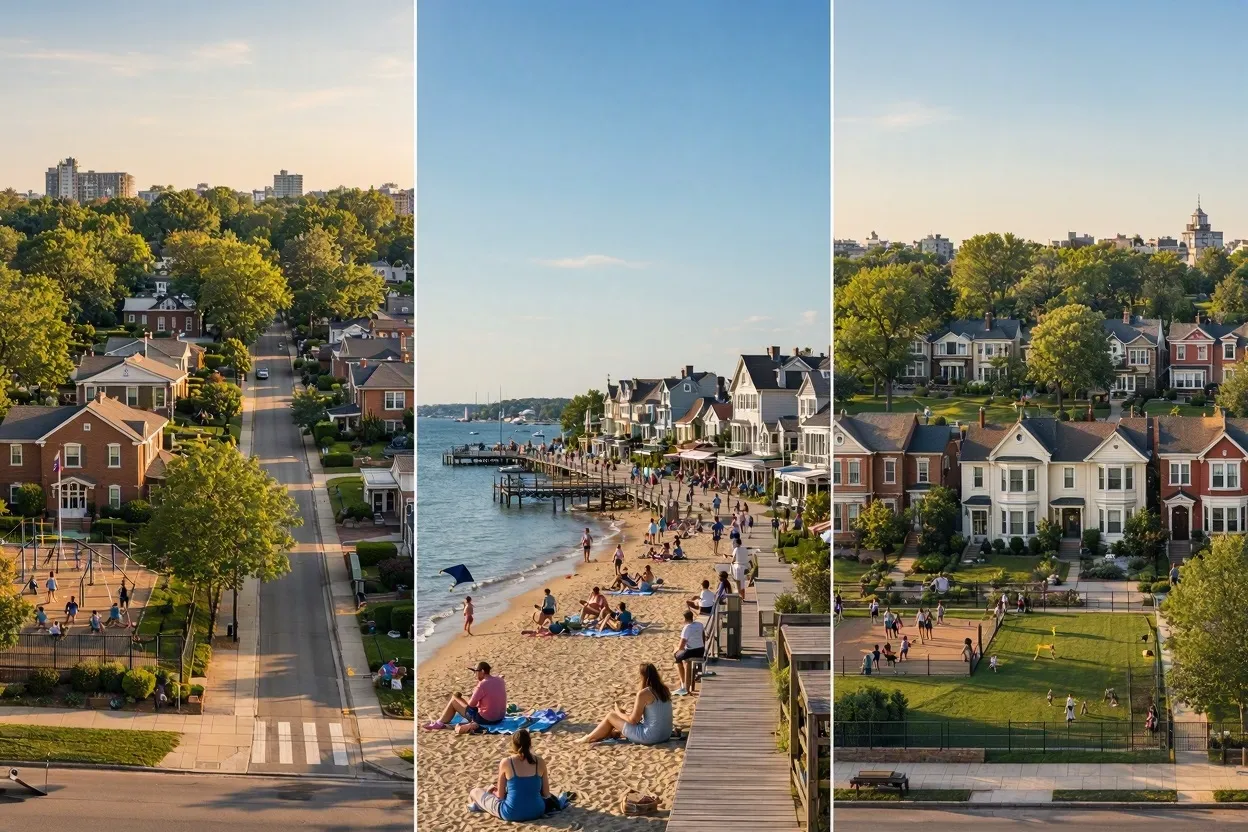
Leaside, The Beaches, and Riverdale consistently rank among the best neighborhoods in Toronto for families, largely because of school quality, park access, and a lower density of high-rise buildings. Each one shows up on nearly every credible list of family-friendly neighborhoods in Toronto, and each serves a different family profile: Leaside for school catchment and walkability, The Beaches for a slower, lakefront pace, and Riverdale for downtown proximity without giving up community feel. None of the three show up prominently in travel-focused guides to Toronto. Visitors rarely need a school catchment map. Families searching for the best neighborhoods in Toronto should weigh resident-focused rankings and current TDSB school performance data more heavily than tourist recommendations, since the two audiences want different things.
- Leaside: Tree-lined, near the old city boundary. Detached homes. Moderate commute to the Financial District (north of the DVP). Above-average elementary schools.* Best for school catchment plus walkability.
- The Beaches: Lakefront boardwalk, summer jazz festival. Semi-detached and detached homes. Longer commute (lakefront). Not top-ranked for schools, but valued for pace. Best for lakefront, lower-density living.
- Riverdale: Skyline views, borders Greektown. Mixed housing stock. Short commute (east of the Don River). Solid school data, secondary to Leaside. Best for downtown proximity plus community feel.
*Confirm against the current TDSB report card before citing as fact.
Best Neighborhoods in Toronto for Renters and Investors
St. Lawrence Market, the Distillery District, and Regent Park rank among the strongest options for renters and investors watching the best neighborhoods in Toronto for growth potential. Each one serves a different angle on the Toronto rental market: St. Lawrence Market for renters who want to skip the Financial District commute entirely, the Distillery District for investors chasing short-term rental and tourism demand, and Regent Park for investors betting on continued appreciation from unfinished redevelopment. Anyone renting sight-unseen should still request current comparables through TRREB or a licensed local agent rather than relying on listing photos alone.
- St. Lawrence Market: Historic 1850s market with 100+ food stalls. Rental demand driver: Financial District workers who want to skip a commute. Price trend: steady. Best for renters and investors prioritizing rental stability over upside.
- Distillery District: Converted Victorian-era distillery, now pedestrian-only galleries and boutiques. Rental demand driver: Christmas market and year-round tourism. Price trend: smaller units, pricier per square foot. Best for investors targeting short-term rental demand.
- Regent Park: One of the city’s largest public housing revitalizations. Rental demand driver: ongoing redevelopment not yet finished. Price trend: continued appreciation potential. Best for investors watching for growth ahead of full redevelopment.
Safest Neighborhoods in Toronto
Yes, Toronto has several neighborhoods with consistently low crime rates, and Forest Hill, Rosedale, and Lawrence Park rank among the safest.
Forest Hill sits in Midtown Toronto and combines winding residential streets with some of the city’s highest average home values. Areas like this typically show up with lower reported crime across most categories tracked by the Toronto Police Service. Rosedale, just east of Yonge Street, holds a similar reputation, built on large lot sizes and mature tree cover that keep the area feeling removed from downtown’s density.
Lawrence Park, further north along the Yonge subway line, rounds out the trio with quiet streets and a strong concentration of single-family homes. None of these three areas show up in nightlife guides, and that’s not a coincidence; lower foot traffic after dark tends to track with lower incident counts.
Safety data changes year to year, so it’s worth pulling up the Toronto Police Service’s public crime map for any neighborhood you’re considering instead of leaning on reputation alone.
Up-and-Coming Neighborhoods Worth Watching
Danforth East, the Junction Triangle, and Weston-Mount Dennis stand out as up-and-coming areas likely to join the best neighborhoods in Toronto list within the next few years. Each one is being pulled up by a different driver (retail growth, private investment, and transit infrastructure, respectively), worth watching for anyone tracking up-and-coming Toronto neighbourhoods ahead of the next price cycle.
- Danforth East: Picks up where Greektown’s restaurant strip ends. A steady stream of new bakeries, bars, and small shops has opened along the avenue in recent years. Prices still sit below comparable strips further west, which is exactly why investors have started paying attention.
- Junction Triangle: Squeezed between the Junction, Roncesvalles, and Bloordale Village, already home to tech offices for companies like Ubisoft and FreshBooks. The Museum of Contemporary Art (MOCA) has anchored the neighborhood’s former Tower Automotive Building since 2018, and the surrounding Sterling Master Plan redevelopment is still building out around it: a residential tower at 201 Sterling Road recently topped off, and a 39-storey mixed-use building is proposed next door to MOCA. That kind of sustained build-out around an established anchor, not a single opening, is what tends to keep pulling property values up here.
- Weston-Mount Dennis: Once home to a Kodak manufacturing plant, the area sat overlooked for decades. The Eglinton Crosstown LRT’s Mount Dennis terminus, now open, has accelerated interest, and buyers priced out of the Junction have started looking this way instead.
How to Choose the Right Toronto Neighborhood for Your Situation
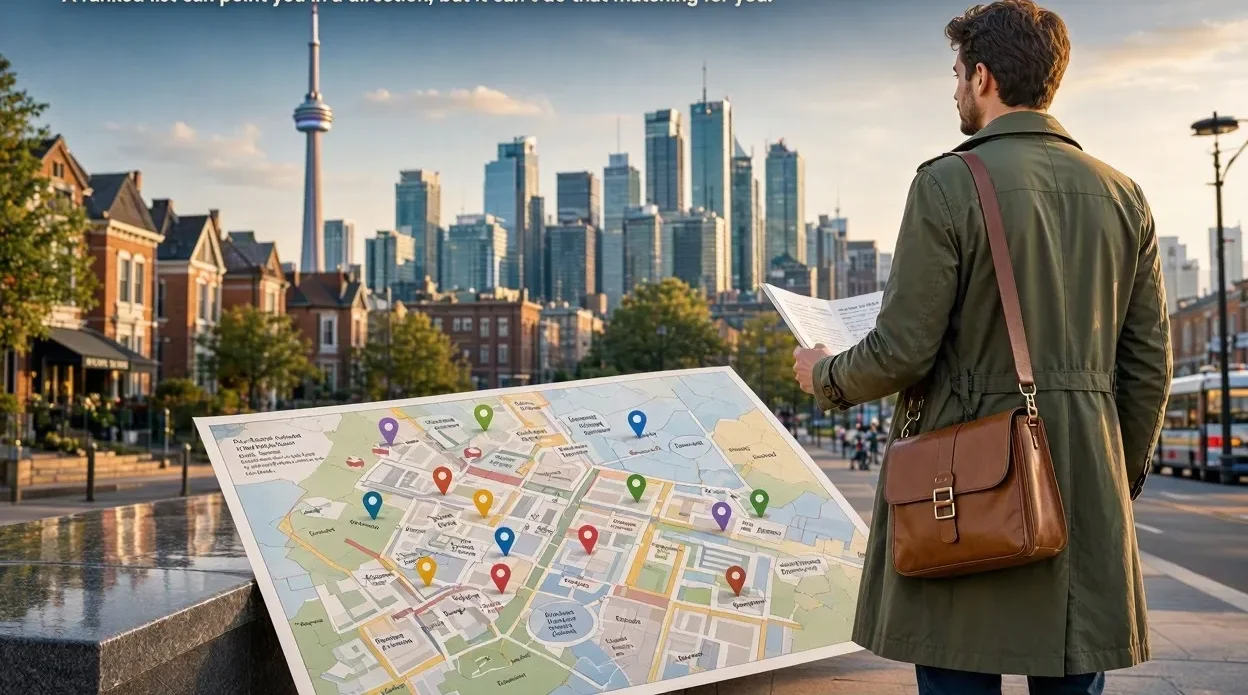
To choose the right neighborhood, match your daily commute, budget, and lifestyle priorities against the specific area. A ranked list can point you in a direction, but it can’t do that matching for you.
Start with the commute. Someone working downtown five days a week gains more from a 15-minute subway ride than from a slightly bigger unit 40 minutes away by car. Next, factor in household size; a couple without kids has different space needs than a family of four eyeing school catchments in Leaside or Riverdale.
Budget realistically using TRREB’s current data rather than outdated price guides, since Toronto’s housing market shifts by district every quarter. Newcomers to Canada should also check which neighborhoods have established settlement services and cultural community hubs nearby, since areas like Scarborough and North York carry deep support networks for specific immigrant communities that don’t show up in a typical “best neighborhoods” list.
Finally, walk the neighborhood at two different times of day before deciding. Photos and reviews miss things that a 20-minute walk at 7 p.m. reveals immediately.
Conclusion
Finding the best neighborhoods in Toronto comes down to matching a specific area to a specific need, not chasing a single ranked list. Young professionals gain the most from Yonge and Eglinton or King West, families tend to settle happily in Leaside or Riverdale, and investors watching for growth should keep an eye on Regent Park and the Junction Triangle. Transit expansion (the Eglinton Crosstown now open, the Ontario Line still under construction) will keep reshaping which neighborhoods top these lists over the next several years. Check current TRREB data, walk the streets at different times of day, and weigh commute time against price before signing anything.
FAQs

Michael Reynolds
Michael Reynolds leads ImmigrationWin’s immigration, visa, and global mobility content division. He specializes in researching immigration policies, visa requirements, application processes, and international relocation pathways for individuals, families, students, and professionals. With extensive experience analyzing immigration regulations and official government guidance, Michael brings a research-driven approach to complex immigration topics and changing visa policies. He is the primary author of ImmigrationWin’s visa guides, immigration resources, and country-specific content, helping readers better understand their options and make informed decisions about their international journey.
Related Posts