
How Much Down Payment for a House in Canada? (2026 Rules)
You need a minimum of 5% of the purchase price for homes up to $500,000, 10% on the portion between $500,000 and $1.5 million, and 20% on any home priced at $1.5 million or more. These aren’t lender preferences. They’re federal rules set by the Office of the Superintendent of Financial Institutions (OSFI) and enforced through Canada Mortgage and Housing Corporation (CMHC) insurance requirements. Your down payment amount for a house in Canada depends entirely on which price bracket your purchase falls into, so the math changes as soon as you cross $500,000.
A $450,000 home needs $22,500 down. A $900,000 home needs $65,000 down, because the first $500,000 requires 5% ($25,000) and the remaining $400,000 requires 10% ($40,000). A $1.6 million home needs $320,000 down, calculated as a flat 20% with no blended rate. Self-employed buyers and applicants with poor credit history often face higher minimums than these baseline figures, since lenders retain discretion to ask for more.
How Do You Calculate Your Minimum Down Payment?
To calculate your minimum down payment, split the purchase price at the $500,000 and $1.5 million thresholds and apply the matching rate to each portion. Three price bands exist, and each one uses a different formula.
Band 1: Homes at $500,000 or Less
Multiply the purchase price by 5%. A $380,000 condo needs $19,000 down. Simple as that.
Band 2: Homes Between $500,000 and $1,499,999
Take 5% of the first $500,000 ($25,000), then add 10% of whatever’s left. A $700,000 home works out to $25,000 plus 10% of the remaining $200,000 ($20,000), so $45,000 total.
Band 3: Homes at $1.5 Million or More
It’s a flat 20% on the whole price, no blending involved. A $2 million property needs $400,000 down.
Lenders don’t round in your favor, so budget a small cushion above the legal minimum before you start touring open houses.
When Do You Need Mortgage Loan Insurance?
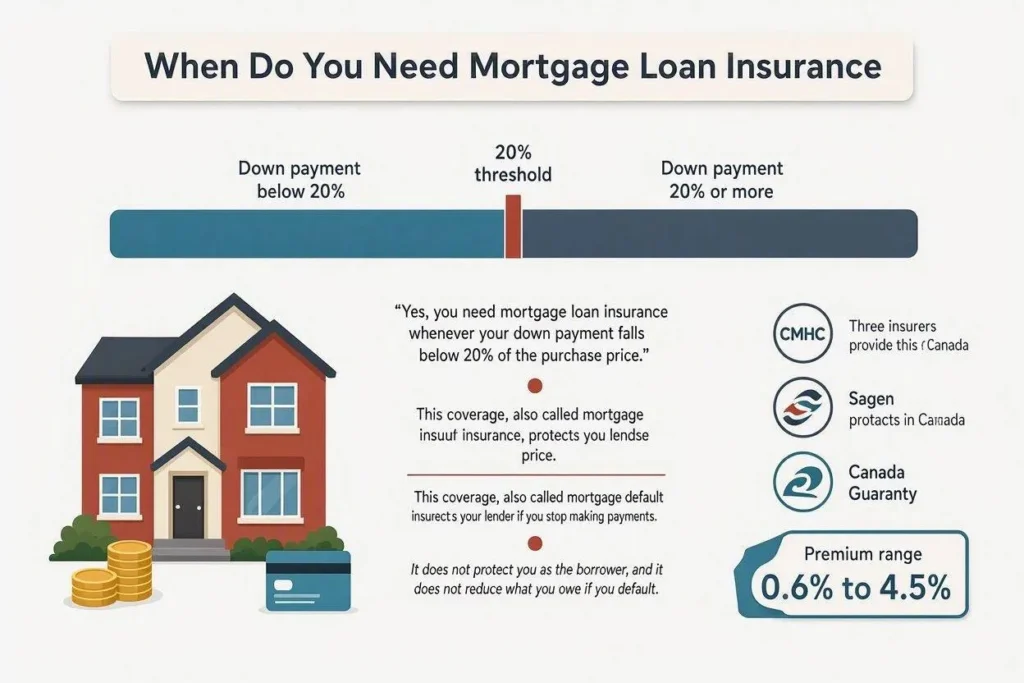
Yes, you need mortgage loan insurance whenever your down payment falls below 20% of the purchase price. This coverage, also called mortgage default insurance, protects your lender if you stop making payments. It does not protect you as the borrower, and it does not reduce what you owe if you default.
Three insurers provide this coverage in Canada: CMHC, Sagen, and Canada Guaranty. Premiums range from 0.6% to 4.5% of your mortgage amount, and the exact rate depends on your down payment percentage. A 5% down payment carries the highest premium bracket, while a 15-19.99% down payment carries the lowest bracket before reaching the insurance-free 20% threshold.
Homes priced at $1 million or more don’t qualify for mortgage loan insurance at all, regardless of your down payment size. If you’re buying above that price point with less than 20% down, most major lenders won’t approve the mortgage. Ontario, Manitoba, and Quebec charge provincial sales tax on insurance premiums, and that tax must be paid upfront rather than rolled into your mortgage.
First-time buyers and buyers of newly built homes get one additional option: a 30-year amortization period on insured mortgages, up from the standard 25 years. Choosing the longer amortization adds roughly 20 basis points to your insurance premium, so a 5-9.99% down payment moves from a 4.00% premium to 4.20%.
What Changes Between a Conventional and a High-Ratio Mortgage?
A conventional mortgage requires 20% or more down and skips mortgage loan insurance entirely. A high-ratio mortgage covers anything below that threshold and requires insurance by law. Three things change once you cross into high-ratio territory.
High-ratio borrowers pay insurance premiums that get folded into the mortgage principal, so they end up paying interest on the premium itself for the entire amortization period. Conventional mortgage holders skip that cost and build equity faster right from the first payment. Oddly enough, some lenders actually offer slightly lower rates on insured mortgages, since the insurance shifts risk away from them.
Even a 20% down payment doesn’t always guarantee an insurance-free mortgage. Self-employed buyers and applicants with thin credit histories sometimes get flagged as higher-risk and asked to insure anyway.
How Does Down Payment Size Affect Your Total Mortgage Cost?
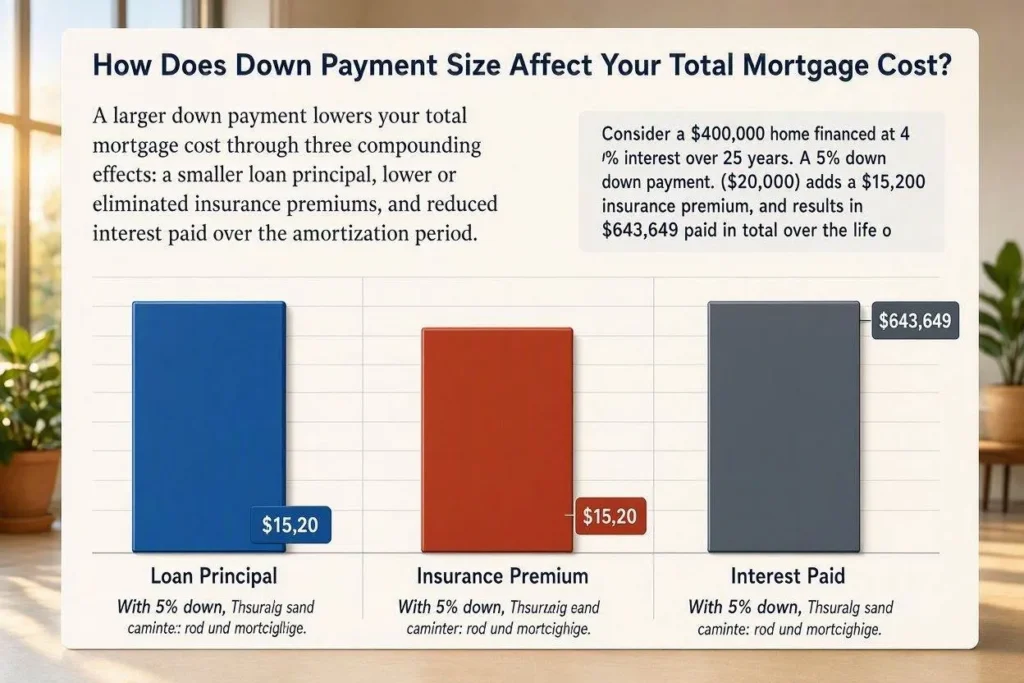
A larger down payment lowers your total mortgage cost through three compounding effects: a smaller loan principal, lower or eliminated insurance premiums, and reduced interest paid over the amortization period.
Consider a $400,000 home financed at 4% interest over 25 years. A 5% down payment ($20,000) leaves a $380,000 mortgage, adds a $15,200 insurance premium, and results in $643,649 paid in total over the life of the loan. A 10% down payment ($40,000) reduces the mortgage to $360,000, drops the premium to $11,160, and brings total cost down to $625,712. A 20% down payment ($80,000) removes the insurance premium entirely, shrinks the mortgage to $320,000, and cuts total cost to $584,979.
That gap between the smallest and largest down payment scenario amounts to $58,670 in total savings over 25 years, all from raising the down payment percentage from 5% to 20% on the same home price.
Where Can Your Down Payment Money Come From?
Lenders accept five main sources for a down payment: personal savings, investment proceeds, registered retirement savings, gifted funds, and equity from a previous property sale.
Personal savings sitting in a chequing or savings account is the simplest of the bunch. No paperwork beyond a bank statement. Selling stocks, bonds, or GICs works too, and most lenders treat those proceeds the same way they’d treat cash savings.
The Home Buyers’ Plan (HBP) is where things get more useful for first-timers. It lets you pull up to $60,000 out of a Registered Retirement Savings Plan (RRSP) tax-free, or $120,000 as a couple, as long as you repay the RRSP within 15 years.
Family gifts are common too, and nearly every lender accepts them. The catch is the gift letter: a signed document from whoever’s giving the money, confirming it’s a gift and not a loan they expect back. Skip that step and the lender may not count the funds at all.
If you’re moving from one home into another, the equity from selling your current place usually rolls straight into the down payment on the next one.
The First Home Savings Account (FHSA) adds a sixth option for first-time buyers specifically. Contributions up to $8,000 per year, capped at $40,000 lifetime, grow tax-free and come out tax-free when used toward a qualifying home purchase. Buyers can combine FHSA withdrawals with an RRSP Home Buyers’ Plan withdrawal on the same purchase, which stacks two tax-advantaged sources into one down payment.
Non-traditional sources, including borrowed funds or gifts from non-immediate family members, trigger a 0.15% insurance surcharge when the down payment sits at 5% or below.
What Costs Come on Top of Your Down Payment?
Closing costs add 1.5% to 4% of the purchase price on top of your down payment, and these funds need to be available as cash rather than financed into the mortgage.
Legal fees typically run $1,500 to $2,000. Title insurance adds another $500 to $600, usually arranged through the same lawyer handling the closing. Land transfer tax varies by province and scales with purchase price. A $1 million home in Ontario carries roughly $16,500 in provincial land transfer tax, and Toronto buyers pay a matching municipal tax on top, pushing the combined total to around $33,000 on that same purchase.
Home inspection fees, appraisal costs, and moving expenses add further costs that fall outside both the down payment and the closing cost estimate most buyers plan for. Set aside a separate buffer for repairs or renovations discovered after move-in, since these surface almost immediately for most new owners.
Is a Bigger Down Payment Always Better?
No, a bigger down payment isn’t always better. The right size depends on your interest rate, your alternative investment options, and how much cash cushion you want to keep outside your home.
A larger down payment cuts your monthly payment, reduces total interest, and gets rid of mortgage insurance once you hit 20%. But putting less down has real upside too. It frees up cash for a Tax-Free Savings Account (TFSA) or RRSP, and it gets you into the market sooner if prices are climbing faster than you can save.
Housing has historically appreciated 1-2% per year above inflation over long time horizons, while equity markets have returned closer to 4-5% per year above inflation over the same stretch. Real estate leverage magnifies whatever return the property generates: a $200,000 down payment on a $1 million home turns a 2% annual price increase into an 8% return on the down payment itself, because the gain applies to the full $1 million while your capital at risk is only $200,000. That leverage cuts both ways. A 20% drop in home value wipes out the entire down payment in the example above.
Buyers carrying low-risk investments like GICs or bonds tend to benefit more from directing extra cash toward a larger down payment, since the guaranteed reduction in mortgage interest often beats what those investments would earn. Buyers comfortable with equity market risk and a longer time horizon sometimes come out ahead keeping their down payment closer to the minimum and investing the difference.
How Can You Save for a Down Payment Faster?

To save for a down payment faster, automate a fixed monthly transfer, redirect windfalls, and cut two or three recurring expenses rather than trying to overhaul your entire budget at once.
Set a specific monthly savings target and automate the transfer the day you get paid, before the money ever touches your everyday spending account. When a bonus, tax refund, or raise comes in, send it straight to the down payment fund instead of letting your lifestyle quietly absorb it. Switching discretionary purchases to cash or debit also helps. Spending habits shift once cards are out of the picture. And rather than trying to trim every line item in your budget, just pick two or three big offenders, maybe dining out, a few unused subscriptions, that gym membership you haven’t visited since January, and cut those hard.
Combine a taxable savings account with an FHSA and an RRSP Home Buyers’ Plan withdrawal to stack tax advantages while you save. A couple using both accounts fully can access $40,000 each in FHSA contributions plus $60,000 each in RRSP withdrawals, reaching $200,000 in tax-advantaged down payment funds before touching a single dollar of taxable savings.
Conclusion
The amount you need for a down payment in Canada comes down to three fixed price bands: 5% up to $500,000, a blended 5%/10% rate up to $1.5 million, and a flat 20% above that. Anything below 20% triggers mortgage loan insurance, which raises your monthly cost but keeps homeownership accessible without a large lump sum saved up front. Run your own numbers against these bands, add a realistic closing cost estimate, and decide whether stretching toward 20% down makes sense for your interest rate and investment goals before you start shopping.
FAQs

Michael Reynolds
Michael Reynolds leads ImmigrationWin’s immigration, visa, and global mobility content division. He specializes in researching immigration policies, visa requirements, application processes, and international relocation pathways for individuals, families, students, and professionals. With extensive experience analyzing immigration regulations and official government guidance, Michael brings a research-driven approach to complex immigration topics and changing visa policies. He is the primary author of ImmigrationWin’s visa guides, immigration resources, and country-specific content, helping readers better understand their options and make informed decisions about their international journey.
Related Posts