

How to Get Pre-Approved for a Mortgage in Canada (2026 Guide)
A mortgage pre-approval is a lender’s written estimate of how much you can borrow, and at what rate, before you make an offer on a home. Getting pre-approved for a mortgage in Canada takes most buyers somewhere between an hour and two weeks. It depends almost entirely on how fast you can pull your documents together.
Buying without pre-approval means guessing at your budget. Buying with one means you walk into a showing already knowing your ceiling, your locked rate, and your monthly payment. You won’t fall for a house you can’t actually afford.
What Is Mortgage Pre-Approval?
Mortgage pre-approval is a conditional commitment from a lender to loan you up to a set amount at a specific rate, based on your income, debt, and credit. The lender reviews your finances first and hands you a letter stating your maximum loan amount, your rate, and how long that rate stays locked.
It’s not a guarantee. The lender still has to approve the actual property once you make an offer, and your financial situation needs to stay roughly the same between pre-approval and closing. A new car loan or a job change in that window can shrink your approved amount, or kill it entirely.
Some lenders split this into two stages: pre-qualification first, then pre-approval. Others treat it as one step. Ask your lender directly which definition they use. The terms aren’t standardized across Canadian banks and credit unions, and that inconsistency trips up a lot of first-time buyers.
Why Get Pre-Approved Before You House Hunt
Pre-approval gives you three things a quick online estimate can’t: a locked rate, a real budget ceiling, and proof to sellers that you’re not wasting anyone’s time.
Real estate agents treat a pre-approval letter as evidence you can actually close. In a multiple-offer situation, an unverified buyer loses to a pre-approved one almost every time. Your rate hold protects you from increases while you search too, which matters more than usual when the Bank of Canada (BoC) is expected to adjust its overnight rate mid-year, as it has through parts of 2026.
Skip pre-approval and buyers tend to view homes above their real budget, place an offer, and then find out the bank won’t lend that much. That’s weeks wasted and a weaker negotiating position going forward.
Sellers in markets like Toronto and Vancouver routinely pass on offers from unverified buyers when a pre-approved offer is sitting right next to it. The listing agent can spot the difference in seconds. One buyer has a document proving financing is lined up. The other has a verbal assurance. In a bidding war, that gap decides which offer wins.
There’s a quieter benefit too. Pre-approval forces an honest budget conversation before emotions get involved. Buyers who skip it tend to anchor on a listing price they saw online, then stretch their offer to compete, only to discover the lender won’t back the number once the paperwork starts. Setting the ceiling first avoids that entirely.
How to Get Pre-Approved for a Mortgage in Canada: 5 Steps
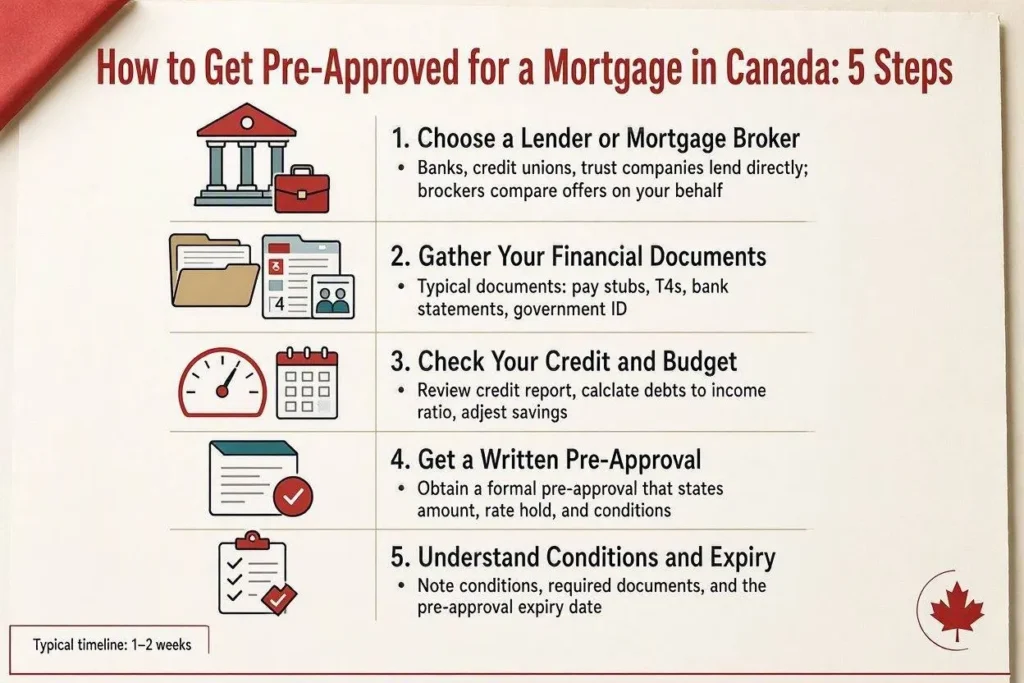
To get pre-approved for a mortgage in Canada, work through these five steps in order.
1. Choose a Lender or Mortgage Broker
Banks, credit unions, and trust companies lend directly. Brokers don’t lend money themselves; they shop your application across multiple lenders, usually at no cost to you, since they earn a commission from whichever lender you go with.
2. Gather Your Financial Documents
Income proof, ID, and asset statements need to be ready before you apply, or the whole process stalls.
3. Submit Your Application and Consent to a Credit Check
Online tools often run a soft check first, which won’t touch your score. A full pre-approval usually involves a hard inquiry.
4. Review Your Maximum Loan Amount and Rate
The lender works this out from your income, debts, credit score, and planned down payment.
5. Receive Your Pre-Approval Letter
It states your loan ceiling, your rate, the rate-hold expiry date, and any conditions attached.
Online pre-approval tools can return a result in under an hour when your documents are ready. If you’re self-employed or have multiple income sources, plan on one to two weeks instead, since lenders review those files by hand rather than through an automated system.
Documents You Need for Pre-Approval
Lenders want proof across four categories: identity, income, assets, and debt.
For identity, that means a driver’s licence, passport, or permanent residency card. For income, recent pay stubs and an employment letter, or two years of Notice of Assessment (NOA) if you’re self-employed. For assets, bank and investment statements showing your down payment and closing costs are actually covered. And for debt, statements for credit cards, car loans, student loans, and any court-ordered support payments.
Almost every delay in this process traces back to missing paperwork. Collect everything before you apply, not after the lender asks for it a second time.
Credit Score Requirements for Mortgage Pre-Approval
A credit score of 680 or higher qualifies you with most Canadian banks and credit unions for their best rates. Scores between 600 and 679 can still work with a prime lender if your income and debt levels are strong. If they’re not, you may need a B-lender instead. Below 600, you’re typically looking at a B-lender or private lender, both of which charge more and set stricter terms.
Your score decides three things: whether you’re approved, what rate you get, and how much flexibility the lender allows on your debt ratios. If you have time before applying, raise it first. Even a 20-point bump can shift you into a better rate tier.
The fastest way to move the number: pay down credit card balances, hold off on new credit applications in the months before you apply, and check your credit report for errors that shouldn’t be there.
Down Payment Rules in Canada
Canada sets minimum down payments in tiers, based on the purchase price.
Homes under $500,000 need a minimum 5% down. Homes between $500,000 and $999,999 need 5% on the first $500,000 and 10% on the rest. Homes at $1.5 million or more need a minimum 20% down.
Take a $600,000 home as an example. You’d need at least $35,000 down: $25,000 (5% of the first $500,000) plus $10,000 (10% of the remaining $100,000).
Put down less than 20% and you’ll need mortgage default insurance through CMHC (Canada Mortgage and Housing Corporation), Sagen, or Canada Guaranty. That insurance protects the lender, not you, and the premium gets rolled into your mortgage balance.
GDS and TDS: The Two Ratios That Decide Your Limit
Lenders run two ratios to set your maximum mortgage: Gross Debt Service (GDS) and Total Debt Service (TDS).
GDS covers your housing costs (mortgage payment, property tax, heating, and half of any condo fees) as a share of your gross income. TDS adds every other debt payment on top of that. Most major lenders want GDS under 39% and TDS under 44%.
A lower ratio means a bigger approved mortgage. Pay off a car loan or clear a credit card balance before applying and your TDS drops, which can raise your approved amount even if your income hasn’t changed at all.
The Mortgage Stress Test
Every federally regulated lender in Canada requires you to qualify at a stress-tested rate, not your actual contract rate. The Office of the Superintendent of Financial Institutions (OSFI) sets this rule under its B-20 guideline. You need to qualify at whichever is higher: your contract rate plus 2%, or a minimum qualifying rate OSFI sets separately.
The point of the stress test is to confirm you can still handle payments if rates climb after you close. It shrinks your approved amount compared to what your contract rate alone would suggest, so build that into your expectations before you start touring homes at the top of your range.
Credit unions that aren’t federally regulated sometimes run their own qualifying rules instead of the OSFI stress test. Worth asking about directly if this affects your situation.
Mortgage Broker vs. Mortgage Lender
A mortgage lender loans you money directly. A mortgage broker doesn’t lend anything; a broker finds a lender for you and compares offers across their network.
Go with a broker if you want several offers compared through one application. Brokers pull your credit once and shop it across multiple lenders, which protects your score from repeated hard inquiries. Go with a direct lender if you already bank with them and want a faster, single-institution process.
Provinces and territories regulate mortgage brokers, so confirm any broker’s licence with your provincial regulator before you sign anything.
Pre-Approval vs. Pre-Qualification
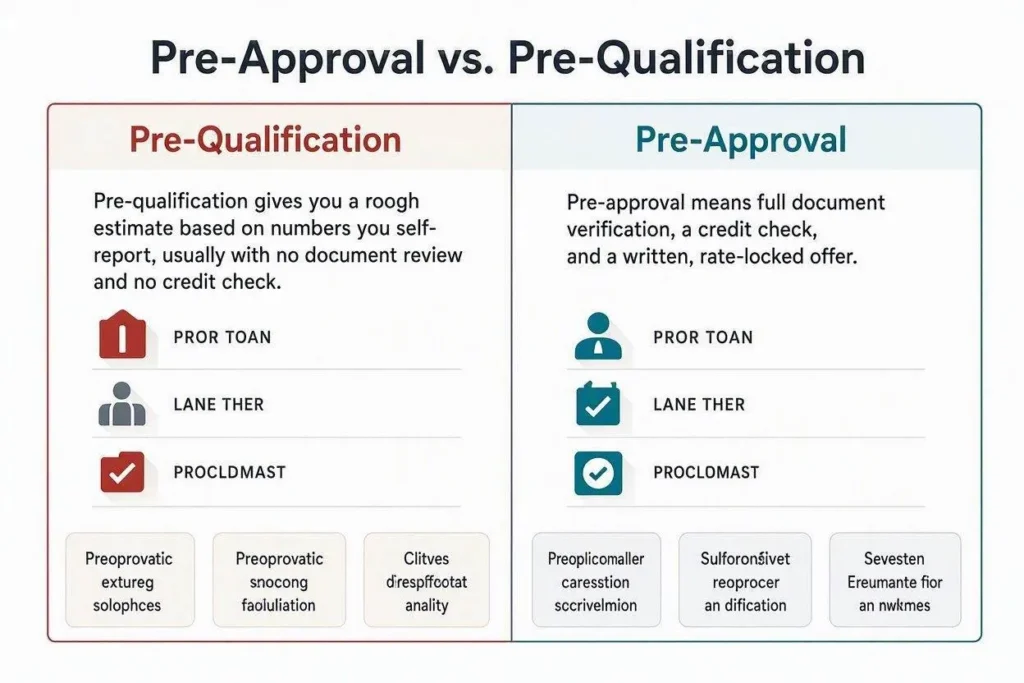
Pre-qualification gives you a rough estimate based on numbers you self-report, usually with no document review and no credit check. Pre-approval means full document verification, a credit check, and a written, rate-locked offer.
Use pre-qualification early, while you’re still deciding whether to buy at all. Move to full pre-approval once you’re actively house hunting and want your rate protected. Pre-qualification takes minutes. Pre-approval can take hours or weeks, depending on how complicated your file is.
How Long Your Rate Hold Lasts
Most Canadian lenders hold your pre-approved rate for 90 to 120 days. Rates go up during that window, you keep your locked rate. Rates drop, many lenders will honour the lower one instead, though that depends on the lender’s own policy.
Apply for pre-approval 90 to 120 days before you plan to close, not earlier. Apply too soon and your rate hold expires before you’ve even found a home, and you’re stuck reapplying and going through another credit check.
Fixed vs. Variable Rate: Which to Choose at Pre-Approval
Pick a fixed rate if you want a payment that never moves for your whole term. Pick variable if you can live with payments that shift alongside the BoC’s overnight rate, in exchange for a rate that’s historically landed lower over time.
Your pre-approval letter usually locks in a rate for one specific mortgage type. Switching from fixed to variable, or back, after pre-approval typically means going back to your lender for a new rate quote, since the two products carry different rate-hold terms.
Buyers pre-approving during a stretch of BoC rate cuts often lean variable, betting on further drops. Buyers pre-approving when rates feel uncertain tend to lean fixed, trading potential savings for a payment they know won’t move. Neither is the “right” answer across the board. It comes down to how much payment fluctuation you can stomach and how long you plan to stay put.
Newcomers to Canada: Your Pre-Approval Path
Newcomers to Canada can get pre-approved for a mortgage even without any Canadian credit history. Most lenders ask for permanent residency, at least two years of employment history (Canadian or international), and a minimum 5% down payment, which triggers mandatory default insurance.
Put down 20% or more and you qualify for a conventional mortgage with no default insurance required. Put down at least 35% and some lenders will approve you even with zero Canadian credit or employment history.
No Canadian credit file? Lenders will often accept alternative proof instead: 12 months of on-time rent or utility payments, an international credit report, or a reference letter from your bank back home. Ask about newcomer-specific mortgage programs directly, since several major banks run products built for exactly this situation.
Self-Employed Borrowers: What Changes
Self-employed applicants carry a heavier documentation load, mostly because there’s no single pay stub a lender can point to. Expect to hand over two years of Notice of Assessment from the Canada Revenue Agency (CRA), business financial statements, and a longer timeline, usually one to two weeks instead of same-day online approval.
If your income fluctuates, lenders average it across the two most recent tax years. A strong spike in year two won’t count in full unless you can show it’s part of an ongoing trend rather than a one-off contract.
What Happens After Pre-Approval
Pre-approval sets your budget ceiling. It doesn’t guarantee final approval on any specific property. Once your offer is accepted, the lender re-verifies your finances and orders a property appraisal to make sure the home’s value actually matches the loan amount.
That full approval process typically runs one to three weeks after an accepted offer. The appraisal alone can take three to ten business days, depending on the property and its location. Homes with issues like asbestos, outdated wiring, or heritage restrictions can still get declined even after you’re personally pre-approved, so factor property condition into how you structure your offer.
Don’t spend right up to your maximum. Leave room for closing costs, moving expenses, and the maintenance bills that show up in year one. Your pre-approval reflects what a lender is willing to hand you, not what you should comfortably spend.
Keep your financial picture steady through the whole rate-hold window. Don’t open new credit cards, finance a car, co-sign someone else’s loan, or switch jobs before closing. Any of these can trigger a reassessment that lowers your approved amount, or cancels your pre-approval outright, even with weeks left on the hold.
Common Mistakes That Delay Pre-Approval
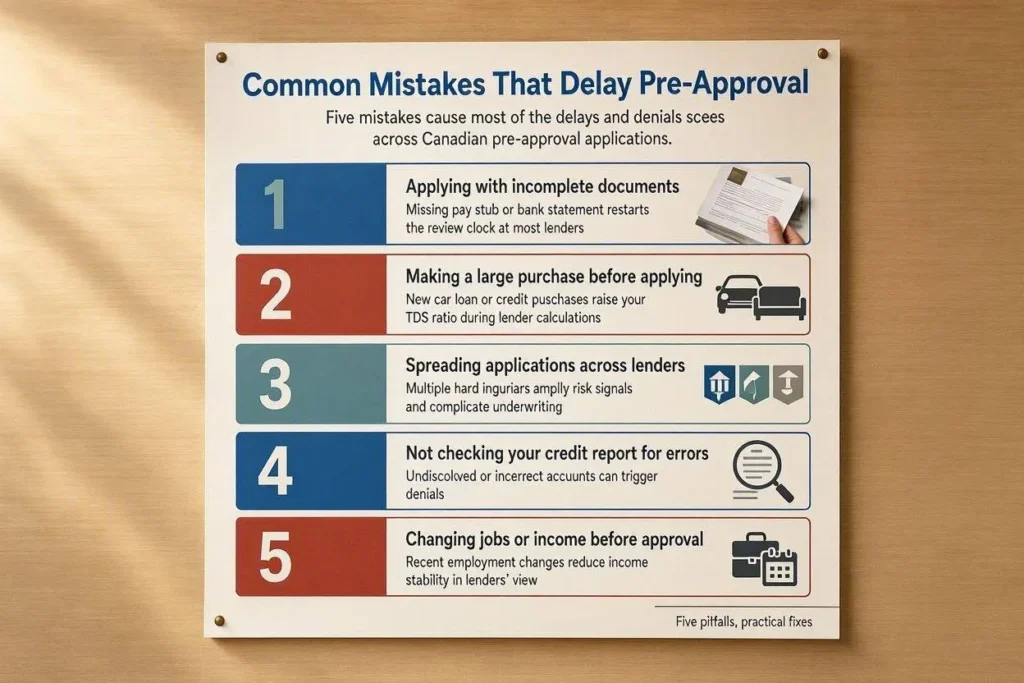
Five mistakes cause most of the delays and denials seen across Canadian pre-approval applications.
Applying with incomplete documents tops the list; missing one pay stub or bank statement restarts the review clock at most lenders. Making a large purchase before applying is a close second, since a new car loan or furniture bought on credit raises your TDS ratio right when the lender is calculating it. Spreading applications across lenders outside the 14-to-45-day window means each hard inquiry counts separately against your score instead of grouping into one. Underestimating closing costs catches plenty of first-time buyers off guard, since legal fees, land transfer tax, and inspection costs can add up to 1.5% to 4% of the purchase price on top of the down payment. And treating the pre-approval letter as a done deal leads some buyers to skip a home inspection or waive conditions they really shouldn’t, since the lender can still walk away from the specific property.
If Your Pre-Approval Gets Refused
A refused pre-approval usually traces back to one of four things: low credit score, high debt-to-income ratio, unstable employment history, or a down payment that couldn’t be fully verified.
Fix the specific reason before you reapply. Pay down debt if TDS is the problem. Give it time and rebuild your score if credit history is the issue. Add a co-signer with stronger income and credit if you need the boost. A handful of credit unions also offer alternative mortgage products aimed specifically at previously declined applicants, worth asking about if a standard bank turns you down.
One refusal isn’t the final word. Different lenders set different internal thresholds, so a second application somewhere else, or through a broker, can produce a completely different result.
Saving Faster with an FHSA
The First Home Savings Account (FHSA) lets first-time buyers contribute up to $8,000 a year, tax-deductible, toward a down payment, with tax-free withdrawals when the money goes toward a home. Pair it with an RRSP Home Buyers’ Plan withdrawal and you can move a lot faster than saving in a regular account.
Building your down payment through an FHSA before you start the pre-approval process can push you into a lower down-payment tier, or clear the 20% threshold entirely and skip default insurance altogether.
Conclusion
Getting pre-approved for a mortgage in Canada comes down to five things: pick a lender or broker, gather your documents, clear the credit and ratio checks, pass the OSFI stress test, and lock your rate for 90 to 120 days. Buyers who show up with their paperwork ready and a clear read on their GDS and TDS ratios get through this in hours instead of weeks. First-time buyer, newcomer, self-employed, it doesn’t matter which one describes you. The steps stay the same. Only the paperwork changes.
FAQs

Michael Reynolds
Michael Reynolds leads ImmigrationWin’s immigration, visa, and global mobility content division. He specializes in researching immigration policies, visa requirements, application processes, and international relocation pathways for individuals, families, students, and professionals. With extensive experience analyzing immigration regulations and official government guidance, Michael brings a research-driven approach to complex immigration topics and changing visa policies. He is the primary author of ImmigrationWin’s visa guides, immigration resources, and country-specific content, helping readers better understand their options and make informed decisions about their international journey.
Related Posts