

Bank of Canada Interest Rates 2026: Current Rate, Forecast & Mortgage Impact
Bank of Canada interest rates sit at 2.25% as of the July 15, 2026 decision, unchanged for six consecutive announcements. That single number sets the tone for every mortgage renewal, HELOC statement, and GIC rate quoted across the country this year. Homeowners, buyers, and investors all track this rate for one reason: it moves before their bank statement does.
This guide breaks down where the rate stands today, why the Bank of Canada (BoC) hasn’t moved it since late 2025, and what the next decision could mean for your monthly payment.
What Is the Current Bank of Canada Interest Rate?
The current Bank of Canada interest rate is 2.25%, held steady since the last rate cut on October 29, 2025. Governor Tiff Macklem and the Governing Council confirmed the hold again on July 15, 2026, marking the sixth straight pause (starting with the December 10, 2025 decision) after nine consecutive cuts between June 2024 and October 2025 brought the rate down from 5.00%.
Three things are keeping the BoC on the sidelines right now:
- Inflation rose to 3.2% in May 2026, driven mainly by gasoline prices tied to the conflict in the Middle East, while core inflation, which strips out volatile items like fuel, stayed close to the Bank’s 2% target.
- Unemployment held at 6.5% in June, about where it’s been since late 2024.
- GDP growth is projected at just 0.7% for 2026, rising to 1.8% in 2027 and 2028, according to the Bank’s July Monetary Policy Report (MPR).
Canada’s prime rate, the number that actually appears on variable mortgages and lines of credit, sits at 4.45%. Banks calculate prime by adding roughly 2.20 percentage points to the BoC’s overnight rate, a spread that has held steady across RBC, TD, BMO, Scotiabank, CIBC, and National Bank since October 2025.
How Does the Bank of Canada Set Interest Rates?
The Bank of Canada sets interest rates by adjusting the target for the overnight rate at eight scheduled meetings each year. Every commercial lending rate in the country traces back to that single overnight figure.
The Overnight Rate Explained
The overnight rate is the interest rate at which major financial institutions lend money to each other overnight to cover short-term funding needs. When the BoC raises or lowers this target, banks adjust their prime rate within one to two business days, and that shift ripples through variable mortgages, HELOCs, and personal lines of credit almost immediately. Fixed mortgage rates respond differently. They track Government of Canada bond yields, which move on inflation expectations and investor sentiment rather than the overnight rate itself, so a BoC hold doesn’t guarantee a fixed rate stays put.
Fixed Announcement Dates
Since 2000, the Bank of Canada has released interest rate decisions on eight pre-set dates per year instead of meeting on an unpredictable schedule. This system gives markets, lenders, and borrowers a known calendar to plan around. The 2026 schedule ran through January 28, March 18, April 29, June 10, and July 15, with September 2, October 28, and December 9 still ahead. Four of these eight dates, including July’s, come paired with a full Monetary Policy Report containing updated growth and inflation projections.
Bank of Canada Interest Rate History (2020–2026)
Bank of Canada rates swung from a record-low 0.25% in 2020 to a 22-year high of 5.00% in 2023, then eased back to 2.25% by late 2025. The table below shows the path.
| Period | Overnight Rate | Context |
| March 2020 | 0.25% | Emergency pandemic cut, tied for the all-time low |
| July 2023 | 5.00% | Peak of the post-pandemic hiking cycle |
| June 2024 | 4.75% | First cut of the easing cycle begins |
| October 2025 | 2.25% | Ninth consecutive cut; cycle pauses |
| July 15, 2026 | 2.25% | Sixth consecutive hold |
The 5.00% peak in 2023 remains well below Canada’s historical extremes. The overnight rate hit an all-time high of 16.00% in February 1991 and an all-time low of 0.25% in April 2009 during the global financial crisis, according to Bank of Canada historical data. Compared to those extremes, the current 2.25% sits in the lower half of the 36-year range, which explains why the Bank has room to hold rather than cut further while it watches inflation.
When Is the Next Bank of Canada Rate Decision?
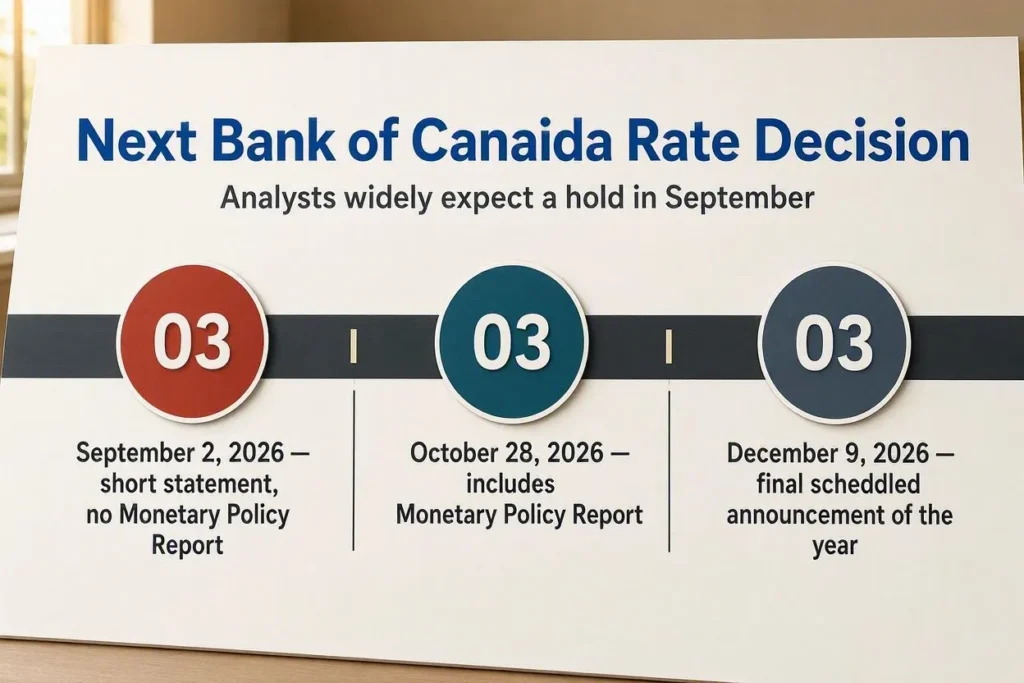
The next Bank of Canada rate decision is scheduled for September 2, 2026. No Monetary Policy Report accompanies this date, so the announcement will be a short statement rather than a full set of updated projections.
Two more decisions follow before year-end: October 28, 2026, which does include an MPR, and December 9, 2026, the final scheduled announcement of the year. Analysts widely expect another hold in September if gasoline-driven inflation stays above the 2% target, though a cut becomes more likely if core inflation continues drifting toward target through the fall. Mortgage brokers and rate-comparison sites like Ratehub and WOWA typically publish updated forecasts within hours of each release, since fixed and variable rates both react to the tone of the accompanying statement.
How Bank of Canada Rates Affect Your Mortgage

Bank of Canada rate changes hit variable mortgages within days. Fixed mortgages take a longer, indirect route through bond markets. The two respond on completely different timelines, which is why understanding the mechanism matters more than watching the headline number alone.
Variable-Rate Mortgages and HELOCs
Variable mortgages, HELOCs, and unsecured lines of credit are priced as “prime minus” or “prime plus” a set percentage, so they move in lockstep with the BoC’s decisions. A homeowner with a mortgage at prime minus 0.50% currently pays an effective rate of 3.95%, given the 4.45% prime rate. If the BoC cuts by 0.25 percentage points at a future meeting, that borrower’s rate drops to 3.70% within a day or two, without any action required on their part.
Fixed-Rate Mortgages
Fixed mortgage rates take a different path entirely. Lenders price them off Government of Canada bond yields, which shift based on where investors expect inflation and rates to head over the next several years, not on where the overnight rate sits today. A BoC hold can still coincide with rising fixed rates if bond yields climb on stronger-than-expected economic data. It matters most for the large number of Canadian mortgages coming up for renewal in 2026, plenty of which were locked in back during the ultra-low-rate years of 2020 to 2022.
Bank of Canada Interest Rate Forecast for 2027
The Bank of Canada interest rate is projected to hold near 2.25% through 2027 before easing slightly toward 2.00% by 2028. Trading Economics’ econometric models, built on current GDP and inflation trajectories, point to a gradual, not dramatic, path forward.
The Bank’s own July 2026 Monetary Policy Report frames inflation as likely to stay above 3% through the summer before converging toward the 2% target sometime in 2027, with Canadian GDP growth improving from 0.7% in 2026 to 1.8% in 2027 and 2028 as the recovery takes hold. Three variables will determine whether that forecast holds. Oil and gasoline prices remain the single biggest wildcard given the ongoing Middle East conflict’s effect on energy costs. Canada’s labour market needs to stay near its current 6.5% unemployment rate without deteriorating further. U.S. trade policy uncertainty continues to weigh on business investment decisions north of the border. If any of these three shifts meaningfully, expect the BoC to move off its current holding pattern faster than models currently predict.
How Bank of Canada Rates Affect Real Estate in Canada
Bank of Canada rates shape Canadian real estate primarily through mortgage affordability and buyer borrowing capacity. Lower rates stretch what a buyer can qualify for; higher rates shrink it, and that single lever moves home prices more than almost any other economic input.
Housing markets across provinces are responding unevenly to the current 2.25% rate environment. Ontario and British Columbia, where average home prices remain highest, show buyers more sensitive to even small rate shifts because a quarter-point change affects a larger mortgage balance. Prairie provinces like Alberta and Saskatchewan, with lower average prices, tend to see comparatively smaller swings in monthly payments from the same rate move. The Bank of Canada’s Financial Stability Report for 2026 notes that Canadian households remain in stable financial condition overall, though vulnerabilities have increased in pockets of the system as a more turbulent global environment introduces new risks. Real estate agents and mortgage brokers watch each fixed announcement date closely because buyer pre-approvals and listing activity both tend to shift in the days following a rate decision, regardless of which direction it goes.
How to Prepare for a Mortgage Renewal in 2026
To prepare for a 2026 mortgage renewal, compare current fixed and variable rates at least four months before your term ends. Waiting until the renewal notice arrives limits your negotiating position and your choice of lenders.
- Request your renewal rate early. Most Canadian banks send an offer 90 to 120 days before maturity, so ask your existing lender for it as soon as that window opens.
- Shop at least two other lenders, including a mono-line lender or credit union. WOWA and Ratehub data show pricing often beats the Big Six by 0.10 to 0.30 percentage points.
- Look past the headline rate on any loan offer. Check the loan term length, the amortization schedule, and any prepayment penalties before you sign. A fixed-rate loan locks your payment for the full term, while a variable-rate loan adjusts as your lender’s prime rate changes.
- Ask about the qualifying rate. It determines how much you can actually borrow, not just what your payment looks like on paper.
- Compare two or three loan quotes side by side, factoring in closing costs, appraisal fees, and any discharge fees from your current lender. Borrowers who shop multiple offers before renewing typically secure better terms than those who accept the first one their bank sends.
- Run the numbers under both a fixed and variable scenario, using your outstanding balance and remaining amortization, not just the headline rate.
- Decide your risk tolerance before you shop. Variable saves money if the BoC cuts as forecast, but costs more if it holds longer than expected.
- Lock in a rate hold if your lender offers one, typically 90 to 120 days. That way a rate increase before your term starts won’t touch your locked-in offer.
Bank of Canada vs. Federal Reserve Rates
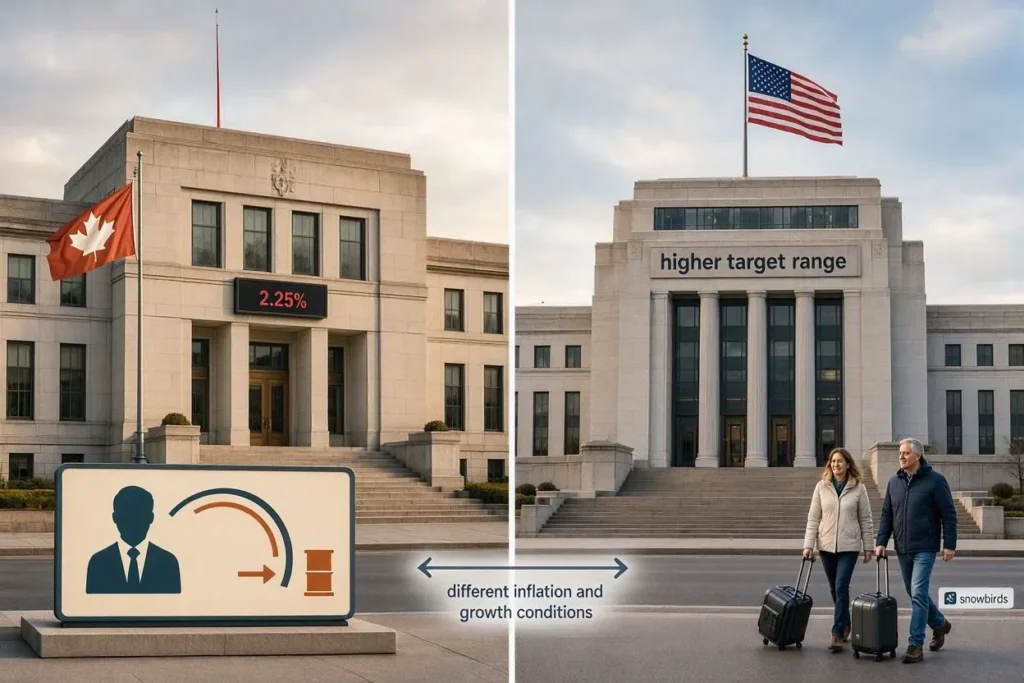
The Bank of Canada’s overnight rate of 2.25% sits below the U.S. Federal Reserve’s target range, reflecting different inflation and growth conditions in each economy. Canada carries a higher household debt-to-income ratio and greater exposure to commodity price swings tied to oil exports, so the BoC can hold, cut, or hike independently of the Fed even when both central banks watch similar inflation data. For Canadian snowbirds, cross-border property owners, and investors holding U.S. dollar assets, the rate gap between the two countries also influences the CAD/USD exchange rate, which affects the real cost of any cross-border mortgage or investment held outside Canada.
Conclusion
Bank of Canada interest rates now sit at 2.25%, a level unchanged since the last rate cut in October 2025 and confirmed again at the July 15, 2026 meeting. Two more decisions remain on the 2026 calendar, September 2 and December 9, alongside an October 28 announcement paired with a full Monetary Policy Report. Variable-rate borrowers feel any BoC move within days; fixed-rate borrowers watch bond yields instead. For the large number of Canadians renewing mortgages this year, the gap between those two mechanisms is the single most important number to understand before signing a new term.
FAQs

Michael Reynolds
Michael Reynolds leads ImmigrationWin’s immigration, visa, and global mobility content division. He specializes in researching immigration policies, visa requirements, application processes, and international relocation pathways for individuals, families, students, and professionals. With extensive experience analyzing immigration regulations and official government guidance, Michael brings a research-driven approach to complex immigration topics and changing visa policies. He is the primary author of ImmigrationWin’s visa guides, immigration resources, and country-specific content, helping readers better understand their options and make informed decisions about their international journey.
Related Posts