
Canada Housing Plan: Full Guide to Programs, Funding and Eligibility
Canada’s housing plan is a federal strategy to build millions of new homes, protect renters and cut costs for first-time buyers through 2031. It bundles construction financing, tax breaks and tenant protections under one umbrella, backed by well over $100 billion in combined funding.
This guide walks through every program tied to Canada’s housing plan, who qualifies for each one, and where the money actually goes.
What Is Canada’s Housing Plan?
Canada’s Housing Plan is the federal government’s strategy to build millions of new homes, protect renters and help Canadians afford housing between now and 2031. Then-Prime Minister Justin Trudeau announced it in April 2024, setting a target of 3.87 million new homes by 2031, split between market-rate construction and new government-backed builds. Housing, Infrastructure and Communities Canada (HICC) manages the plan day to day. The Canada Mortgage and Housing Corporation (CMHC) delivers most of the funding through existing loan and grant programs.
Three pillars hold the plan together:
- Building more homes faster, through construction financing and zoning reform
- Making it easier to rent or own a home, through buyer incentives and tenant protections
- Helping Canadians who can’t afford a home at all, through affordable housing and homelessness funding
A household spending more than 30 percent of its income on housing costs counts as cost-burdened under CMHC’s own affordability benchmark, and that threshold shapes most of the plan’s targets. Interest rates, construction labour supply and provincial zoning law all move independently of federal policy. So treat Canada’s Housing Plan as one lever among several, not a single fix for housing costs.
How Did Canada’s Housing Plan Evolve?
Three phases explain most of the confusion people run into researching this topic. The National Housing Strategy (NHS), an $82 billion, 10-year framework launched in 2017, set the funding architecture that still underpins federal housing spending today, including CMHC’s Apartment Construction Loan Program and Affordable Housing Fund. Canada’s Housing Plan, unveiled in 2024, built on top of that architecture and added new targets, tax measures and a national homebuilding push. Then, in 2025, Prime Minister Mark Carney’s Liberal government introduced Build Canada Homes (BCH), a federal entity that acts as a developer in its own right rather than just a lender. Its goal: roughly double the national construction pace toward close to 500,000 homes a year.
None of these three phases has cancelled the others. Programs from the NHS and the 2024 plan remain active, and BCH adds a new delivery mechanism on top of them.
What Are the Main Programs Under Canada’s Housing Plan?
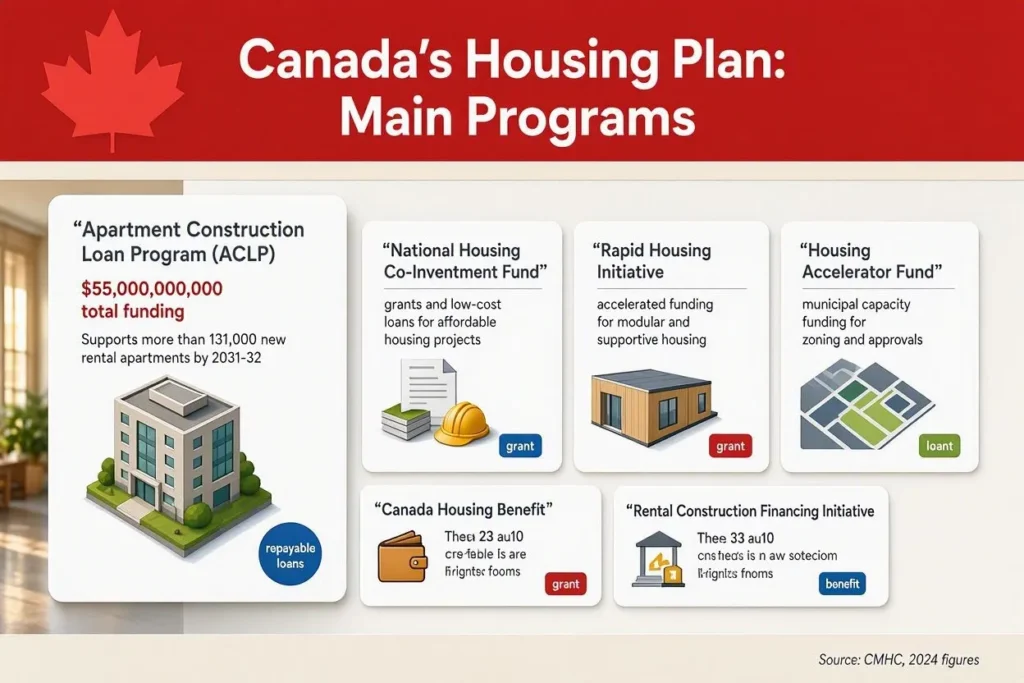
Canada’s Housing Plan runs through several core funding programs, each targeting a different part of the construction pipeline.
Apartment Construction Loan Program (ACLP)
Provides low-cost, repayable loans to developers building rental housing. Funding reached over $55 billion after a $15 billion top-up in 2024, on track to support more than 131,000 new rental apartments by 2031-32, per CMHC’s program figures. A developer converting an underused commercial lot in Halifax into a 200-unit rental building would typically apply here before breaking ground.
Housing Accelerator Fund
Pays municipalities to remove zoning barriers, since restrictive zoning slows construction more than almost any other single factor. As of HICC’s most recent reporting, the federal government has signed 179 agreements under this fund, together projected to fast-track more than 750,000 housing units over the next decade. Cities that legalize fourplexes on single-family lots typically qualify for larger funding allocations than cities that don’t.
Affordable Housing Fund
Supports both new construction and repairs to existing affordable housing stock through low-interest and forgivable loans. Per CMHC’s most recent reporting period, it has committed over $8 billion toward repairing or renewing more than 150,000 homes and building over 32,000 new units. A $1.5 billion top-up to the fund’s New Construction Stream, starting in 2025-26, is projected to support more than 5,000 additional new units.
Build Canada Homes (BCH)
Launched September 14, 2025 with an initial $13 billion capitalization, operating first as a Special Operating Agency within HICC. Separately from that capitalization, the government has committed to provide over $25 billion in debt financing and $1 billion in equity financing to prefabricated home builders (prioritizing those using mass timber or softwood lumber), plus $10 billion in low-cost financing and capital to affordable home builders. BCH’s early spending includes a $1.5 billion Canada Rental Protection Fund to preserve at-risk affordable rentals and $1 billion for transitional and supportive housing. Its first projects are six federal “Direct Build” sites in Dartmouth, Longueuil, Ottawa, Toronto, Winnipeg and Edmonton, targeting 4,000 factory-built homes with construction starting in 2026. On February 5, 2026, the government introduced the Build Canada Homes Act to convert BCH from a temporary agency into a permanent Crown corporation.
Canada Housing Infrastructure Fund
A $6 billion fund that pays for the water, sewer and transit capacity new homes need. Municipalities apply for funding to expand these systems ahead of planned housing developments, closing a gap that older programs never addressed directly.
Secondary Suite and Densification Support
Two smaller measures still in development at the time of writing: the Canada Secondary Suite Loan Program, which will offer low-interest loans to homeowners adding a basement apartment, laneway home or garden suite, and planned mortgage insurance changes to make it cheaper for homeowners in recently rezoned cities to add density on lots they already own.
Indigenous Housing and Infrastructure
Channels roughly $918 million over five years, starting in 2024-25, through Indigenous Services Canada and Crown-Indigenous Relations and Northern Affairs Canada to narrow housing and infrastructure gaps affecting First Nations, Inuit and Métis communities. A companion initiative, the Urban, Rural and Northern Indigenous Housing Strategy, is establishing a National Housing Centre run by Indigenous organizations, with funding delivered on a distinctions-based model.
How Does Canada’s Housing Plan Help First-Time Homebuyers?
Four tools reduce different cost barriers for first-time buyers:
- Home Buyers’ Plan. Allows withdrawals of up to $60,000 from an RRSP without tax penalty, up from $35,000, with an extra three years before repayment starts.
- Tax-Free First Home Savings Account (FHSA). Lets Canadians contribute up to $8,000 a year toward a down payment, with a $40,000 lifetime cap, growing tax-free.
- First-Time Home Buyers’ GST Rebate. In effect since May 27, 2025, this eliminates the GST entirely on new or substantially renovated homes priced at or under $1 million, worth up to $50,000 in savings, and phases the rebate out on a sliding scale for homes priced between $1 million and $1.5 million (a $1.25 million home, for example, qualifies for roughly $25,000). No rebate applies above $1.5 million. The measure is projected to deliver $3.9 billion in tax relief over five years starting in 2025-26.
- 30-year amortizations. As of August 1, 2024, lenders can offer first-time buyers purchasing new construction a 30-year amortization, five years longer than the standard 25-year term. Stretching payments over a longer term lowers the monthly payment, but it also increases total interest paid over the life of the loan.
How Does Canada’s Housing Plan Protect Renters?
Three measures target unfair evictions, legal costs and credit access. The Renters’ Bill of Rights, developed jointly with provinces and territories, pushes for standardized lease terms, price transparency and protection against unfair evictions such as bad-faith renovictions. The Tenant Protection Fund supports legal aid organizations and tenant advocacy groups representing renters facing unlawful rent hikes. New rules are also pushing fintech companies, credit bureaus and lenders to let rental payment history count toward mortgage qualification, closing a gap that has historically favored homeowners over renters when building credit.
How Does Canada’s Housing Plan Address Homelessness?
Reaching Home is the largest of three homelessness measures, supporting people experiencing or at risk of homelessness with rent supplements and access to stable housing across more than 60 designated communities. The Veterans Homelessness Program funds local organizations providing housing and wraparound support for former service members. A third stream matches provincial and territorial funding for encampment response, backing housing-first strategies over enforcement-only approaches.
How Much Is Canada Investing in Housing?
| Program | Funding |
| National Housing Strategy | $82 billion over 10 years (original funding base) |
| Apartment Construction Loan Program | $55 billion in total loan capacity |
| Build Canada Homes | $13 billion initial capitalization, plus $25B debt / $1B equity financing for prefab builders and $10B for affordable home builders |
| Affordable Housing Fund | $14 billion-plus, with $8 billion committed to date |
| Canada Housing Infrastructure Fund | $6 billion for water, sewer and transit capacity |
| Housing Accelerator Fund | $4 billion, topped up by $400 million in 2024 |
| Canada Rental Protection Fund | $1.5 billion to preserve existing affordable rentals |
These figures overlap in places, since later programs sometimes top up earlier ones rather than replace them. The Housing Accelerator Fund’s original $4 billion allocation, for instance, grew by $400 million under the 2024 plan without changing its name or structure.
Who Qualifies for Canada’s Housing Plan Programs?

Eligibility depends entirely on which program applies, since the plan bundles consumer benefits, developer financing and municipal grants under one name. Individual Canadians typically qualify for buyer-facing tools like the FHSA or Home Buyers’ Plan simply by being first-time buyers with valid Canadian residency. Developers and non-profits apply separately for construction financing through CMHC, with eligibility tied to project type, unit count and affordability commitments. Municipalities apply for Housing Accelerator Fund and infrastructure money by submitting action plans showing measurable progress on zoning barriers.
A newcomer to Canada buying a first home can access the FHSA and Home Buyers’ Plan on the same terms as a Canadian-born applicant, provided they meet standard residency and first-time buyer definitions. A private landlord adding a secondary suite would look toward the Canada Secondary Suite Loan Program instead of buyer-facing tools.
Not everyone is convinced the funding adds up to the results promised, though.
What Are the Criticisms of Canada’s Housing Plan?
Independent housing economists and opposition parties have questioned whether Canada’s Housing Plan can hit its 2031 targets given current construction capacity and labour shortages. Statistics Canada’s housing starts data has, in several recent quarters, trailed the pace needed to reach the 3.87 million home goal, and the Canadian Home Builders’ Association has flagged skilled trades shortages as a persistent bottleneck regardless of available funding.
A newer line of criticism centers on funding trajectory rather than construction pace. The Parliamentary Budget Officer has found that total federal planned spending on housing programs is actually set to decline roughly 56 percent, from $9.8 billion in 2025-26 to $4.3 billion in 2028-29, as funding for older programs expires faster than Build Canada Homes ramps up to replace it.
Jurisdictional friction adds another layer. Housing policy sits partly with provinces and municipalities, so federal money tied to zoning reform, as the Housing Accelerator Fund requires, sometimes moves slower than announced timelines suggest. Quebec, for example, negotiated a distinct implementation approach for its Housing Accelerator Fund agreement, reflecting its separate jurisdiction over housing and municipal affairs. Supporters counter that even partial progress on 750,000 fast-tracked units represents meaningful supply growth compared with construction rates before 2017.
How Does Canada’s Housing Plan Compare Across Provinces?
Provinces layer their own programs on top of the federal plan, so the combined benefit to a buyer or renter varies by location.
- Ontario runs its own Housing Supply Action Plan, focused on speeding up municipal approvals in the Greater Toronto Area, and separately announced in October 2025 that it will mirror the federal GST rebate with its own HST rebate: up to $80,000 combined with the federal $50,000, for homes at or under $1 million.
- British Columbia pairs federal Housing Accelerator Fund money with a provincial mandate allowing up to four units on most residential lots.
- Quebec negotiates its housing agreements separately, reflecting its distinct jurisdiction over municipal affairs.
- Atlantic Canada and the Prairie provinces rely more heavily on federal funding than province-specific supply legislation.
A renter in Vancouver dealing with a bad-faith eviction can draw on both the federal Renters’ Bill of Rights framework and British Columbia’s provincial tenancy branch, since neither replaces the other.
How Does Canada’s Housing Plan Measure Progress?
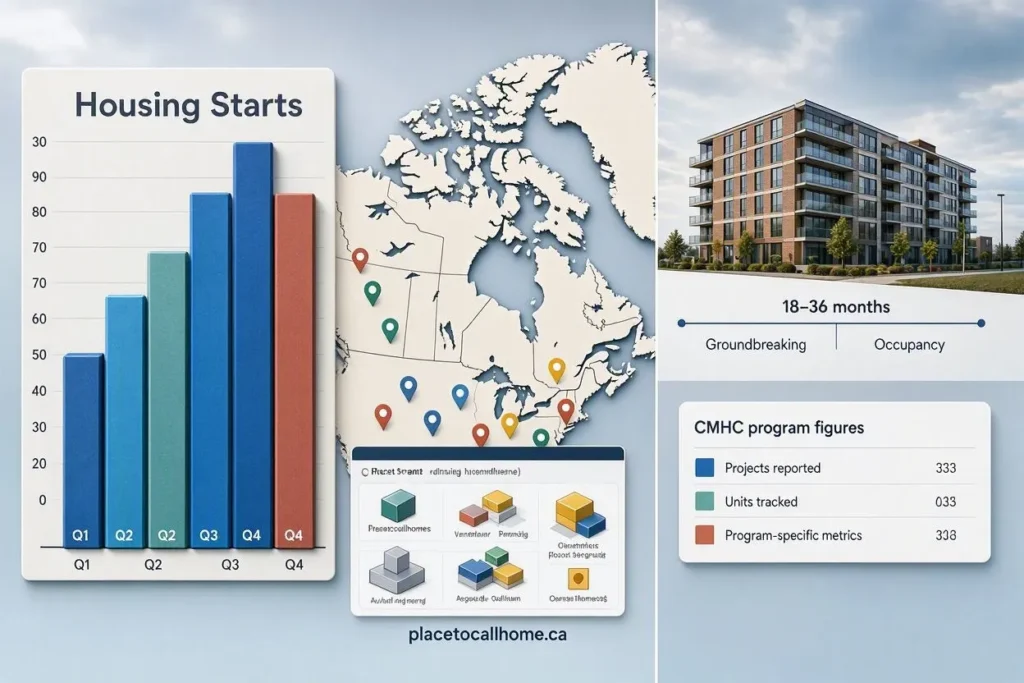
Progress is tracked mainly through housing starts data, published quarterly by Statistics Canada, and through CMHC’s project-level reporting on placetocallhome.ca. Housing starts count new residential construction projects breaking ground, distinct from completions, which count finished homes. A typical apartment building takes 18 to 36 months to move from groundbreaking to occupancy. CMHC also publishes program-specific figures on a rolling basis; the Housing Accelerator Fund’s 750,000-unit projection, for instance, gets revised as more municipalities sign agreements and report against their submitted action plans.
Conclusion
Canada’s Housing Plan spans three overlapping phases: the 2017 National Housing Strategy, the 2024 federal housing plan, and the 2025 Build Canada Homes initiative, now backed by legislation to make BCH a permanent Crown corporation. Together they represent well over $100 billion in combined federal commitments aimed at construction, renter protection and homeownership support. Whether the plan reaches its 3.87 million home target by 2031 depends on factors outside any single program’s control: provincial cooperation, skilled trades supply, interest rate movement, and, per the PBO’s own analysis, whether new spending keeps pace with expiring funding.
FAQs

Michael Reynolds
Michael Reynolds leads ImmigrationWin’s immigration, visa, and global mobility content division. He specializes in researching immigration policies, visa requirements, application processes, and international relocation pathways for individuals, families, students, and professionals. With extensive experience analyzing immigration regulations and official government guidance, Michael brings a research-driven approach to complex immigration topics and changing visa policies. He is the primary author of ImmigrationWin’s visa guides, immigration resources, and country-specific content, helping readers better understand their options and make informed decisions about their international journey.
Related Posts