

New Mortgage Rules Canada: 2026 Buyer’s Guide and Key Changes
New mortgage rules in Canada raised the insured mortgage price cap to $1.5 million, extended amortization to 30 years for eligible buyers, and added a loan-to-income cap for uninsured mortgages between 2024 and 2026. These changes affect how much a buyer can borrow, how much they put down, and how long they take to pay off a home. A buyer purchasing today works with a different set of numbers than a buyer faced just two years ago. Who qualifies for which change depends heavily on buyer status and property type, and that’s covered in full below.
This guide breaks down every major change step by step, starting with the December 2024 price cap increase and ending with Ontario’s 2026 HST rebate on new builds.
What Are the New Mortgage Rules in Canada?
The new mortgage rules in Canada raised the insured mortgage price cap to $1.5 million, extended amortization to 30 years for first-time buyers and new-build purchasers, and added a loan-to-income (LTI) cap for uninsured mortgages. These changes rolled out between August 2024 and March 2026, layered on top of the existing mortgage stress test. A buyer purchasing a $1.4 million home today qualifies for a smaller down payment and lower monthly payments than the same buyer faced in 2023.
The Department of Finance Canada introduced most of these measures to address housing affordability for millennials and Gen Z buyers. The Office of the Superintendent of Financial Institutions (OSFI) added a separate layer of rules focused on lender risk, not buyer affordability directly.
Six separate policy actions make up the full picture:
- Insured mortgage price cap raised to $1.5 million: December 15, 2024
- Amortization extended to 30 years for first-time buyers and new-build purchasers: December 15, 2024
- Federal GST rebate introduced for first-time buyers of new builds: effective March 20, 2025
- OSFI loan-to-income (LTI) cap applied to uninsured mortgages: first quarter of 2025
- OSFI rental income classification clarified: November 2025
- Ontario HST rebate expanded to all buyers of new-build homes: April 1, 2026
Each piece works independently, so a buyer might qualify for one change without qualifying for another. That distinction matters most at the moment a buyer signs a purchase agreement, since that’s when price caps, amortization limits, and income ratios all get tested against a specific property and a specific income.
Why Did the Federal Government Change Mortgage Rules?

Home prices in Toronto and Vancouver rose sharply over the past decade. The old $1 million insured mortgage cap, set back in 2012 and never adjusted since, left many buyers in those cities (and several others) without access to lower-down-payment financing. The government, in its own announcement of the changes, called the December 2024 package the “boldest mortgage reform in decades,” framing it as a response to affordability gaps facing younger buyers.
Three pressures drove the timing. Rising home prices in major metros pushed the median purchase price well past what a $1 million insured cap could support. First-time buyer participation slowed over several consecutive years. And a federal plan targeting nearly 4 million new homes needed financing tools to match new supply with qualified buyers. Without easier financing, new construction risks sitting unsold or getting absorbed only by investors and cash buyers. That’s a big part of why the reforms lean so heavily toward first-time buyers and new-build purchasers.
How Much Higher Is the Insured Mortgage Price Cap?
The insured mortgage price cap increased from $1 million to $1.5 million, effective December 15, 2024. An insured mortgage lets a buyer put down less than 20% of the purchase price, provided the buyer carries mortgage default insurance through the Canada Mortgage and Housing Corporation (CMHC) or a private insurer such as Sagen or Canada Guaranty.
A buyer purchasing a $1.4 million home now qualifies for insured financing that wasn’t available under the old cap. That change unlocked lower down payments across dozens of mid-size Canadian cities, not just Toronto and Vancouver. Calgary, Ottawa, and parts of the Greater Golden Horseshoe all have neighborhoods where detached homes cross the old $1 million threshold regularly.
The insured category still excludes second-home and investment purchases. It applies only to owner-occupied primary residences; investors purchasing rental properties still need a minimum 20% down payment regardless of price.
What Are the New Down Payment Requirements?
Three tiers apply to insured mortgages as of 2026:
- Homes priced at $499,999 or below require 5% down.
- Homes priced between $500,000 and $1,499,999 require 5% on the first $500,000 plus 10% on the remainder.
- Homes priced at $1,500,000 or above require 20% down and fall outside insured mortgage eligibility entirely.
A concrete example: a $1.4 million home previously required a $280,000 down payment under the old $1 million cap, since anything above that threshold needed a full 20% down. Under the new rules, that same home requires roughly $115,000 down, a difference of $165,000.
| Home Price | Old Minimum Down Payment | New Minimum Down Payment |
| $400,000 | $20,000 (5%) | $20,000 (5%, unchanged) |
| $1,000,000 | $200,000 (20%) | $95,000 |
| $1,400,000 | $280,000 (20%) | $115,000 |
| $1,600,000 | $320,000 (20%) | $320,000 (20%, above cap) |
Buyers with non-traditional down payment sources, such as unsecured personal loans or lines of credit, can access CMHC’s Home Start product for 1- or 2-unit properties with a loan-to-value between 90.01% and 95%, provided they show a strong credit management history. That option carries a higher insurance premium, covered further down.
How Does the 30-Year Amortization Rule Work?
The 30-year amortization rule lets first-time buyers and all new-build purchasers stretch insured mortgage payments over 30 years instead of the standard 25, lowering the monthly payment by spreading principal repayment across more years. For example, a $600,000 mortgage at a 5% interest rate costs roughly $3,490 per month on a 25-year schedule and drops to around $3,220 per month over 30 years, about $270 less each month.
That lower payment comes at a cost: total interest paid over the life of the loan rises, sometimes by tens of thousands of dollars, because the balance takes longer to shrink. CMHC also applies a 20-basis-point premium surcharge to insured mortgages using the 30-year option. Buyers weighing this option should compare total interest paid, not just the monthly figure.
Two groups qualify:
- First-time buyers: anyone who hasn’t owned a home in the past four years, or who is separated from a spouse and re-entering the market, qualifies regardless of home type.
- New-build purchasers: buyers of any newly built home qualify too, regardless of prior ownership.
Repeat buyers purchasing resale homes don’t qualify for the 30-year insured option.
What Is the Mortgage Stress Test in 2026?
The mortgage stress test requires borrowers to qualify at either their contract rate plus 2% or 5.25%, whichever is higher. OSFI sets this minimum qualifying rate for all federally regulated lenders, applying it to both insured and uninsured mortgages at the point of purchase. If a borrower’s contract rate is 4.5%, the stress test rate becomes 6.5%, since that exceeds the 5.25% floor.
The rule has stayed largely unchanged since 2021, aside from one exemption: since November 21, 2024, the stress test no longer applies to straight renewal switches between federally regulated lenders. That matters for homeowners comparing rates at renewal, since it removes a barrier that once locked people into their existing bank.
OSFI had floated eliminating the stress test entirely for uninsured mortgages in favor of the loan-to-income cap covered next. That didn’t happen. OSFI confirmed in its early-2026 quarterly update that the stress test remains in place alongside the LTI limits, so borrowers now face both tests, not one replacing the other.
What Is the OSFI Loan-to-Income Cap?
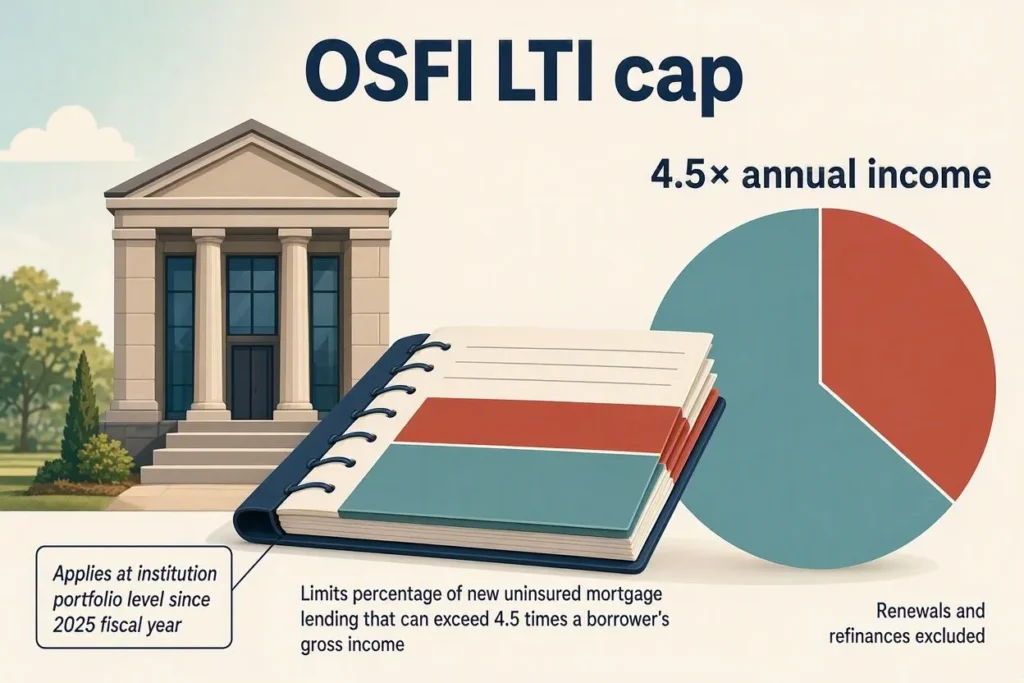
The OSFI loan-to-income (LTI) cap limits how much of a bank’s new uninsured mortgage lending can exceed 4.5 times a borrower’s annual gross income. It has applied at the portfolio level, not to individual applications, since the start of each institution’s 2025 fiscal year. Each lender manages its exposure based on the overall mix of loans on its books, and renewals and refinances fall outside its scope.
First-time buyers in high-cost markets feel this rule most directly. A household earning $120,000 combined gross income faces a practical ceiling near $540,000 in mortgage debt under a lender applying the 4.5x threshold strictly, even if the stress test alone would technically allow more. That ceiling can push buyers toward smaller homes or markets outside Vancouver and Toronto.
OSFI had considered replacing the stress test entirely with this LTI approach, an idea Superintendent Peter Routledge raised publicly in 2024. OSFI’s early-2026 update confirmed the stress test stays in place alongside the cap rather than being replaced, so a borrower who clears one test doesn’t automatically clear the other.
How Did OSFI Clarify Rental Income Rules in 2025?
OSFI’s capital rules for banks, set out in Guideline B-20 and the Capital Adequacy Requirements (CAR) guideline, determine how much capital a lender must hold against different types of mortgages. In September 2025, OSFI updated the CAR classifications, which triggered questions from mortgage brokers and investors about whether rental income calculations for borrowers had changed. OSFI clarified in November 2025 that they hadn’t: investor-owners can still use rental income to qualify for new mortgages, including on multiple properties, exactly as before.
What changed relates to lender capital requirements, not borrower qualification. A mortgage is classified as General Residential Real Estate (GRRE) only if the income supporting it hasn’t already been used to classify another mortgage as GRRE. If repayment depends materially on rental income from the property itself, the mortgage falls under Income-Producing Residential Real Estate (IPRRE) instead, which requires the lender to hold more capital because of the higher risk profile. This distinction affects the lender’s balance sheet, not the paperwork: an investor applying for a third rental property mortgage in 2026 still submits the same rental income documentation required before the update.
Do the New Mortgage Rules Apply to Renewals?
Most new mortgage rules apply only to new purchase agreements, not renewals with your existing lender. The price cap increase, the 30-year amortization option, and the LTI cap all target new mortgage originations specifically.
One exception: the stress test removal for renewal switches. Since November 21, 2024, borrowers switching from one federally regulated lender to another at renewal no longer face the stress test, whether the mortgage is insured or uninsured.
Renewing homeowners should still confirm with their lender whether any product-specific terms changed, since individual banks sometimes adjust internal policies beyond what federal or OSFI rules require.
Are Non-Canadians Still Restricted From Buying Property?
Yes. The Prohibition on the Purchase of Residential Property by Non-Canadians Act, in effect since January 1, 2023, blocks federally regulated lenders from issuing mortgages to non-Canadians for residential property purchases, with exceptions for permanent residents, individuals recognized under the Indian Act, and certain work-permit holders authorized to work in Canada.
Non-permanent residents legally authorized to work in Canada can still access CMHC Home Start financing under separate eligibility rules, provided at least one unit in the property remains owner-occupied. Buyers uncertain about their status under this act should consult a real estate lawyer or notary before signing, since violations carry financial penalties and potential forced sale of the property.
This citizenship-based restriction sits apart from the financing changes covered elsewhere in this guide, but it’s worth checking early. Before evaluating whether a rebate or price-cap change even applies, a buyer needs to confirm they’re eligible to get a mortgage in Canada at all. The next set of changes, by contrast, is a tax rebate available to eligible buyers regardless of the financing route they take.
What Is the Ontario HST Rebate for New Homes?
Two separate rebates apply to new-build homes in Ontario, and they’re easy to conflate.
Federal GST rebate (first-time buyers only)
Effective for agreements signed on or after March 20, 2025: a 100% GST rebate on new builds priced up to $1 million, scaling down between $1 million and $1.5 million.
Ontario HST rebate (all buyers)
Announced in March 2026, this broader rebate fully covers the provincial and federal HST on new homes priced up to $1 million (up to $130,000), with a declining rebate on homes between $1 million and $1.85 million. It applies only to agreements of purchase and sale signed between April 1, 2026, and March 31, 2027, and covers primary residences as well as qualifying long-term rental purchases.
Because the two rebates run alongside each other, a first-time buyer purchasing a $900,000 newly built condo in Toronto within the window can potentially claim both, avoiding federal GST and provincial HST charges that would otherwise add tens of thousands of dollars to the purchase price. A repeat buyer purchasing the same condo in the same window would qualify for the Ontario rebate but not the first-time-buyer GST rebate.
Buyers outside Ontario don’t receive the provincial rebate but remain eligible for the federal GST rebate on qualifying new-build purchases if they’re first-time buyers.
How Do CMHC Insurance Premiums Work Under the New Rules?
CMHC insurance premiums range from 3.00% to 4.70% of the total loan amount, depending on loan-to-value ratio and down payment source, and are typically added to the total loan balance rather than paid upfront:
- 80.01% to 85% loan-to-value: 3.00% premium
- 85.01% to 90% loan-to-value: 3.30% premium
- 90.01% to 95% loan-to-value: 4.20% premium
- 90.01% to 95% with a non-traditional down payment source: 4.70% premium
Borrowers using the 30-year amortization option pay an additional 20-basis-point surcharge on top of these rates. A $500,000 mortgage at 95% loan-to-value carries a premium of roughly $21,000, added directly to the principal balance and repaid over the amortization period.
Energy-efficient homes may qualify for a 25% partial refund on the insurance premium through CMHC’s Eco Products program, a separate incentive worth factoring into the overall cost comparison for new or renovated efficient homes.
Who Benefits Most From the New Mortgage Rules in Canada?
First-time buyers purchasing homes between $500,000 and $1.5 million benefit most: lower down payments, the 30-year amortization option, and, in Ontario, the possibility of stacked tax rebates on new construction. Buyers of any income level purchasing newly built homes also qualify for extended amortization, even without first-time buyer status.
Three groups see limited or no benefit:
- Repeat buyers of resale homes above $1 million don’t qualify for 30-year amortization and face the same down payment tiers as before.
- Investors purchasing rental or second properties get no benefit from the insured mortgage category, which excludes non-owner-occupied purchases entirely.
- Homeowners renewing with their existing lender see no direct change from the core reforms, aside from the renewal-switch stress test exemption.
A buyer’s exact price range, buyer status, and property type determine which of these changes actually apply. Assuming a reform applies without checking is the single most common mistake buyers make here, so it’s worth running the numbers against your specific situation with a broker or lender before house-hunting begins.
How to Prepare for a Mortgage Application Under the New Rules

Gather proof of income, calculate debt service ratios, and confirm whether the target property qualifies as insured. Lenders typically require recent pay stubs, a T4 or Notice of Assessment, and two to three months of bank statements before issuing a pre-approval; self-employed borrowers generally need two years of tax returns and business financials.
Five steps before applying:
- Calculate the Gross Debt Service (GDS) ratio, keeping housing costs under 39% of gross income.
- Calculate the Total Debt Service (TDS) ratio, keeping all debt payments under 44% of gross income.
- Confirm your credit score meets your lender’s minimum threshold for insured products (commonly around 600, though this varies by lender and insurer).
- Determine whether the target home price and buyer status qualify for insured financing and 30-year amortization.
- Get a written pre-approval that locks in a rate for 90 to 120 days while shopping for a property.
A mortgage broker or lender specialist can run these numbers precisely, since debt service calculations vary by lender and by how they treat variable income like bonuses, overtime, or rental income from an existing property.
Conclusion
New mortgage rules in Canada reshaped affordability for a specific group: first-time buyers and new-build purchasers in the $500,000 to $1.5 million range. The price cap increase, 30-year amortization option, and loan-to-income cap arrived in stages between August 2024 and early 2025, while OSFI’s November 2025 rental income clarification and Ontario’s 2026 HST rebate rounded out the current landscape. A $1.4 million home purchase today requires $165,000 less in down payment than it did before December 2024. That figure captures the practical scale of these changes for real buyers in real markets across the country.
Frequently Asked Questions

Michael Reynolds
Michael Reynolds leads ImmigrationWin’s immigration, visa, and global mobility content division. He specializes in researching immigration policies, visa requirements, application processes, and international relocation pathways for individuals, families, students, and professionals. With extensive experience analyzing immigration regulations and official government guidance, Michael brings a research-driven approach to complex immigration topics and changing visa policies. He is the primary author of ImmigrationWin’s visa guides, immigration resources, and country-specific content, helping readers better understand their options and make informed decisions about their international journey.
Related Posts