
Best Cities to Rent in Canada: Full Rankings & Rent Data
Regina, Saskatoon, Winnipeg, Edmonton, and Trois-Rivières currently rank among the best cities to rent in Canada, based on rent-to-income ratios under 24%, average one-bedroom rents between $757 and $1,410, and steady job markets in healthcare, energy, and public administration. Toronto and Vancouver sit at the opposite end, where renters routinely hand over 40% or more of their pre-tax income. Sherbrooke, Saguenay, and other smaller Quebec cities post some of the lowest rent-to-income ratios in the country, often under 20%. Pick a city from this list, and the math usually works in your favor, provided your job or income source can travel with you.
What Makes a City One of the Best Cities to Rent In?
A city earns a spot among the best cities to rent in Canada when four factors align: affordable rent relative to local income, low vacancy pressure, a stable job market, and manageable day-to-day costs beyond housing. Rent alone tells you almost nothing. A $900 apartment in a town with few jobs isn’t a win. A $1,600 apartment in a city with strong wages and steady hiring often beats it.
Four metrics drive this ranking:
- Rent-to-income ratio, the share of gross income a typical renter spends on housing, with anything above 30% flagged as cost-burdened by the Canada Mortgage and Housing Corporation (CMHC).
- Vacancy rate, which shows how much room renters have to negotiate or switch units without a long search.
- Job market depth, meaning whether the local economy supports more than one or two industries.
- Cost of daily living, covering utilities, transit, and groceries, which shift the real affordability picture city to city.
Toronto looks expensive on rent alone. Factor in transit costs and grocery prices, though, and the gap with a city like Winnipeg widens even further.
Best Cities to Rent in Canada Right Now
Regina, Saskatoon, Winnipeg, Trois-Rivières, Sherbrooke, Edmonton, Moncton, Quebec City, Thunder Bay, Saint John, Calgary, and Windsor make up the strongest lineup of best cities to rent in Canada today, when ranked by rent-to-income ratio and job market stability. Here’s how they stack up:
| Rank | City | Province | Avg. 1BR Rent | Rent-to-Income Ratio | Best For |
| 1 | Trois-Rivières | Quebec | $785 | 17.4% | Families, low fixed costs |
| 2 | Saguenay | Quebec | $810 | 17.5% | Budget-conscious renters |
| 3 | Sherbrooke | Quebec | $920–1,050 | 19.6% | Students, healthcare workers |
| 4 | Regina | Saskatchewan | $1,255–1,403 | 19.9% | Public-sector roles |
| 5 | Saskatoon | Saskatchewan | $1,350–1,402 | 21.2% | Remote workers, mid-market rent |
| 6 | Edmonton | Alberta | $1,320–1,410 | 21.6% | Manufacturing, clean energy |
| 7 | Winnipeg | Manitoba | $1,185–1,409 | 23.2% | Steady-job seekers |
| 8 | Quebec City | Quebec | $1,364–1,518 | 23.3% | Newcomers, public service |
| 9 | Calgary | Alberta | $1,610–1,640 | 23.7% | Energy, logistics, tech |
| 10 | Moncton | New Brunswick | $757–1,215 | 24.1% | First-time renters |
Two things jump out immediately. Seven of the top ten sit outside Ontario and British Columbia entirely. And three provinces (Quebec, Saskatchewan, Alberta) account for most of the list. Rent varies by source and month within this table because CMHC, Rentals.ca, and Prepare for Canada each pull from slightly different snapshots, so treat the ranges as realistic bands rather than fixed prices.
City Profiles: Where Rent Actually Fits the Paycheque
Regina, Saskatchewan
Regina offers the sharpest balance between rent and income of any Prairie capital, sitting at a 19.9% rent-to-income ratio. A one-bedroom runs $1,255 to $1,403 depending on the source. Median household income near $74,800 keeps that math comfortable. Public-sector, agriculture, and energy jobs anchor the economy. Commutes stay short here, and that saves both time and money, especially next to a 45-minute Toronto subway ride.
Saskatoon, Saskatchewan

Saskatoon pairs a diversified economy with rents that haven’t caught up to demand, landing it a 21.2% rent-to-income ratio. Tech, agriculture, and education roles keep hiring steady, and rent sits between $1,350 and $1,402 for a one-bedroom. RentCafe’s 2026 report ranked Saskatoon second nationally for renter search activity, with online listing views up 27% year-over-year (YoY). People are choosing this city on purpose, not settling for it.
Winnipeg, Manitoba
Winnipeg tops multiple 2026 renter-interest rankings, pairing a $400,000 median home price with rent around $1,185 to $1,409. Manufacturing, aerospace, and healthcare drive employment here. Winters run brutal, no argument there, but transit and childcare typically cost less than in Toronto or Vancouver. RentCafe handed Winnipeg a perfect renter-interest score of 100 out of 100. Decisive renters, apparently, find what they want fast in this city.
Edmonton, Alberta
Edmonton delivers some of the strongest housing value among Canada’s major metros, with one-bedroom rent near $1,320 to $1,410 against median income around $78,500. Manufacturing, clean energy, and public administration jobs support that. Alberta also charges no provincial sales tax, so every paycheque stretches a bit further once you’re actually paying bills there.
Trois-Rivières and Sherbrooke, Quebec
Trois-Rivières and Sherbrooke hold the two lowest rent-to-income ratios in this ranking, at 17.4% and 19.6%. Riverfront setting, small-town pace, full city services, that’s Trois-Rivières in a sentence. Sherbrooke throws two universities into the mix, drawing students and healthcare staff toward rent averaging $920 to $1,050. Housing rarely swallows the whole budget in either city. Shorter commutes and cheaper groceries handle the rest.
Moncton, New Brunswick
Moncton posts the lowest raw rent on this list, averaging $757 to $1,215 for a one-bedroom. It claimed the top spot in RentCafe’s Q1 2026 renter-interest report for the third straight quarter. Back-office finance, tech, and transportation jobs support the local economy, and the Atlantic Immigration Program (AIP) fast-tracks permanent residency for newcomers landing here. Few cities on this list offer that kind of settlement incentive.
Cities Where Renters Are Getting Squeezed
Vancouver and Toronto remain the two toughest markets for renters in Canada, with rent-to-income ratios near 40% to 45%, well past CMHC’s cost-burden threshold. Vancouver’s average one-bedroom sits around $2,650 to $2,782 against median income near $76,000, which produces a ratio close to 41.8%. Toronto trails slightly at 40.6%. Its market still pulled off something odd in July 2026, though: rents climbed 1.6% month-over-month (MoM) to $2,577, the strongest showing among Canada’s six largest markets, while listings dropped roughly 6% YoY as supply tightened.
Ottawa sits in a stranger middle zone. Rent averages $1,990 to $2,018, expensive in raw dollars, but median income near $91,300 pulls the ratio down to a more workable 26.4%. Halifax tells a different story entirely. Nova Scotia held the title of Canada’s priciest province for apartment and condo rents through a third straight month in mid-2026, averaging $2,377, ahead of even British Columbia. And North Vancouver stayed the single most expensive rental market in the country outside the six largest metros, at $3,019 for a one-bedroom.
Fixed or entry-level income? Vancouver, Toronto, Ottawa, Halifax, and North Vancouver all deserve real caution before you sign anything.
What Is a Rent-to-Income Ratio and Why Does It Matter More Than Sticker Rent?
A rent-to-income ratio measures the share of gross monthly income that goes toward rent, calculated by dividing annual rent by median household income and multiplying by 100. CMHC flags anything above 30% as unaffordable. This one number explains why a $785 apartment in Trois-Rivières can beat a $1,240 apartment in a higher-wage city. A “cheap” rent in a low-wage town isn’t automatically a bargain, in other words.
Two examples make the point. A $1,200 unit in a city earning $42,000 median income eats up 34% of gross pay. A $1,600 unit in a city earning $70,000 costs just 27%, despite the higher sticker price. The second option wins on paper. Raw rent rankings miss this entirely, which is exactly why rent-to-income numbers matter more for anyone actually planning a move.
How Vacancy Rates Affect Your Negotiating Power
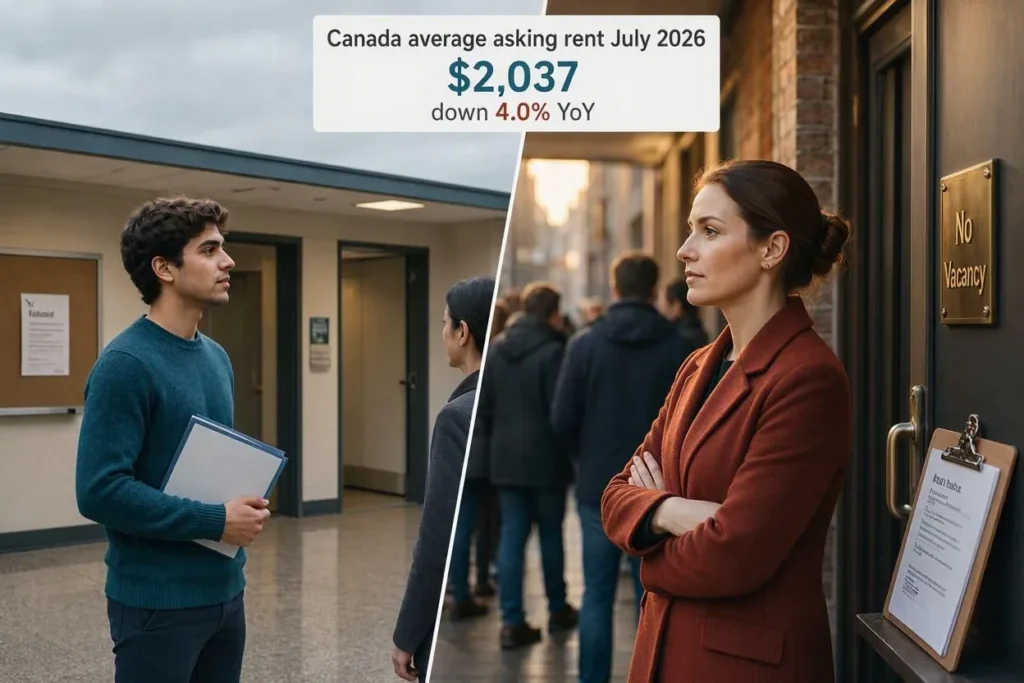
Higher vacancy rates give renters more leverage to negotiate rent, request repairs, or walk away from a bad lease, while low vacancy pushes prices up and shrinks your options. Canada’s national asking rent hit $2,037 in July 2026, down 4.0% YoY. That’s the 22nd straight month of annual decline, according to Rentals.ca and Urbanation’s August 2026 report, even as the market posted four consecutive months of MoM gains. National softening hides sharp regional splits, though.
Saskatchewan and Manitoba led rent growth over the past year. Both provinces slipped on a monthly basis in July 2026 anyway, an early signal that interprovincial demand may be easing as other regions become relatively cheaper by comparison. Purpose-built rental apartments proved the most resilient property type nationally, meanwhile, down just 2.6% YoY to $2,041 against a steeper 7.5% annual drop for houses and townhomes. Weighing unit types? Purpose-built buildings tend to hold value better than condos or secondary-market rentals, cooling market or not.
Rent Control and Tenant Protections by Province
Rent control rules vary sharply across Canada, and most rental guides skip this entirely, leaving a real blind spot for renters comparing cities. Ontario caps annual rent increases on units built before November 2018, but leaves newer buildings uncapped. British Columbia (BC) ties its allowable increase to inflation, adjusted yearly. Quebec sets no hard percentage cap at all; the Tribunal administratif du logement reviews disputed increases case by case instead. Alberta and Saskatchewan run with no rent control whatsoever, so landlords there can raise rent by any amount between fixed-term leases, provided proper notice goes out.
This matters more than people expect when comparing two similarly priced cities. A $1,300 apartment in Winnipeg, where Manitoba caps annual increases at a government-set percentage, carries far less long-term risk than the same rent in Calgary, where a landlord could double it at renewal with enough notice. Check the provincial tenancy board site before signing anywhere. Not after.
Best Cities to Rent Based on Who You Are
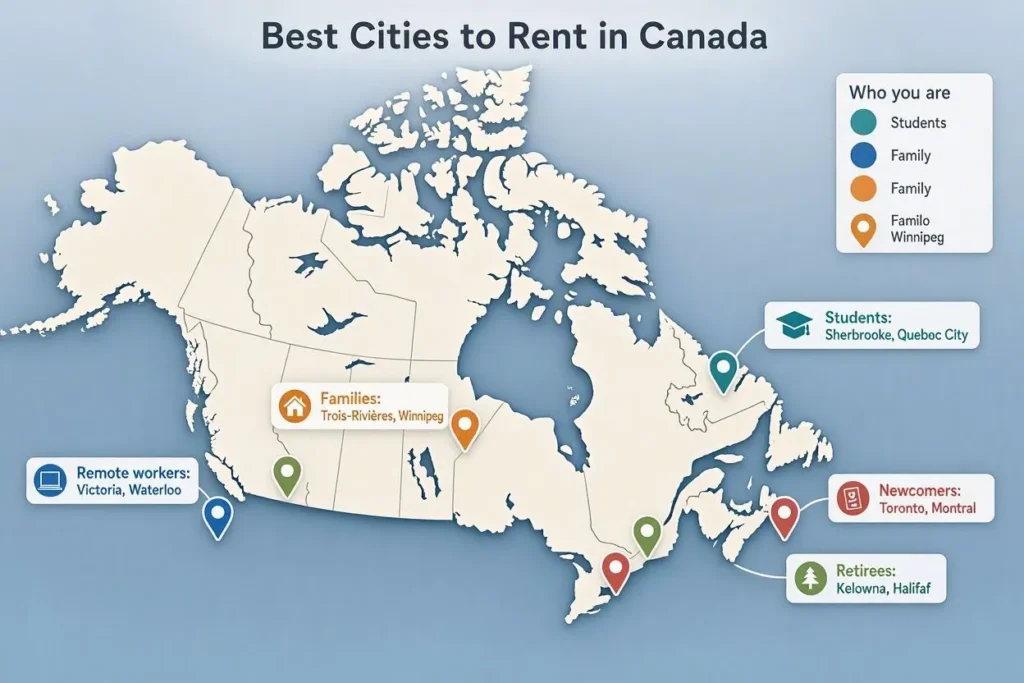
The best city to rent in Canada depends heavily on your life stage, since students, families, remote workers, newcomers, and retirees each optimize for different things. Here’s how that breaks down.
Students do best in Sherbrooke or Quebec City. Two university systems keep rent moderate there, and bilingual job options stay open after graduation. Families tend to favor Trois-Rivières or Winnipeg, both offering larger unit availability and rent-to-income ratios low enough to leave room for childcare and savings. Remote workers gain the most by trading Vancouver or Toronto for Regina or Sherbrooke, a move that can free up 15 to 20 percentage points of income once rent stops swallowing the paycheque. Newcomers chasing fast permanent residency should look at Winnipeg through the Manitoba Provincial Nominee Program, Regina through the Saskatchewan Immigrant Nominee Program, or Moncton through the Atlantic Immigration Program. Each runs active nomination streams that speed up the process. Retirees on fixed incomes often land well in Saint John or Thunder Bay, where lower day-to-day costs and shorter commutes stretch a pension further than a costlier metro ever would.
The Real Monthly Cost: Utilities, Transit, and Hidden Extras
Rent is the largest single line item for most renters, but utilities, transit, and groceries can shift total affordability by hundreds of dollars a month between cities. Alberta’s lack of provincial sales tax lowers everyday purchases across the board, a real advantage in Calgary and Edmonton that never shows up in rent figures. Quebec cities generally carry lower electricity costs thanks to provincial hydro rates. Atlantic Canada, though, tends to run higher heating bills through long winters.
Nobody quantifies utilities by city in the articles researched for this piece, which leaves a real gap. As a rough benchmark, a one-bedroom in a Prairie or Quebec city typically adds $120 to $180 (roughly $90 to $135 USD) monthly for heat and electricity combined. Coastal cities like Vancouver or Halifax often run $80 to $130 (about $60 to $97 USD) instead, milder climate offset by higher base utility rates. Add these figures to rent before comparing two cities, not after you’ve already signed somewhere.
Conclusion
Regina, Saskatoon, Winnipeg, and the Quebec trio of Trois-Rivières, Saguenay, and Sherbrooke give renters the best shot at keeping housing costs under control in Canada right now. None of them match Toronto or Vancouver on job density, and that’s the honest tradeoff. What they offer instead is a rent-to-income ratio that leaves room for savings, an emergency fund, or just breathing room at the end of the month. Run your own numbers against your own income before you commit anywhere. The national market keeps shifting month to month, and the gap between the best cities to rent in Canada and the worst ones has never been wider.
FAQs

Michael Reynolds
Michael Reynolds leads ImmigrationWin’s immigration, visa, and global mobility content division. He specializes in researching immigration policies, visa requirements, application processes, and international relocation pathways for individuals, families, students, and professionals. With extensive experience analyzing immigration regulations and official government guidance, Michael brings a research-driven approach to complex immigration topics and changing visa policies. He is the primary author of ImmigrationWin’s visa guides, immigration resources, and country-specific content, helping readers better understand their options and make informed decisions about their international journey.
Related Posts