

How to Price a Home for Sale in Canada: A Seller’s Step-by-Step Guide
Pricing a home in Canada isn’t about pulling a number off an online estimator or dusting off last year’s property assessment. It comes down to three things: a Comparative Market Analysis (CMA) built from sales in the last 90 days, an honest read on whether buyers or sellers have the upper hand locally, and a pricing strategy that actually fits that read. The national average home price hit $674,819 in July 2026, according to CREA’s monthly statistics release, but that number hides enormous variation between, say, a Calgary bungalow and a Halifax townhouse. A price that moves a home in one postal code can sit untouched for months two streets over.
Get this number right, and everything else about the sale gets easier. Get it wrong, and no amount of staging or professional photography will save the listing.
Why Pricing Matters More Than Marketing Ever Will

Price decides who even sees a listing, let alone who books a showing or writes an offer. There’s no marketing budget clever enough to fix a number that’s out of step with the market. Take a three-bedroom home in Mississauga: list it at $949,000 and it shows up in every buyer search capped at $950,000. Bump it to $955,000, and it disappears from that entire search pool, even though the real difference is less than 1%.
Buyers filter by price before they’ve read a word of the description, so overpricing doesn’t just risk a lower final sale, it risks the home never reaching buyers who would’ve paid full value. And once a listing sits for 30 days, buyers start assuming something’s wrong with it, so showings keep dropping even after a price correction brings the number back in line.
Step 1: Figure Out What Kind of Market You’re In
A seller’s market means tight inventory and fast sales. A buyer’s market is the opposite, and pricing strategy needs to flip depending on which one you’re facing. CREA tracks this through months of inventory, essentially how long it would take to sell every active listing at the current sales pace. Nationally, that sat at 4.8 months at the end of June 2026, per CREA’s statistics. CREA defines a seller’s market as below 3.6 months of inventory and a buyer’s market as above 6.4 months, both benchmarked one standard deviation from the long-term average of five months.
Seller’s market (under 3.6 months of inventory)
Multiple offers and bidding wars are common. Pricing at or slightly below market value often pushes the price up from there.
Balanced market (3.6 to 6.4 months)
Accurately priced homes sell within a normal timeframe, no discount tactics needed.
Buyer’s market (above 6.4 months)
Sellers need to price at or below comparable listings just to get people through the door.
A seller in Calgary during a tight-inventory month is making a completely different pricing decision than a Toronto condo seller sitting on six months of unsold stock in the same building. Checking the current sales-to-new-listings ratio for your specific city (most provincial boards publish this monthly) tells you more than any national headline ever will.
Step 2: Get a Comparative Market Analysis
A CMA pulls sale prices from similar homes sold in the past 60 to 90 days, then adjusts for differences in size, condition, and location to land on a realistic list price. Agents build these using MLS data, which most individual sellers can’t access directly. In practice, this can be quick: for a condo, an agent might start from the building’s average price per square foot, then adjust down for a lower floor or no view, arriving at a number in a matter of minutes once the comparable sales are in hand.
A CMA worth trusting adjusts for at least five things:
- Square footage (in both sq ft and m², since listing platforms mix the two)
- Lot size and frontage
- Age and condition of major systems (roof, furnace, windows)
- Number of bedrooms and bathrooms
- Proximity to transit, schools, or busy roads
Two homes on the same street can sell tens of thousands of dollars apart once these adjustments are factored in, even if they look nearly identical from the curb.
Step 3: CMA vs. Appraisal vs. Automated Valuation Model
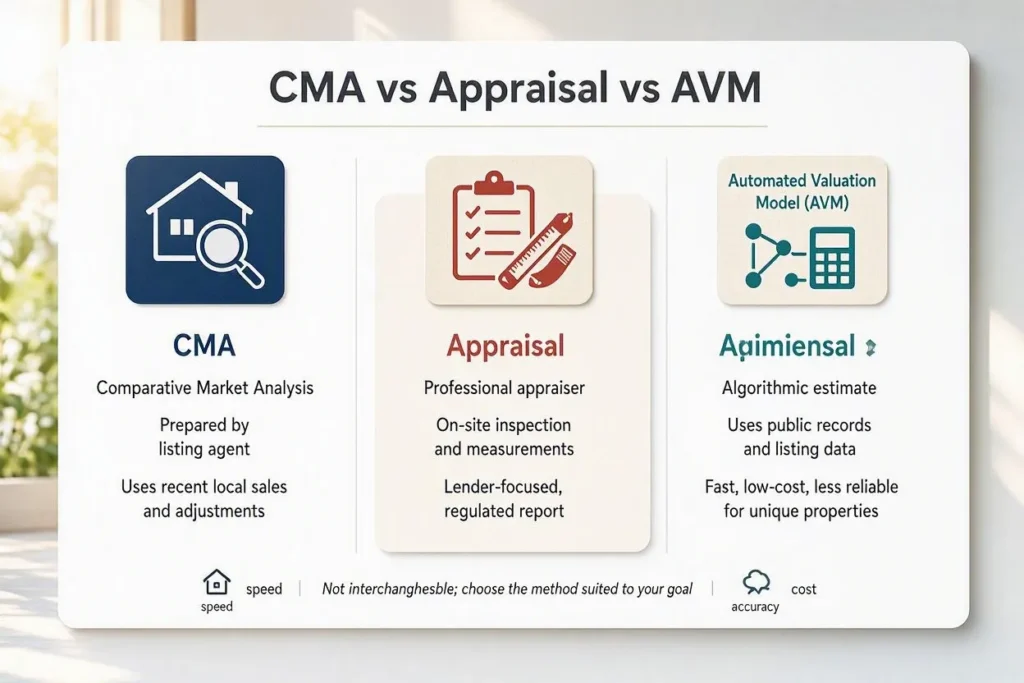
These three methods all estimate home value, but they’re not interchangeable, and sellers mix them up constantly.
| Valuation Method | Who Performs It | Typical Cost | Best Use |
| CMA | Licensed real estate agent | Usually free | Setting an initial list price |
| Appraisal | Accredited Appraiser (AACI designation) | $300–$600 CAD | Mortgage lending, estate settlement, disputes |
| AVM | Algorithm (online estimator tools) | Free | Rough starting benchmark only |
An AVM runs public sales data through a formula. That formula has no idea the house backs onto a highway or that the kitchen got gutted last year. A licensed appraiser actually walks the property and carries legal accountability for the number they land on, which is exactly why lenders require an appraisal before approving a mortgage and won’t take an AVM figure as a substitute.
Step 4: Pick a Pricing Strategy
The right approach depends on market conditions, your timeline, and how unique the property actually is compared to what else is on the market. A handful of strategies come up again and again across Canadian brokerages, each carrying a different level of risk.
- Market-value pricing: matches recent comparable sales directly. Safest bet in a balanced market, and the option least likely to produce an appraisal gap.
- Below-market (event) pricing: lists slightly under value to generate showings and competing offers. Works best when inventory sits below 3.6 months.
- Above-market (aspirational) pricing: tests a higher number, usually reserved for properties with no real comparables.
- Aggressive underpricing: a sharper version of event pricing, used when a fast, clean sale matters more than squeezing out every dollar.
- Overpricing to “test the market”: starting high and planning to cut later. This one backfires most often, because days-on-market piles up before the first cut even happens.
A seller with 90 days before a job relocation might reach for event pricing to force a quick decision. A seller with no deadline and a genuinely rare property (a century home on a double lot, say) might go aspirational instead and accept a longer wait for a shot at a premium offer.
Step 5: Use Psychological Pricing
This one’s simple: set your list price just under a round-number search threshold, and you show up in searches you’d otherwise miss entirely. A home at $799,900 appears in every buyer search set up to $800,000. The exact same home at $805,000 vanishes from that whole bracket, even though the gap is only $5,100.
But this only works as a complement to accurate pricing, not a substitute for it. A home genuinely worth $850,000 doesn’t turn into a bargain by listing it at $799,900. It just gets flooded with showings from buyers whose budget caps out well below what you’ll eventually accept, wasting everyone’s afternoon.
Step 6: Do the Net Proceeds Math First
Net proceeds are the sale price minus commission, your outstanding mortgage balance, legal fees, and any provincial land transfer costs tied to the deal. Sellers often anchor their asking price to a target take-home number without running these numbers first, which leads to prices set too high to cover for costs a buyer never actually pays.
Commission structures vary by brokerage and are negotiable in Canada, but a total of around 5% of the sale price, split between the listing agent and buyer’s agent, is a common reference point. On a $700,000 sale, that works out to roughly $35,000 before legal fees, mortgage discharge penalties, or moving costs even enter the picture. Confirm the actual rate with your agent, then run this math before setting a list price, not after closing.
Net proceeds also depend on rules that shift by province, which is where pricing gets locally specific fast.
Province-by-Province Differences Worth Knowing
Data access, disclosure rules, and market-reporting boards all vary by province, so a pricing approach that works in Ontario won’t necessarily transfer to British Columbia or Quebec. Ontario sellers operate under the Trust in Real Estate Services Act (TRESA), which governs how agents disclose competing offers. British Columbia requires a Property Disclosure Statement (PDS) in most residential transactions, giving buyers formal notice of known defects that can move the negotiated price.
Regional boards publish different benchmarks, too:
Toronto Regional Real Estate Board (TRREB)
Covers the GTA, publishes monthly average and benchmark prices by district.
Greater Vancouver Realtors (GVR)
Publishes a sales-to-active-listings ratio each month, with its own thresholds for buyer’s, balanced, and seller’s conditions, check their current release for the exact cutoffs.
Fraser Valley Real Estate Board (FVREB)
Reports separately from GVR despite covering an adjacent region, so sellers near the boundary need to check both.
A seller near the Fraser Valley and Greater Vancouver line who only checks one board’s statistics is basing a list price on half the picture.
Pricing Mistakes That Actually Cost Money
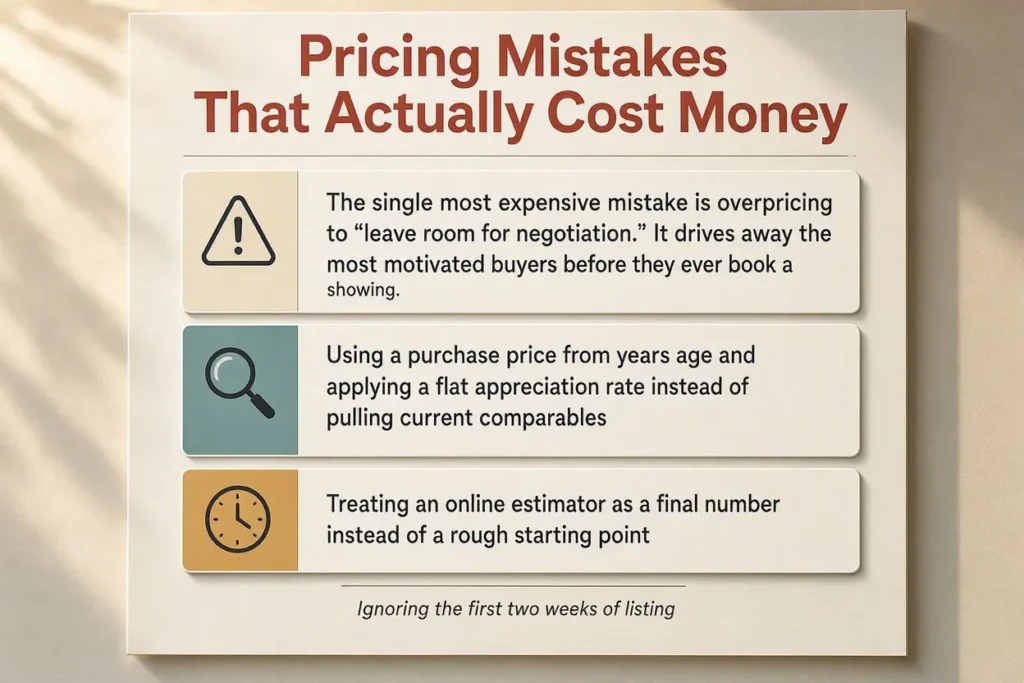
The single most expensive mistake is overpricing to “leave room for negotiation.” It drives away the most motivated buyers before they ever book a showing. A few other errors show up over and over:
- Using a purchase price from years ago and applying a flat appreciation rate instead of pulling current comparables
- Treating an online estimator as a final number instead of a rough starting point
- Ignoring the first two weeks of listing activity, usually the clearest signal of whether the price is right
- Making a timid 1–2% price cut instead of a meaningful 3–5% (or more) once a cut is actually necessary
- Comparing your home to fully renovated listings instead of true comparables in similar condition
Waiting too long to react to weak showing activity compounds every one of these. A home sitting for three weeks with no offers rarely fixes itself just by waiting.
Conclusion
Pricing a home in Canada comes down to five things: an accurate CMA, an honest read on local market conditions, a strategy that matches those conditions, a real net-proceeds calculation, and awareness of the provincial rules shaping disclosure and data access. Skip any one of these and it shows up later as a stale listing, a lowball offer, or money left on the table that didn’t need to be. National averages make for a good headline, but the only price that actually matters is the one built from comparable sales on your specific street, adjusted for what your home actually offers.
FAQs

Michael Reynolds
Michael Reynolds leads ImmigrationWin’s immigration, visa, and global mobility content division. He specializes in researching immigration policies, visa requirements, application processes, and international relocation pathways for individuals, families, students, and professionals. With extensive experience analyzing immigration regulations and official government guidance, Michael brings a research-driven approach to complex immigration topics and changing visa policies. He is the primary author of ImmigrationWin’s visa guides, immigration resources, and country-specific content, helping readers better understand their options and make informed decisions about their international journey.
Related Posts