
How to Rent an Apartment in Canada: A Step-by-Step Renter’s Guide
Renting an apartment in Canada breaks down into five stages: set a budget, gather your documents, search verified listing platforms, submit an application with references, and sign a lease that lines up with your province’s tenancy law. Newcomers without Canadian credit history hit one extra wall, since landlords check for it directly, but there are eight documented ways around that.
What to Know Before You Start Renting in Canada
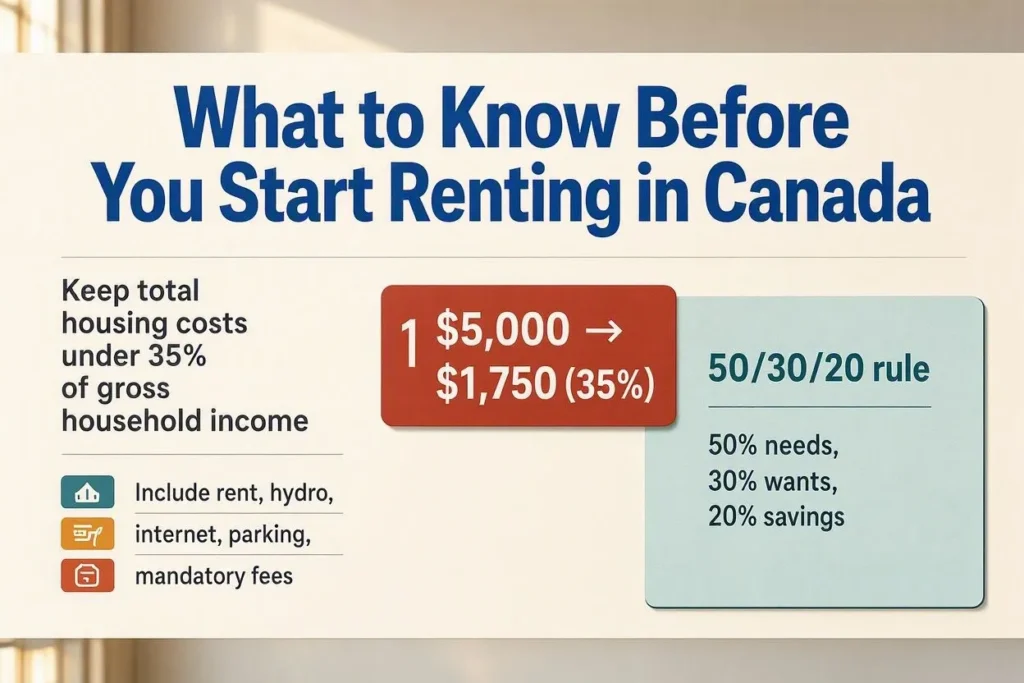
The Financial Consumer Agency of Canada (FCAC) recommends keeping total housing costs under 35% of gross household income. So a household bringing in $5,000 a month before taxes should cap rent and utilities at $1,750. That 35% isn’t just the rent check, either. It covers hydro, internet, parking, and whatever mandatory building fees get tacked on.
Some financial advisors use a stricter framework. The 50/30/20 rule puts 50% of income toward needs (rent included), 30% toward wants, and 20% toward savings, which forces a tighter housing number than the FCAC guideline allows. A renter earning $4,000 a month under this model would aim for $2,000 total on all needs combined, not just rent, so the actual housing line usually ends up closer to 25 to 30% of income once groceries and transit are factored in.
Credit history matters before location does. Canadian landlords pull credit reports for nearly every application, and most newcomers simply don’t have one yet. Sort out a plan for that gap before you start apartment hunting. It saves weeks of rejected applications later.
How Much Does It Cost to Rent an Apartment in Canada?
A one-bedroom in a Canadian city center averages around $1,857 USD a month; the same unit outside the core drops to roughly $1,185 USD. Prices swing hard by city, though. Comparing Vancouver to Quebec City is really comparing two different markets.
Figures below are recent-year cost-of-living estimates converted to USD; both local rents and the exchange rate move over time, so treat them as a rough guide and check a current listing site for today’s numbers.
| City | 1-Bedroom (City Center) | 3-Bedroom (City Center) |
| Vancouver | $2,000 USD | $3,646 USD |
| Toronto | $1,777 USD | $2,992 USD |
| Ottawa | $1,407 USD | $2,226 USD |
| Montreal | $1,181 USD | $2,089 USD |
| Quebec City | $898 USD | $1,395 USD |
Vancouver rent runs almost 2.2 times higher than Quebec City for the identical one-bedroom unit. Beyond the base rent, budget for the recurring costs that never show up in the listing price:
- Utilities: $300–$500 a month (electricity, water, gas combined)
- Internet: around $60 USD a month
- Renter’s insurance: $20–$50 a month
- Parking or EV charging: $50–$100 a month
- Storage: $50–$200 a month if you need it
- Public transit or rideshare: $100–$125 a month
A security deposit, often called last month’s rent, adds a one-time cost equal to a full month’s rent in most provinces. British Columbia caps this at 15 days’ rent instead, and Ontario requires first and last month’s rent with no separate damage deposit allowed by law, though provincial tenancy rules do get amended, so confirm the current figure with your province’s landlord-tenant board before signing anything.
What Documents Do You Need to Rent an Apartment in Canada?
Canadian landlords typically ask for six things: valid ID, proof of income, a credit report, landlord references, a completed rental application, and a guarantor agreement if you need one. Property management companies enforce this list to the letter, while private landlords will sometimes accept substitutes case by case.
Proof of income can be recent pay stubs, an employment offer letter on company letterhead, or bank statements showing steady deposits. A newcomer without Canadian work history often submits a job offer letter instead of pay stubs, since three months of paycheck history just doesn’t exist yet. If you’re a first-time renter with no prior landlord to reference, line up two personal or professional references ahead of time. Waiting until a landlord asks costs you valuable time in a competitive search.
Here’s the full checklist landlords ask for most:
- Government-issued photo ID (driver’s license or passport)
- Proof of income (pay stubs, offer letter, or bank statements)
- Credit report (through Equifax or TransUnion Canada)
- Landlord references from previous rentals
- Completed rental application form
- Guarantor agreement, if income or credit history falls short
Newcomers also need immigration documents on top of the standard list. A valid visa, study permit, or permanent residency card confirms you’re legally allowed to rent long-term, and landlords will ask for it alongside your ID.
How to Rent an Apartment in Canada Without Credit History or a Job Letter

Yes, you can rent in Canada without a credit history or a job letter by offering proof of savings, a local guarantor, or a larger security deposit instead. Royal Bank of Canada has published newcomer guidance covering tactics like these; most take nothing more than a phone call or a bank visit to set up, though it’s worth checking RBC’s current newcomer resources directly for the specifics.
A bank letter confirming four months of rent held in savings often substitutes for a credit check entirely. Say a newcomer has $8,000 in a Canadian chequing account and wants a $2,000-a-month unit. That balance can stand in for a credit score, because it shows the ability to pay directly rather than relying on a payment history that doesn’t exist yet.
Six more options close the gap when savings alone won’t cut it:
- Local guarantor or co-signer. A Canadian resident with strong credit agrees to cover rent if you can’t, though this puts a real legal obligation on that person.
- Shared accommodation. Subletting, joint leases with an established roommate, or renting a room from a resident landlord all come with lighter screening than a full unit lease.
- Larger security deposit. Offering above the provincial minimum, where it’s legally allowed, signals financial reliability to a hesitant landlord.
- Individually owned units. Condos and basement apartments owned by private landlords, rather than corporate buildings, allow more case-by-case flexibility.
- Neighborhoods farther from downtown. Less competition out there means landlords screen less aggressively.
- Temporary housing first. A short stay in a hotel, hostel, or homestay buys time to build three to four months of Canadian banking or employment history before you apply for a permanent lease.
A survival job, retail, food service, or delivery work outside your trained field, produces a job letter fast, even when it has nothing to do with your actual career. That letter alone often unlocks approval where savings and guarantors aren’t an option.
Where to Search for an Apartment in Canada
Renters find apartments through four main channels: online rental portals, real estate agents, property management websites, and local Facebook groups. Each suits a different kind of renter, and combining two or more usually gets you there faster than sticking to one.
Rentals.ca, Realtor.ca, PadMapper, Zumper, and Liv.rent carry the biggest inventory across major cities, and filtering by price, pet policy, and move-in date narrows things down quickly, especially in fast-moving markets like Toronto and Vancouver, where listings can vanish within 48 hours of going up. Kijiji tends to turn up a mix of private landlords and sublets that rarely make it onto the bigger portals.
Real estate agents earn their commission from the landlord, not the tenant, in most Canadian rental deals, so using one costs you nothing extra. They’re most useful in tight markets or for higher-end units, where they handle the paperwork and schedule viewings for you. Facebook groups fill a narrower niche: city-specific pages surface sublets, roommate openings, and off-market listings that never make it to a formal portal at all.
How to Spot and Avoid Rental Scams in Canada
Before you start contacting listings, know the red flags. A listing is a scam if it asks for payment before a viewing, prices far below market rate, or wants money sent to a landlord who claims to be out of the country. Fraud reports in Canada tend to cluster in tight, high-demand markets like Toronto and Vancouver, where competition pushes renters to move fast and skip verification steps.
Six warning signs show up in nearly every documented scam:
- Rent priced noticeably below comparable units in the same building or area
- A request for deposit or first month’s rent before any formal agreement is signed
- Wire transfers or crypto requested instead of standard payment methods
- A landlord who won’t do an in-person or live video tour
- Listings with only exterior shots or a single low-quality photo
- Pressure to decide immediately, framed as “other people are already interested”
Verifying a listing takes about fifteen minutes and can spare you a real financial loss. Cross-check the landlord’s name against the property tax record, reverse-search the listing photos, and insist on a signed lease before any payment goes out. That closes off the three most common fraud paths, and it’s worth doing before you send anything to anyone you found online.
How to Apply for an Apartment in Canada: Step by Step
Applying involves five steps: submit the rental application, provide supporting documents, wait for approval, sign the lease, and pay first month’s rent plus deposit. Property management companies run this formally; private landlords sometimes fold it all into a single meeting.
- Fill out the rental application with your personal details, employment history, and current address.
- Submit supporting documents (proof of income, credit report, ID, references) together to avoid back-and-forth delays.
- Wait for approval, which usually takes two to five business days through an agency.
- Sign the lease only after reading every clause, especially the sections on maintenance responsibility and rent increases.
- Pay first month’s rent and the security deposit, then arrange your utility transfers before move-in.
Going through a private landlord skips some of that formality, but you should still verify their identity and property ownership before any money changes hands. Asking to see a copy of the property tax bill, or ID matching the listed owner’s name, catches most fraudulent listings before a deposit gets sent.
What Tenant Rights and Lease Terms Apply in Canada?
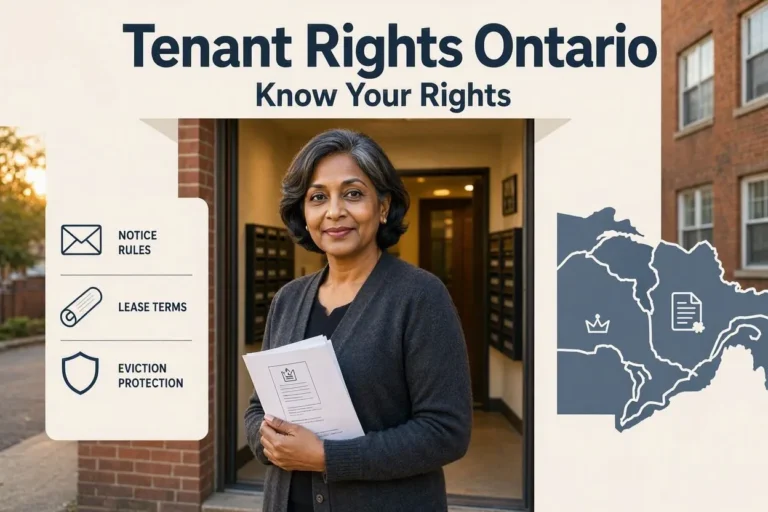
Canadian tenants have the legal right to a safe, well-maintained unit, reasonable privacy, uninterrupted utilities, and protection from eviction without valid cause. Provincial law governs the specifics, so tenant rights in Ontario differ in real ways from tenant rights in British Columbia or Quebec.
Two lease structures dominate the market. A fixed-term lease locks in rent and duration, usually 12 months, and neither side can change the terms mid-contract without mutual agreement. A month-to-month lease renews automatically until either party gives proper notice, trading price certainty for flexibility.
Every lease should spell out, in writing, before you sign:
- Monthly rent and what it includes (utilities, parking, storage)
- Security deposit amount and the conditions for its return
- Maintenance responsibilities split between landlord and tenant
- Notice period required before either side ends the tenancy
- Rules on subletting, pets, and additional occupants
- The process and notice required for the landlord to enter the unit
Roommates on the same lease share full legal responsibility for the total rent. If one stops paying, the other becomes liable for the whole amount. Separate leases avoid that exposure, though fewer landlords offer this since it means more administrative work on their end.
Move-In Checklist for Your First Canadian Apartment
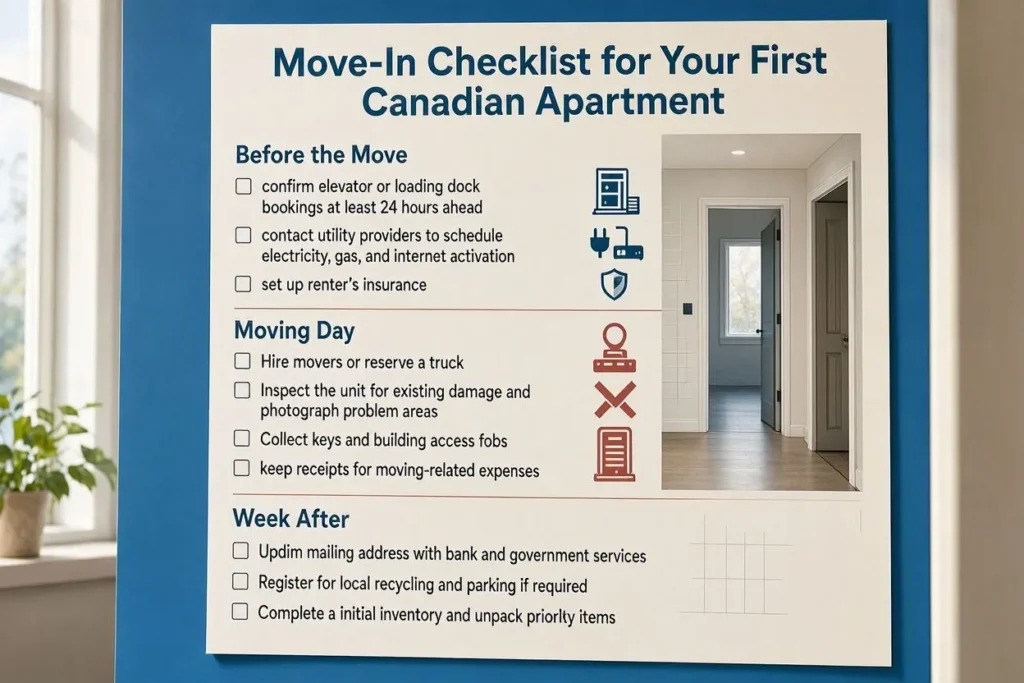
A move-in checklist covers three phases: before the move, moving day itself, and the week after. Skip any phase and you’ll likely end up paying for it later, whether that’s a late utility setup fee or a disputed damage deposit at lease end.
Before moving day, confirm elevator or loading dock bookings at least 24 hours ahead, contact utility providers to schedule electricity, gas, and internet activation, and set up renter’s insurance if it wasn’t required at signing. On moving day, pick up your keys, walk through the unit with photos of any existing damage, and test every appliance while you’re at it. One renter who photographs a scuffed hallway wall on day one avoids a damage-deposit dispute eight months later when that same mark gets blamed on them.
After the move, update your mailing address with banks and government agencies, find the nearest grocery store and pharmacy, and read through the building’s amenity rules. A tenant who works through all three phases in order usually gets from signed lease to fully settled apartment within two to three weeks.
Conclusion
Newcomers without Canadian credit history can close that gap with proof of savings, a local guarantor, or a larger deposit, rather than waiting months to build a score from scratch. The renters who move fastest through this whole process are the ones who get their documents and financing sorted before they start browsing listings, not after they’ve already found the place they want.
Frequently Asked Questions

Michael Reynolds
Michael Reynolds leads ImmigrationWin’s immigration, visa, and global mobility content division. He specializes in researching immigration policies, visa requirements, application processes, and international relocation pathways for individuals, families, students, and professionals. With extensive experience analyzing immigration regulations and official government guidance, Michael brings a research-driven approach to complex immigration topics and changing visa policies. He is the primary author of ImmigrationWin’s visa guides, immigration resources, and country-specific content, helping readers better understand their options and make informed decisions about their international journey.
Related Posts