
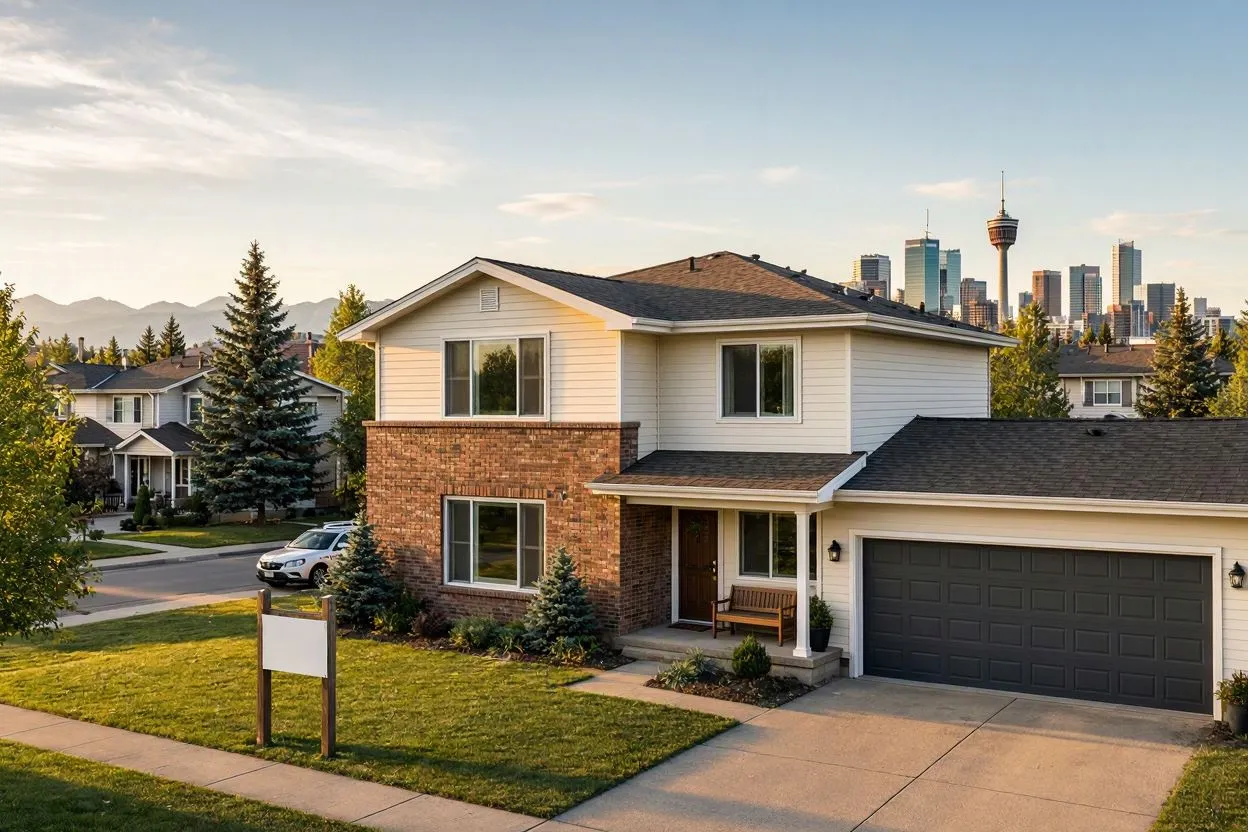
Average House Price in Calgary: Prices by Type & Area
The average house price in Calgary was $638,440 in August 2026, while the benchmark price for a typical home stood at $569,800. Calgary Real Estate Board data puts detached homes at an $813,806 average and apartment condos at $316,248. Prices have held flat for most of the year. Condos keep sliding, though, and detached homes in the West and City Centre districts are edging higher. This guide breaks down the latest numbers by property type and district, then shows the income, down payment and closing costs a buyer needs in Calgary this fall.
What Is the Average House Price in Calgary Right Now?
The average house price in Calgary was $638,440 in August 2026, up 4.3% year over year. That figure comes from 1,660 sales reported by the Calgary Real Estate Board (CREB), and it moved 1.4% higher than July’s $629,882. It isn’t the whole picture, though. CREB’s benchmark price, which tracks a typical home rather than whatever happened to sell, sat at $569,800 and slipped 1.1% from August 2025.
The two numbers point in opposite directions. Buyers who read only one of them walk away with the wrong impression of the market.
Average vs Benchmark vs Median vs Asking Price
Each of the 4 main price measures answers a different question, and Calgary sites quote all of them without always saying which one they mean.
| Price measure | Value | What it measures |
| Average sold price | $638,440 | Total sales dollars divided by 1,660 August sales (CREB) |
| Multiple Listing Service (MLS®) Home Price Index (HPI) benchmark | $569,800 | Estimated value of a typical home, adjusted for the mix of sales (CREB) |
| Median sold price | $565,000 | The middle sale, with half above and half below (CREB) |
| Average asking price | $698,217 | Active residential listings over $250,000, not closed sales (Sept. 30, 2026) |
Use the benchmark to track direction and the average to estimate a budget. Asking prices run high partly because expensive listings take longer to sell, and Calgary homes sold at 97.5% of list price in August.
CREB’s benchmark detached home gives the “typical” label some shape: about 1,410 sq ft (131 m²) of above-grade space on a 4,897 sq ft (455 m²) lot, with 3 bedrooms and a 1992 build year.
Why the Average Rose While the Benchmark Fell
Sales above $1 million increased while cheaper homes sold less often, which pulled the average up even as typical values eased. CREB tied that upper-end growth to detached and semi-detached homes, the same segments where supply expanded most. Meanwhile, apartment sales dropped 26% year over year, so fewer low-priced condos entered the calculation. A shift in the sales mix of that size can lift the average without a single home gaining value.
Average House Price in Calgary by Property Type
Detached homes averaged $813,806 in August 2026, more than 2.5 times the $316,248 average for apartment condominiums. Property type moves the number more than any other factor, so the citywide figure rarely matches the home a buyer is shopping for.
| Property type | Average sold price | Avg. YoY | Benchmark price | Benchmark YoY | Median price |
| Detached | $813,806 | +4.2% | $744,300 | -1.1% | $695,000 |
| Semi-detached | $691,163 | +5.2% | $690,500 | +1.0% | $576,500 |
| Row / townhouse | $444,734 | -3.2% | $415,200 | -5.4% | $409,680 |
| Apartment condo | $316,248 | -5.1% | $295,400 | -8.2% | $285,000 |
| All residential | $638,440 | +4.3% | $569,800 | -1.1% | $565,000 |
Semi-detached homes are the only segment where the benchmark rose. Apartments sit at the other end. CREB data puts the apartment benchmark nearly 13% below its August 2024 peak of $341,300.
How Have Calgary House Prices Changed in 2026?
Calgary house prices have moved sideways in 2026, with the benchmark holding between $553,400 and $572,500 from January to August. The average swung harder, climbing through the spring before easing in July.
| Month (2026) | Average sold price | Benchmark price |
| January | $618,101 | $553,400 |
| February | $628,353 | $559,400 |
| March | $641,510 | $564,500 |
| April | $651,545 | $567,700 |
| May | $665,719 | $569,400 |
| June | $669,425 | $572,500 |
| July | $629,882 | $569,200 |
| August | $638,440 | $569,800 |
Year-to-date numbers smooth out that spring spike. From January through August, the average sold price came to $645,503, a 2.3% gain over the same stretch of 2025, while the year-to-date benchmark of $565,738 ran 3.2% lower.
How Much Have Prices Risen Since 2019?
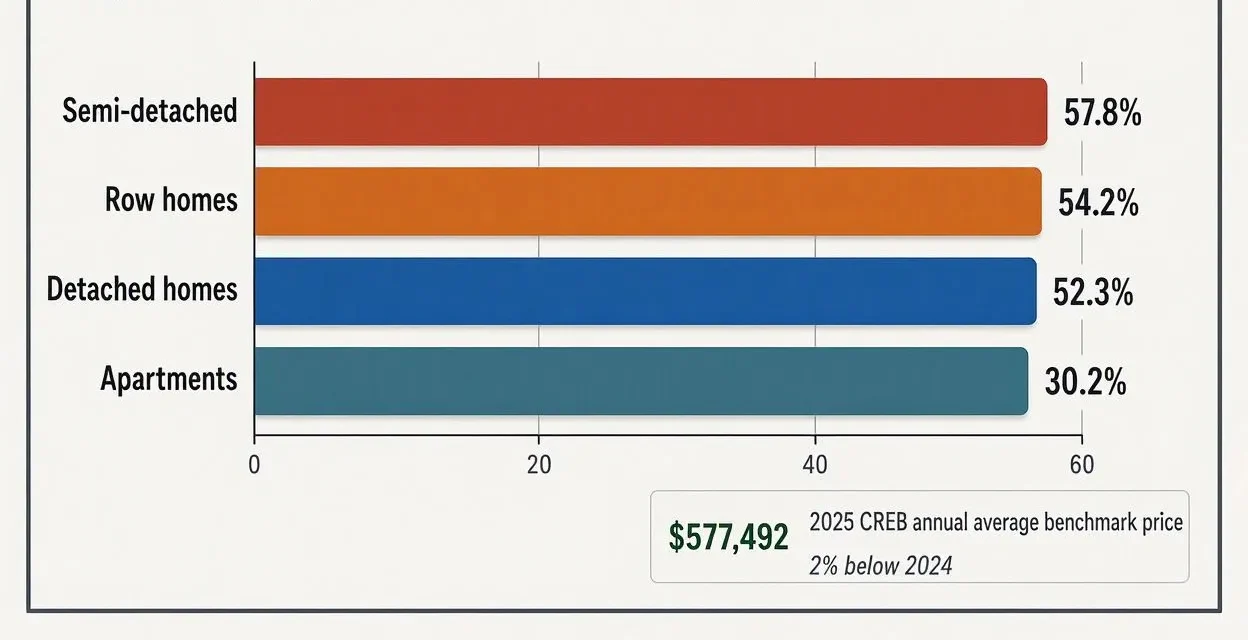
Calgary home prices rose between 30.2% and 57.8% from 2019 to 2025, depending on property type. City of Calgary figures based on CREB median sale prices show semi-detached homes gained 57.8%, row homes 54.2%, detached homes 52.3% and apartments 30.2% over that period. Recent softening hasn’t come close to erasing those gains. In 2025, CREB’s annual average benchmark price was $577,492, only 2% below 2024.
Which Calgary Districts Have the Highest and Lowest Prices?
City Centre and the West district carry Calgary’s highest detached prices, near $1 million, while the East and North East districts stay under $561,000. CREB splits the city into 8 districts, and the gap between the top and bottom one tops $500,000 for a detached home.
| District | Detached benchmark | Detached YoY | Apartment benchmark | Apartment YoY |
| City Centre | $995,700 | +2.2% | $303,500 | -7.5% |
| West | $992,500 | +2.8% | $322,500 | -7.8% |
| North West | $781,500 | -1.3% | $283,300 | -8.3% |
| South | $715,200 | -1.7% | $274,700 | -9.6% |
| South East | $703,600 | -1.7% | $311,600 | -8.0% |
| North | $647,400 | -3.9% | $300,900 | -9.3% |
| North East | $560,500 | -6.4% | $251,900 | -12.1% |
| East | $489,500 | -3.1% | $211,100 | -12.8% |
Inner-city communities such as Altadore and Mount Royal push up City Centre’s figure, and West district neighbourhoods like West Springs and Aspen Woods do the same out west. On the other side of the ledger, the North East posted the steepest detached decline at 6.4%. CREB points out that the same district led the city in price growth over the two years before, so part of today’s drop is a pullback from a higher base.
How Does Calgary Compare With Other Canadian Cities?
Calgary’s benchmark price of $569,800 sits about $143,000 above Edmonton’s and roughly $356,000 below the Greater Toronto Area’s. For a buyer relocating from Toronto, that gap alone equals more than 60% of what a typical Calgary home costs.
| Market (August 2026) | Benchmark price | Benchmark YoY | Average sold price |
| Calgary | $569,800 | -1.1% | $638,440 |
| Greater Edmonton Area | $426,900 | -0.6% | $469,602 |
| Greater Toronto Area | $925,900 | -4.5% | $993,410 |
| Metro Vancouver | $1,081,900 | -5.6% | $1,213,418 |
Nearby towns shift the math again. Airdrie’s benchmark came in at $508,800 in August, over 4% lower than a year earlier, and Okotoks landed at $608,400 with a decline of nearly 2%. Chestermere carries the loosest conditions in the region, with 9 months of supply.
How Much Income Do You Need to Buy a House in Calgary?
To buy a home at Calgary’s $638,440 average price, a household needs about $123,500 in annual income, assuming a 20% down payment. That estimate runs the payment through the federal stress test, which the Office of the Superintendent of Financial Institutions (OSFI) sets at the higher of 5.25% or the contract rate plus 2 percentage points.
| Home (August 2026 price) | 20% down payment | Monthly payment at 4.94% | Income needed to qualify |
| Apartment condo ($316,248) | $63,250 | $1,463 | $62,700* |
| Row / townhouse ($444,734) | $88,947 | $2,057 | $86,900* |
| Benchmark home ($569,800) | $113,960 | $2,636 | $110,500 |
| All-types average ($638,440) | $127,688 | $2,953 | $123,500 |
| Semi-detached ($691,163) | $138,233 | $3,197 | $133,400 |
| Detached ($813,806) | $162,761 | $3,764 | $156,500 |
Assumptions: 25-year amortization, 4.94% five-year fixed rate (the average uninsured rate reported by nesto on Sept. 28, 2026), qualification at 6.94%, a 39% gross debt service (GDS) limit, $100 a month for heating and property tax at 0.665% of the price. *Condo fees aren’t included, and lenders count half of them against GDS, so the real income bar for condos and many townhouses runs higher.
Broker rates beat that average. Ratehub listed a lowest insured five-year fixed rate of 4.34% on Sept. 29, 2026, which trims the payment for buyers with less than 20% down.
What Is the Minimum Down Payment for an Average Calgary Home?
The minimum down payment on a $638,440 home is $38,844, or 5% of the first $500,000 plus 10% of the remaining $138,440. Anything under 20% requires mortgage default insurance through the Canada Mortgage and Housing Corporation (CMHC) or a private insurer, and the premium gets added to the loan. First-time buyers qualify for 30-year amortizations on insured mortgages under the same December 15, 2024, rule change that lifted the insured price cap to $1.5 million.
Tax-sheltered savings help close the gap. The First Home Savings Account (FHSA) allows $40,000 in lifetime tax-deductible contributions, and the Home Buyers’ Plan (HBP) lets first-time buyers withdraw up to $60,000 from a Registered Retirement Savings Plan (RRSP).
What Does It Cost to Close on a Calgary Home?
Alberta charges no land transfer tax, so Calgary buyers pay Land Titles registration fees instead, about $1,255 on an average-priced home with 20% down. The Government of Alberta fee schedule sets the transfer fee at $50 plus $5 for every $5,000 of property value, and the mortgage registration follows the same formula on the loan amount.
Compare that with Ontario. A $500,000 purchase there carries $6,475 in provincial land transfer tax alone, before Toronto’s municipal tax gets added on top.
Property tax is the recurring cost to plan around. Calgary’s 2026 combined residential rate works out to roughly 0.665% of assessed value, which puts the bill for the typical single-family home, assessed at a median of $706,000, near $4,695 a year. About 42% of that amount goes to the Province of Alberta. City of Calgary figures show the provincial share rose $338 for the typical home this year, while the City’s portion rose $49.
Legal fees and a home inspection round out the closing budget.
Is Calgary a Buyer’s Market Right Now?
No, Calgary is not a buyer’s market as a whole; the city sat in balanced territory in August 2026 with 3.9 months of supply, while apartments leaned toward buyers at 5.7 months. A reading of 3 to 5 months marks a balanced market. Below 3 favours sellers, and above 5 favours buyers.
| Property type | Months of supply | Days on market |
| Semi-detached | 3.30 | 40 |
| Detached | 3.39 | 35 |
| Row / townhouse | 3.85 | 47 |
| All residential | 3.92 | 41 |
| Apartment condo | 5.68 | 52 |
Location changes the answer. Detached supply stayed below 3 months in the North West, West, South and South East districts, which still tilts those areas toward sellers. The North and North East, by contrast, carried more than 4 months.
What Is Driving Calgary House Prices?
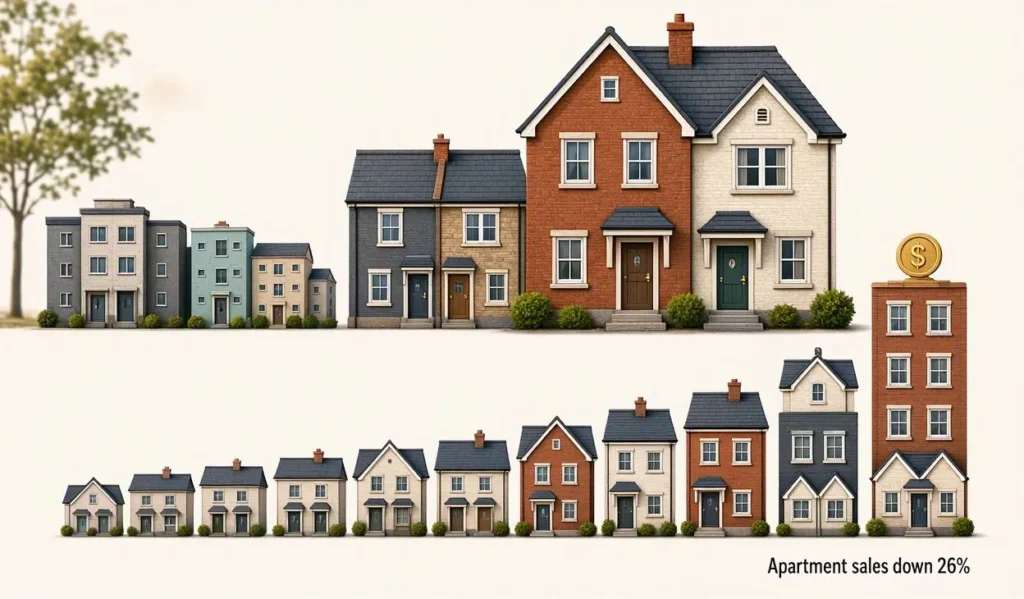
5 forces are shaping Calgary prices in 2026: new supply, slower population growth, stable interest rates, rental competition and the repeal of citywide rezoning.
- New supply. Record housing starts in 2025 are now turning into finished apartment and rental units, and CREB’s 2026 forecast expects that higher-density supply to keep weighing on condo and row prices this year.
- Slower population growth. The City of Calgary estimates the population will grow by 34,000 people in 2026, down from 53,000 in 2024 to 2025 and 88,000 in 2023 to 2024.
- Stable interest rates. The Bank of Canada held its policy rate at 2.25% on September 2, 2026, its seventh hold in a row, and the next decision lands on October 28.
- Rental competition. Calgary’s rental vacancy rate climbed to 5.1% in 2025, and CMHC projects 5.7% for 2026. CREB’s chief economist, Ann-Marie Lurie, noted in the August release that favourable rental conditions are slowing the move from renting to owning.
- Rezoning repeal. City Council voted 12 to 3 on April 8, 2026, to repeal blanket rezoning, and on August 4, 2026, about 99% of properties returned to their pre-2024 zoning. Rowhouse and infill projects on those lots now need a land use amendment first, which adds time before new townhouses reach the market.
Should You Rent or Buy at Calgary’s Current Prices?
Renting costs less for small units right now, while buying looks stronger for families who need a detached home. City of Calgary data shows rents for multi-residential units fell 9.6% year over year and rents for basement suites and other secondary units fell 8.0%. Detached-home rents moved the other way, jumping 16.5%, and townhouse and duplex rents rose 1.0%.
That split mirrors the ownership market. A one-bedroom renter has little pressure to buy while landlords compete for tenants in new rental towers. A family renting a detached house faces the opposite math, since the rent keeps climbing while the detached benchmark has held near $744,300.
Anyone searching the average house price Calgary buyers pay should run both numbers side by side. Compare the monthly mortgage payment in the income table above, plus property tax, with the rent for the same type of home in the same district.
How Should Buyers and Sellers Use These Numbers?
Match the price to your exact property type and district, since the citywide figure can miss a specific home by $300,000 or more. A detached house in the West district and an apartment in the East district both feed the same citywide average, yet their benchmarks sit $781,400 apart.
- Budget from the benchmark for your district and type, then add about 10% as a cushion, because the average sold price runs above the benchmark in most months.
- Negotiate below list on condos, since apartments averaged 52 days on market and sold at 96.4% of asking in August.
- Price detached listings close to recent district sales, especially in the North West, West, South and South East, where supply stayed under 3 months.
- Plan for longer marketing times when selling a condo, because apartments carry nearly 6 months of supply citywide.
Will House Prices in Calgary Go Down?
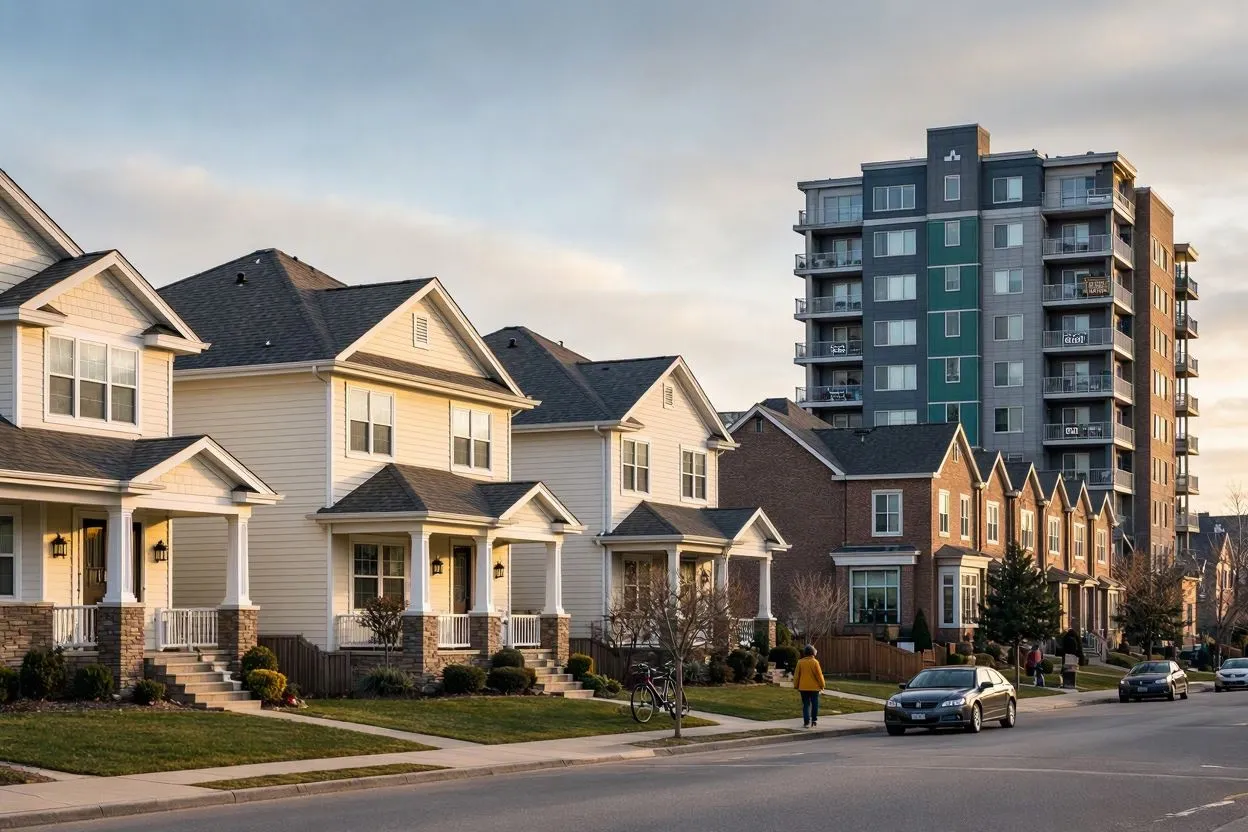
No, a broad price drop is not the expected path, but apartment and row prices are forecast to keep easing while detached values hold steady. CREB’s 2026 forecast, released in January, projected a slight decline in total residential prices for the year, driven by higher-density homes. Eight months of data have tracked that call closely.
Three scenarios frame the rest of 2026 and early 2027:
- Base case (our analysis): The benchmark stays within 1% to 2% of $570,000, with detached homes flat and condos down another few percent as new rental buildings open.
- Downside case: Money markets price in about 100 basis points of rate increases over the next 12 months, and a hike that arrives early would squeeze buyers who qualify at the edge of the stress test.
- Upside case: The federal and Alberta energy memorandum of understanding (MOU), which CREB flagged as an upside risk, lifts investment and job growth in the oil and gas sector.
Buyers weighing a condo gain the most negotiating room today. Detached buyers in the West or City Centre will find far less of it.
Conclusion
Calgary’s average house price tells a split story in 2026: the $638,440 average sold price rose on the back of more $1 million sales, while the $569,800 benchmark shows typical values holding flat. Condo buyers hold real negotiating room as apartment supply stays high. Detached buyers in the West or City Centre face tighter competition, and it shows in prices near $1 million.
Before you set a budget, match the price to the property type and district you want, then run the stress test on your own income. CREB publishes fresh numbers on the first business day of each month, so check the next release before you make an offer.
Frequently Asked Questions

Michael Reynolds
Michael Reynolds leads ImmigrationWin’s immigration, visa, and global mobility content division. He specializes in researching immigration policies, visa requirements, application processes, and international relocation pathways for individuals, families, students, and professionals. With extensive experience analyzing immigration regulations and official government guidance, Michael brings a research-driven approach to complex immigration topics and changing visa policies. He is the primary author of ImmigrationWin’s visa guides, immigration resources, and country-specific content, helping readers better understand their options and make informed decisions about their international journey.
Related Posts