

Tenants Rights When Landlord Sells Property: What to Know
Your lease stays in force when your landlord sells the property, and the new owner must honor its rent, end date and security deposit. A sale isn’t an eviction. The buyer steps into the old landlord’s legal position, which means a tenant holding a 12-month lease can stay through the final day of that lease even after the deed changes hands.
Month-to-month renters carry more risk. Even they’re owed written notice, though, and that notice runs from 30 days in Florida to 90 days in Washington when a single-family home is sold. Those two rules sit at the center of tenants rights when landlord sells property, and everything else (showings, deposit transfers, buyout offers, foreclosure) builds on them.
Does a Lease Survive When a Landlord Sells the Property?

Yes, a lease survives the sale because it attaches to the property, not to the person who owns it. The new owner inherits every term the old landlord signed. Rent stays put. Your move-out date doesn’t budge either, and neither do the clauses covering pets, parking and who handles repairs.
The rule comes from long-standing property law: a buyer who finds a tenant living in the home takes title subject to that tenant’s lease. Only 2 exceptions change the outcome. One is a termination-upon-sale clause written into your lease; the other is a foreclosure, where the lease ranks below the mortgage and federal law steps in.
Landlord Is Selling House: What Are My Rights?
You keep 9 core rights during a sale, and the most important one is the right to stay until your lease ends. The table pairs each right with what it means in practice.
| Right | What it means for you |
| Stay through the lease term | The new owner can’t end a fixed-term lease early without a sale clause or your written agreement |
| Written notice before a tenancy ends | Month-to-month tenancies need statutory notice, usually 30 to 90 days |
| Advance notice before showings | California and Oregon require 24 hours; the URLTA model sets 2 days |
| Quiet enjoyment | Showings can’t become so frequent that they turn into harassment |
| Your full security deposit | The deposit transfers to the buyer, who owes it back at move-out |
| Unchanged rent | Rent stays fixed until a fixed-term lease expires |
| A habitable home | Repairs remain the landlord’s duty before and after closing |
| Protection from lockouts and retaliation | Florida tenants recover actual damages or 3 months’ rent, whichever is greater |
| Freedom to refuse a buyout | Cash for keys is an offer, never an order |
None of these protections depend on the buyer’s plans. An investor and a young family hoping to move in inherit exactly the same lease. The family simply waits longer for the keys, which is part of why tenants rights when landlord sells property matter so much to buyers reading the listing fine print.
Fixed-Term Lease vs. Month-to-Month: How a Sale Affects Each
A fixed-term lease protects you through its end date, while a month-to-month tenancy can end once the landlord gives the notice your state requires. That single difference drives most outcomes.
| Lease type | Can the sale end it early? | Notice owed | Can rent rise during the sale? |
| Fixed-term (6 or 12 months) | No, unless the lease has a sale clause or you agree | None until the term expires | No, unless the lease allows it |
| Month-to-month | Yes in most states, with proper notice | 30 to 90 days, by state and tenancy length | Yes, with written notice and within any rent cap |
Can a Landlord Break a Lease to Sell?
No, a landlord cannot break a fixed-term lease just because a buyer wants the home empty. Selling doesn’t appear among the lawful grounds for ending a lease early. A landlord who wants the house vacant has 2 real options: wait for the term to expire, or pay you to leave sooner.
When Does a Termination-Upon-Sale Clause Apply?
A termination-upon-sale clause applies only when your signed lease contains one, and the landlord must still give the notice that clause and state law require. Look for a paragraph titled “Termination” or “Sale of Property” in your lease. Clauses like this typically promise 30 or 60 days’ notice, roughly 4.3 to 8.6 weeks. In just-cause states such as California, Oregon and Washington, the statute controls whenever it conflicts with the clause, and California voids any lease term that waives AB 1482 protections.
Tenants Rights When Landlord Sells Property: How Much Notice Is Required?
A landlord must give 30 to 90 days’ written notice to end a month-to-month tenancy over a sale, depending on the state and how long you’ve lived there. Fixed-term tenants get no termination notice mid-lease, since the lease can’t end early. The table compares 6 states spanning the full range, plus the Uniform Residential Landlord and Tenant Act (URLTA), the 1972 model law many states borrowed from.
| State | Month-to-month notice | Can a sale alone end the tenancy? | Entry notice for showings |
| California | 30 days under 1 year; 60 days at 1 year or more (Civ. Code §1946.1) | No after 12 months: AB 1482 requires just cause (§1946.2), plus 1 month’s rent in relocation aid for no-fault endings | 24 hours in writing (§1954) |
| Florida | 30 days before the end of a monthly period (§83.57(3), since July 1, 2023) | Yes for month-to-month, with notice | Consent the tenant can’t unreasonably withhold; repair entry needs 24 hours, 7:30 a.m. to 8:00 p.m. (§83.53) |
| New York | 30, 60 or 90 days by length of occupancy (Real Property Law §226-c) | Covered units under the 2024 Good Cause Eviction Law need good cause | Reasonable notice; no statewide statute |
| Oregon | 30 days in year 1; after year 1, 90 days with a qualifying reason (ORS 90.427) | Only when the buyer will occupy the home as a primary residence | 24 hours (ORS 90.322) |
| Washington | Just cause required for every termination (RCW 59.18.650) | Yes for a single-family home, with 90 days’ written notice | 2 days; 1 day for showings to buyers (RCW 59.18.150) |
| New Jersey | 2 months for a buyer-occupant (N.J.S.A. 2A:18-61.2(f)) | Only in buildings of 3 or fewer units when the buyer will live there and the contract requires vacancy | Set by lease; no general statute |
| URLTA model | Varies by adopting state | Not a ground on its own | 2 days (§3.103) |
These periods count calendar days, so 60 days equals about 8.6 weeks and 90 days about 12.9 weeks. Check your county too. Miami-Dade County, for one, requires 60 days for certain month-to-month terminations, double Florida’s statewide floor.
Do You Have to Allow Showings When Your Landlord Is Selling?
Yes, you must allow showings at reasonable times once your landlord gives the notice your state requires. Turning away lawful entry counts as a lease violation in most states, and in Florida it can lead to a 7-day notice to cure under §83.56. Your side of the bargain comes with rules the landlord has to follow:
- Expect written notice before each entry, at least 24 hours in California and Oregon
- Ask for fixed showing windows, such as weekday evenings from 5 p.m. to 7 p.m.
- Stay home during any showing if you prefer
- Request that listing photos leave out personal items, such as family pictures and mail
- Log every entry with the date, time and notice you received
California carves out one shortcut. Under Civil Code §1954, a landlord who has sent written notice of the sale within the past 120 days may give oral notice for buyer showings. Limits still exist, though: Florida’s §83.53(3) bars landlords from using access to harass a tenant, and the implied covenant of quiet enjoyment protects renters everywhere from daily walk-throughs.
What Happens to Your Security Deposit When the House Is Sold?
Your security deposit moves to the new owner at closing, and the new owner becomes responsible for returning it when you move out. Sellers have a second route. They can refund the deposit directly to you with an itemized statement instead.
California spells out both paths in Civil Code §1950.5, and a buyer who receives neither a transfer nor proof of refund ends up jointly liable with the seller. Florida covers transfers in §83.49(7). Ask for a letter listing the exact amount moved, the new holder’s name and, in Florida, the bank holding the funds. A $2,400 deposit should show up as $2,400 on that letter, plus any interest your state requires.
Who Do You Pay Rent to After the Sale?
You pay the new owner only after receiving written notice of the ownership change, and you keep paying the original landlord until that notice arrives. A proper notice names the new owner and gives a mailing address with payment instructions. During the transition month, pay by check or a traceable app, never cash.
How to Verify the New Owner Before Redirecting Rent
To verify the new owner, compare the name on the notice with the deed recorded at your county recorder’s office. Public listings tell scammers exactly which homes are changing hands, and a fake “new landlord” letter costs nothing to print. Run these 5 checks first:
- Search the property address on the county recorder’s website for a deed dated after closing.
- Match the buyer (grantee) name on that deed to the name on your notice.
- Call your old landlord at a number you already have, never one printed on the notice.
- Request a joint letter signed by both the seller and the buyer.
- Keep paying the original landlord until checks 1 and 2 line up.
Can a New Owner Raise the Rent or Change Lease Terms?
No, a new owner cannot raise rent or change terms during a fixed-term lease unless the lease itself allows it. Month-to-month tenants face a different picture. A new owner can raise their rent with written notice: 30 days in Florida under §83.57, and 30, 60 or 90 days in New York for increases of 5% or more under §226-c.
Rent caps add a ceiling in some states. California’s AB 1482 limits yearly increases to 5% plus the local Consumer Price Index (CPI), never above 10%. New York’s Good Cause Eviction Law treats any hike above the lesser of 10% or 5% plus CPI as presumptively unreasonable in covered units.
Should You Accept a Cash-for-Keys Offer?
Accept a cash-for-keys offer only if it covers your full moving costs plus the higher rent you’ll pay for the rest of your current lease. You’re never obligated to say yes. A buyout is a contract, and you have as much say over its price as the landlord does.
Add up 4 costs before you answer:
- Moving expenses, such as a truck, movers and packing supplies
- Rent difference for every remaining month at your next home
- Deposit and application fees at the new rental
- Lost wages for the days spent searching and moving
Here’s how the math plays out. Say your rent is $1,800, similar units list at $2,100 and 8 months remain on your lease. The rent gap alone reaches $2,400; add $1,500 for movers and a $2,100 deposit at the new place, and your floor sits at $6,000 before lost wages.
State relocation laws set a minimum in some places. California requires 1 month’s rent for no-fault terminations under AB 1482, while Oregon requires 1 month’s rent when a landlord owning 5 or more units ends a tenancy for a buyer-occupant. Get any buyout in writing with the move-out date, the payment date and a promise to return your old deposit.
What Happens If the Sale Is a Foreclosure?
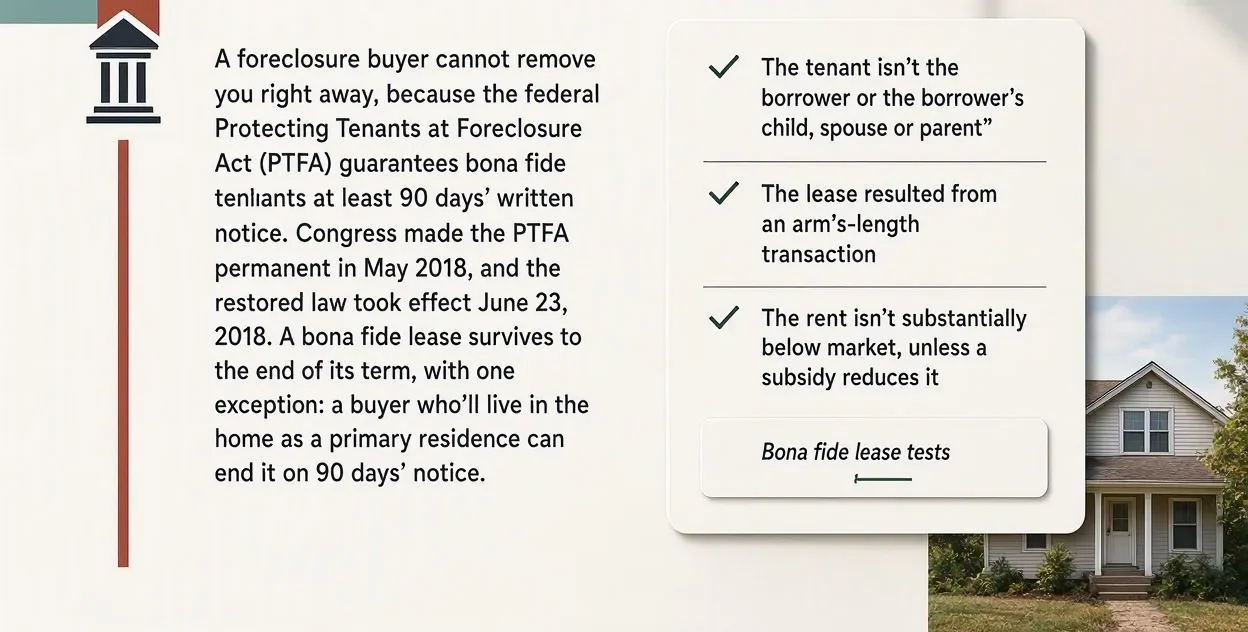
A foreclosure buyer cannot remove you right away, because the federal Protecting Tenants at Foreclosure Act (PTFA) guarantees bona fide tenants at least 90 days’ written notice. Congress made the PTFA permanent in May 2018, and the restored law took effect June 23, 2018. A bona fide lease survives to the end of its term, with one exception: a buyer who’ll live in the home as a primary residence can end it on 90 days’ notice.
Your tenancy counts as bona fide when it meets these tests:
- The tenant isn’t the borrower or the borrower’s child, spouse or parent
- The lease resulted from an arm’s-length transaction
- The rent isn’t substantially below market, unless a subsidy reduces it
Foreclosure notices from the lender don’t replace the 90-day notice. Only the new owner can serve it, and state laws granting longer periods still apply on top of the PTFA.
Special Situations That Change the Rules
Section 8 Voucher Tenants
Section 8 tenants keep their voucher through a sale, but the subsidy on that home continues only if the new owner takes over the Housing Assistance Payments (HAP) contract with the local public housing agency (PHA). Tell your PHA caseworker the week you learn about the sale. A buyer who wants rental income usually signs on, since the subsidized portion of rent arrives on schedule. If the buyer refuses the contract, your PHA helps you move with the same voucher.
Do Tenants Get the First Chance to Buy?
No, most U.S. tenants have no legal right of first refusal, and Washington, D.C., is the major exception. The District’s Tenant Opportunity to Purchase Act (TOPA) of 1980 gives tenants in multi-unit buildings a chance to buy and to match any third-party contract. Single-family homes have been exempt since July 3, 2018, except for elderly (62 or older) or disabled tenants who signed a lease by March 31, 2018.
Exempt D.C. owners still owe tenants written notice within 3 calendar days of receiving or soliciting an offer. Outside D.C., nothing stops you from making an offer of your own, and a seller who’d rather skip months of showings will often listen.
States Where a Sale Alone Cannot End a Tenancy
A sale alone can’t end your tenancy in just-cause states, such as California, Oregon, Washington and New Jersey, unless a specific statutory ground applies. Each state carves out a narrow sale-related ground with long notice: 90 days in Oregon and Washington, 2 months in New Jersey. California works differently. The sale itself isn’t just cause there, but a buyer who moves in after closing can rely on the owner move-in ground in §1946.2.
New York joined this group in April 2024. Its Good Cause Eviction Law applies automatically in New York City and in other localities that opt in, so a landlord there needs a listed reason to refuse renewal.
Selling a Rental Property With Tenants: What Landlords Must Do
Landlords selling a rental property with tenants must honor every existing lease and transfer each deposit at closing. Selling a property with a tenant usually takes longer and lands a lower price, because owner-occupant buyers want possession on day one. Investors read it the other way. A tenant who pays on time is income from the first month, with no vacancy gap to cover.
Selling House With Tenants: 6 Landlord Duties
- Send a written intent-to-sell letter before the listing goes live.
- Give statutory notice before every showing.
- Keep up repairs through the closing date.
- Disclose every lease to buyers in the purchase contract.
- Obtain a signed estoppel certificate confirming rent, deposit and lease dates.
- Transfer deposits and send the tenant a change-of-ownership letter.
Tenants who receive an estoppel certificate should read it line by line before signing. That form becomes the official record of your rent and lease dates, and a buyer relies on it. Write any verbal side agreement, such as a pet approval or a parking spot, directly onto the form.
Illegal Tactics a Landlord Cannot Use During a Sale
A landlord cannot force you out through lockouts, utility shutoffs or harassment, even with a buyer waiting at closing. Common examples include changing the locks, removing doors, cutting electricity and moving your belongings to the curb. Courts treat each one as an illegal self-help eviction.
Penalties run high. Florida tenants collect actual damages or 3 months’ rent, whichever is greater, under §83.67, and Washington awards the greater of actual damages or 3 times the monthly rent for a wrongful eviction under RCW 59.18.650(4). Retaliation is barred as well. In Florida, §83.64 blocks a landlord from raising rent or refusing renewal because you reported a code violation.
How to Protect Yourself When the For Sale Sign Goes Up
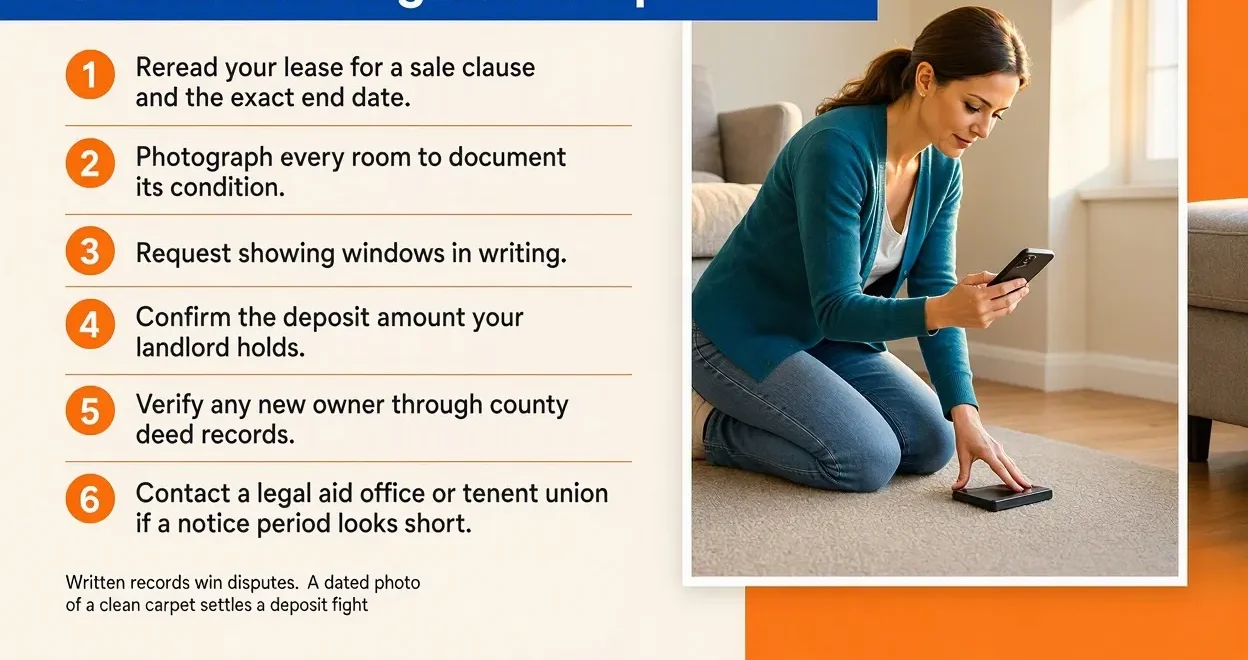
To protect yourself, take these 6 steps in order:
- Reread your lease for a sale clause and the exact end date.
- Photograph every room to document its condition.
- Request showing windows in writing.
- Confirm the deposit amount your landlord holds.
- Verify any new owner through county deed records.
- Contact a legal aid office or tenant union if a notice period looks short.
Written records win disputes. A dated photo of a clean carpet settles a deposit fight in minutes, while a verbal promise from a seller who’s moved to another state settles nothing.
Conclusion
Tenants rights when landlord sells property rest on one rule: the lease outlives the sale. A fixed-term tenant stays until the final day of the lease, a month-to-month tenant gets 30 to 90 days’ written notice, and the deposit follows the property to its next owner. Foreclosure doesn’t erase those protections. Federal law adds a 90-day floor on top of them.
Keep every notice, photo and payment receipt from the day the sign goes up. Most disputes over a sale turn on paperwork. If a landlord or buyer skips a required notice, a local legal aid office or tenant attorney can enforce your state’s rules, often at no cost to you.
FAQs

Michael Reynolds
Michael Reynolds leads ImmigrationWin’s immigration, visa, and global mobility content division. He specializes in researching immigration policies, visa requirements, application processes, and international relocation pathways for individuals, families, students, and professionals. With extensive experience analyzing immigration regulations and official government guidance, Michael brings a research-driven approach to complex immigration topics and changing visa policies. He is the primary author of ImmigrationWin’s visa guides, immigration resources, and country-specific content, helping readers better understand their options and make informed decisions about their international journey.
Related Posts