

Best Time to Sell a House in Canada: Month-by-Month Data
Spring, specifically May, is the best time to sell a house in Canada. Homes listed in May sell for roughly 12.8% above market value on average, based on benchmark pricing data cited by multiple Canadian brokerages, and buyer traffic peaks nationally between March and June. The right month for one seller isn’t automatically the right month for another, though. A waterfront property in Muskoka moves faster in July. A downtown Toronto condo can sell in February with the right price. Local inventory, interest rates, and your own timeline all shift the calculation.
This guide breaks down the best time to sell a house in Canada by season, by month, and by property type, then walks through the financial and personal factors that matter more than the calendar.
Best Season to Sell: Spring, Ranked Against Summer, Fall, and Winter

Spring ranks first among the four selling seasons in Canada, followed by fall, then summer, then winter. Each season carries distinct trade-offs in buyer demand, competition, and presentation.
Spring (March–June)
Spring wins because buyer demand and listing activity both surge at once, and demand outpaces the new supply. Families search in March and April so they can close and move before September, giving sellers a six-month runway before the school year starts. Melting snow and blooming landscaping also do free staging work that a $3,000 winter photography touch-up can’t replicate.
The catch: everyone else lists in spring too. A Calgary brokerage tracking 2025 sales data found new listings jumped 71% from February to May, while sales volume rose only 49% over the same period. Competition grew faster than demand did. A well-priced three-bedroom bungalow in a desirable school district still moves quickly. An overpriced one gets buried under forty other options.
Summer (June–August)
Summer holds second place for most property types, but it’s the strongest season for one category: waterfront and recreational homes. A cottage on Georgian Bay shows better in July, with the dock in and the lake at full summer color, than it does in October with bare trees and a hauled-out boat. For urban detached homes and condos, though, summer brings a real slowdown. Buyers leave for vacation, showings get harder to schedule around July long weekends, and agents report softer open house traffic through August.
Fall (September–November)
Fall is a legitimate second window. Buyers who didn’t close in spring often return to the market in September with more urgency, wanting to settle before winter. A Calgary team’s November 2024 data showed 1,797 home sales that month, down from the summer peak but still a meaningful share of annual volume. Pricing accuracy matters more here than in spring, since the fall buyer pool is smaller and less forgiving of an inflated asking price.
Winter (December–February)
Winter sells fewer homes overall, but the buyers who show up are serious. February 2025 data from one Calgary market report recorded 1,721 sales with homes moving in 33 days on average. Winter transactions aren’t rare, just smaller in number. If you need to close before December 31 for tax planning, or you’re relocating for a January job start, winter’s thinner inventory can work in your favor: less competition means your listing doesn’t disappear into a stack of forty others.
Best Month to Sell a House in Canada
May is the best month to sell a house in Canada, based on seller premium data tracked across multiple provincial markets. Homes sold in May command a premium of approximately 12.8% above benchmark value, driven by peak buyer traffic and the shortest average days-on-market of the calendar year. Sellers who list in the first two weeks of May, ahead of the late-May competition surge, tend to see the fastest offers.
February deserves a mention too. Listing before the March rush lets a seller catch buyers who’ve already been searching since January, without competing against the full spring inventory wave that hits by April.
Worst Month to Sell a House in Canada
November is the worst month to sell a house in Canada. Seller premiums drop to their lowest point of the year, averaging around 6.3%, less than half of May’s figure. Buyer attention shifts toward the holidays, daylight hours shrink, and homes from the fall listing wave are still sitting on the market, adding competition rather than reducing it. If your sale timeline is flexible, pushing a November listing into early December or waiting for the February uptick usually produces a stronger result.
How Interest Rates Affect the Best Time to Sell
Interest rates move buyer demand faster than the seasons do. After a period of aggressive hikes, the Bank of Canada shifted into a lower, more stable rate environment, holding its policy rate around 2.25% in late 2025. That decline filtered through to mortgages: many lenders now offer five-year fixed rates in the mid-4% range, down from the 5–6% levels sellers faced two years earlier.
Lower rates expand the pool of qualified buyers because monthly payments drop for the same purchase price. A buyer who could only afford $650,000 at a 6% rate might qualify for $720,000 at 4.5%, widening the market for mid-range detached homes and townhouses in particular. If the Bank of Canada signals further cuts, check the timing of your listing against the next scheduled rate announcement. A rate drop announced two weeks after you list could bring a fresh wave of buyers into your price range.
Benchmark Prices: How a Neighbourhood Sets a New High
A benchmark price gets set when multiple home sales in the same neighborhood come in well above the previous norm, creating a new baseline for the area. One high sale on its own doesn’t count. It could be an outlier, a bidding war between two motivated buyers, or a home with an unusual feature that skewed the number.
The mechanism plays out in three steps. First, a single sale closes at a price meaningfully above recent comparables, say, $200,000 over asking on a street where most homes sell within $20,000 of list price. Second, that sale gets noticed: neighbors talk, and other owners on the same street start wondering what their own home might fetch. Third, if two or three more sales close at similarly elevated prices within the following months, appraisers and real estate agents start using those sales as the new comparables, and the benchmark shifts for the entire area.
A new transit line, a top-ranked public school, or a wave of trendy restaurants opening nearby can all trigger this pattern. If your neighborhood is showing early signs of a benchmark shift, list while the shift is fresh, before every other seller on the street catches on and floods the market.
How to Tell if You’re in a Buyer’s or Seller’s Market
Ask a local agent for the sales-to-active-listings ratio in your area. Above 20%, it’s a seller’s market: low inventory, high demand, and enough leverage to price firmly and expect a quick offer. Below that, buyers have the upper hand. More homes are competing for fewer buyers, listings sit longer, and buyers have room to negotiate on price or attach conditions.
Get this number before you set your asking price, not after. A home priced as if it’s still a seller’s market, when the numbers have actually shifted toward balance, can sit unsold for 60 days while a comparable place down the street, priced to match current conditions, closes in three weeks.
Best Time to Sell by Property Type
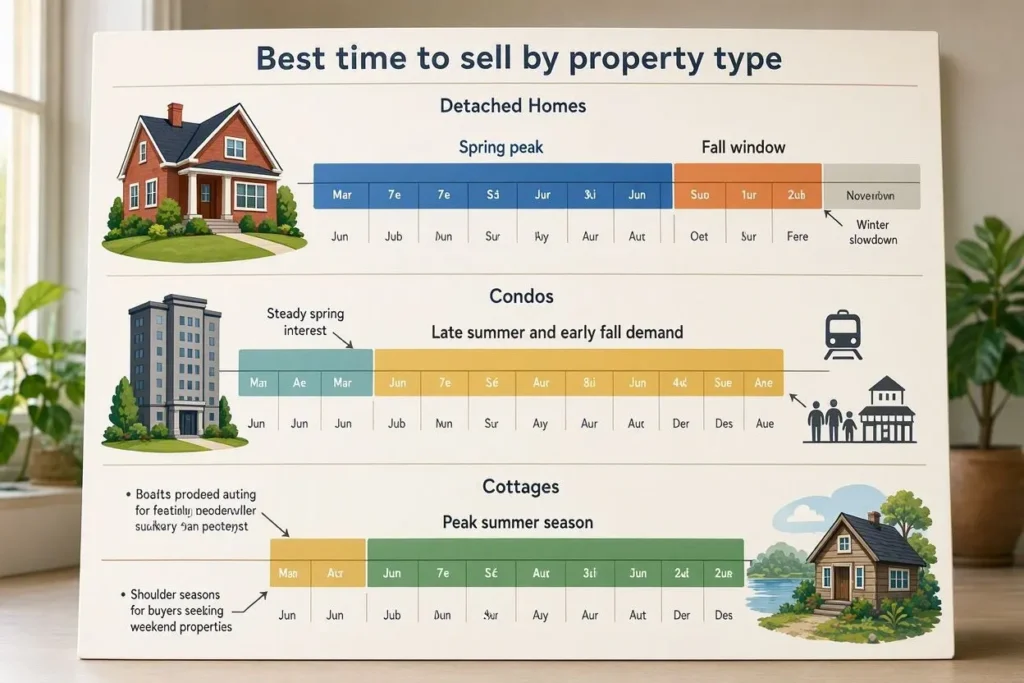
Timing advice built around single-family detached homes doesn’t automatically apply to condos or cottages. The three main property types follow different calendars.
Detached homes and townhouses follow the standard seasonal pattern described above: spring peak, fall secondary window, and winter slowdown. Families driving these purchases care about school calendars and yard visibility, both of which favor the March-through-June window.
Condos show less seasonal variation than detached homes. A downtown Toronto or Vancouver condo buyer is often a young professional, a downsizer, or an investor, none of whom are constrained by a school calendar. Condo sales stay comparatively steady across the year, though spring still edges out other seasons for buyer volume.
Waterfront and cottage properties invert the standard calendar entirely. A lakefront home in Muskoka, the Kawarthas, or the Okanagan sells best in June through August, when the dock is in, the water is warm, and a buyer can picture summer weekends on the property immediately. Listing the same cottage in November, with the dock pulled and the trees bare, asks a buyer to imagine a season they can’t see. That’s a harder sell regardless of the asking price.
The Cost of Waiting for the “Perfect” Time
Every month spent waiting for ideal market conditions carries a real dollar cost, not just an opportunity cost. Take a $700,000 home carrying a mortgage payment near $3,800 monthly, property taxes around $450, utilities near $250, and routine maintenance averaging $300: a combined carrying cost of roughly $4,800 per month. Waiting six months for a marginally better market translates to nearly $29,000 in carrying costs alone, before accounting for any price movement in either direction.
If prices in your local market drop even 2% while you wait, a $700,000 home loses $14,000 in value on top of the carrying costs already spent. The math rarely favors indefinite waiting unless a specific, identifiable market shift is expected within a short, defined window.
Canada-Specific Timing Triggers Sellers Overlook
A few things specific to Canada also affect when buyers show up, and most seasonal charts miss them.
Tax deadlines. The FHSA (First Home Savings Account) and the RRSP Home Buyers’ Plan both work on the calendar year. Buyers trying to use up their FHSA room before December 31 often start searching in November and December, so there’s a small pocket of motivated buyers even in the slow season.
The Foreign Buyer Ban. This federal law blocks most non-Canadians from buying residential property. It’s been extended and tweaked a few times since it started, and each change affects how many foreign buyers are active in cities like Vancouver and Toronto. Worth checking the current rules before you assume your buyer pool looks the way it did a few years ago.
Land transfer tax rebates. Ontario and Toronto both give first-time buyers a rebate on land transfer tax. These programs vary by province and city, and some have deadlines tied to your closing date. When a deadline is coming up or a program is about to change, you’ll sometimes see a short rush of buyers trying to close in time.
Immigration. Canada’s immigration targets add steady demand for housing all year, not just in spring. Cities that get the biggest share of new permanent residents, mainly Toronto, Vancouver, and Calgary, tend to have more consistent buyer demand year-round than smaller markets.
Personal Circumstances That Override the Calendar
Market timing matters less than personal readiness in several common situations. A job relocation with a fixed start date doesn’t wait for May. A divorce settlement or an inheritance sale often carries its own legal timeline. A mortgage renewal date matters too: selling before your term ends, without porting the mortgage to a new property, can trigger a prepayment penalty worth thousands of dollars.
If any of these apply to your situation, the “best time to sell a house in Canada” isn’t a month on a chart. It’s the month your circumstances require action. A well-priced, well-presented home sold in November under time pressure still outperforms an unprepared listing rushed onto the market in May.
How to Choose Your Own Best Time to Sell

Five factors decide your personal best time to sell, ranked by weight: your local sales-to-active-listings ratio, your property type, current mortgage rates, your own timeline constraints, and the specific month’s seasonal demand pattern. Pull the first three from a local agent’s market report before you commit to a listing date. Weigh the last two against your actual circumstances, not against a generic seasonal calendar built for a different city or property type.
A homeowner in Calgary selling a detached bungalow in a seller’s market, with a mortgage renewal six months out and no urgent relocation, should target the first two weeks of May. A Toronto condo owner facing a January job transfer should list in December regardless of season, because a smaller, motivated buyer pool in December beats an empty unit sitting through a spring listing that never happens.
Conclusion
May remains the strongest single month to list a home almost anywhere in Canada, and spring as a whole outperforms every other season on buyer demand and seller premium. That single data point doesn’t override a mortgage renewal date, a job relocation, or a neighborhood benchmark shift happening in October instead of April. Pull your local sales-to-active-listings ratio, check current mortgage rates against your target buyer pool, and price the home to match the season you actually list in, not the season a national average says is ideal.
FAQs

Michael Reynolds
Michael Reynolds leads ImmigrationWin’s immigration, visa, and global mobility content division. He specializes in researching immigration policies, visa requirements, application processes, and international relocation pathways for individuals, families, students, and professionals. With extensive experience analyzing immigration regulations and official government guidance, Michael brings a research-driven approach to complex immigration topics and changing visa policies. He is the primary author of ImmigrationWin’s visa guides, immigration resources, and country-specific content, helping readers better understand their options and make informed decisions about their international journey.
Related Posts