
First Time Home Buyer Incentive Canada: 2026 Programs & Rebates Guide
A first time home buyer incentive in Canada is any government program, tax credit, or rebate designed to lower the upfront or ongoing cost of buying a first home. These tools come from federal, provincial, and municipal governments, and they take different forms: tax-free withdrawals, refundable credits, land transfer tax rebates, forgivable loans. Some buyers qualify for four or five of these at once. That can mean tens of thousands of dollars in combined savings.
Affordability is still the main obstacle for Canadians trying to buy in 2026, and the rules around who qualifies keep shifting. One of the biggest federal programs on this list was quietly killed off two years ago, and a surprising number of blogs still write about it like it’s active. This guide covers what’s actually available right now, flags what’s gone, and shows how to stack the rest.
What Is a First Time Home Buyer Incentive in Canada?
A first time home buyer incentive is financial assistance that reduces the cost of purchasing a first property, usually through one of five mechanisms: tax-free savings accounts, RRSP withdrawal privileges, refundable or non-refundable tax credits, land transfer tax rebates, or direct down payment loans. Ottawa runs the largest programs nationally, while provinces and select cities add their own layers on top.
Three qualifying conditions apply to nearly every program on this list. Buyers must not have owned and lived in a home they or their spouse owned in the current year or the four calendar years before it. The property must become the buyer’s principal residence within a set window after closing, typically nine months to one year. Income and purchase-price caps apply to several provincial and municipal programs, so a buyer’s location and household earnings often determine which incentives actually apply.
Federal First Time Home Buyer Incentive Programs
Home Buyers’ Plan (HBP)
The Home Buyers’ Plan lets first-time buyers withdraw up to $60,000 tax-free from a Registered Retirement Savings Plan (RRSP) for a down payment, or $120,000 combined for a couple. Repayment starts two years after the withdrawal and stretches over 15 years, interest-free. Miss a scheduled repayment, and the Canada Revenue Agency (CRA) adds that year’s missed amount to taxable income instead of charging interest.
Eligibility extends beyond people who’ve never owned property. Buyers qualify if they haven’t lived in a home they or a spouse owned during the current calendar year or the four years before it, which means a previous owner can requalify after a long enough gap. Divorced or separated individuals can also access the HBP a second time, even without meeting the standard first-time buyer test, provided the earlier withdrawal has been fully repaid.
First Home Savings Account (FHSA)
The First Home Savings Account combines RRSP-style tax deductions with TFSA-style tax-free withdrawals for home purchases, capped at $8,000 in annual contributions and $40,000 over a lifetime. Introduced in the 2023 federal budget and administered by the CRA, the account stays open for 15 years or until the holder turns 71, whichever comes first. Unused contribution room carries forward by up to $8,000 into the following year.
Opening an FHSA requires three things: Canadian tax residency, an age between 18 and 71, and first-time buyer status for both the account holder and their spouse. Funds that go unused for a home purchase transfer to an RRSP or RRIF without penalty, so the account carries no real downside if plans change.
Home Buyers’ Amount Tax Credit
The Home Buyers’ Amount delivers a non-refundable federal tax credit worth up to $10,000, translating to roughly $1,500 back at tax time. Buyers claim it on the return for the year they purchased the home, and it applies to single-family homes, townhouses, condos, mobile homes, and qualifying co-op shares. A spouse or common-law partner can claim the credit instead, but only one person per household can claim it per purchase.
GST/HST New Housing Rebate
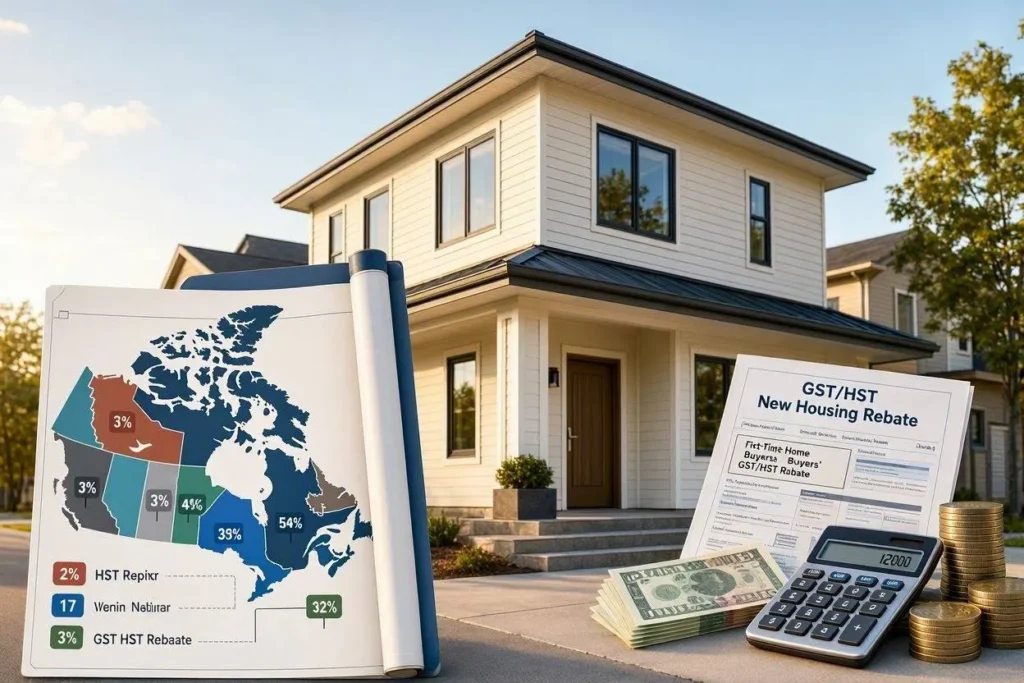
The GST/HST New Housing Rebate returns part of the federal sales tax paid on a newly built or substantially renovated home. The rebate amount shifts by province because HST rates differ regionally, and it can total thousands of dollars on an eligible new-construction purchase. A separate First-Time Home Buyers’ GST/HST Rebate has been proposed to enhance this benefit specifically for first-time purchasers, though the federal government hasn’t finalized its details as of this writing.
Multigenerational Home Renovation Tax Credit
The Multigenerational Home Renovation Tax Credit refunds 15% of eligible renovation costs, up to $50,000, for building a secondary living unit for a family member. First-time buyers purchasing a home with the intention of housing parents, grandparents, or an adult family member with a disability can apply this credit toward the renovation, not the purchase itself. It’s a frequently overlooked federal benefit that pairs well with multigenerational buying strategies.
The Discontinued FTHBI (What Replaced It)
No, the First-Time Home Buyer Incentive (FTHBI) is not currently available. The Canada Mortgage and Housing Corporation (CMHC) ended the shared-equity mortgage program on March 21, 2024, and stopped accepting new applications after March 31 of that year. Under the old FTHBI, the government contributed 5% toward a resale home or 10% toward a new build, then shared in any gain or loss when the buyer sold or after 25 years, whichever came first.
The income cap of $120,000 and the four-times-income mortgage limit restricted the program to homes priced around $500,000, which shut out most buyers in Toronto and Vancouver. Ottawa replaced it with the FHSA, which industry analysts consider more flexible because it carries no shared-equity repayment risk. Any article or advertisement describing the FTHBI as an active program is out of date and should not be relied on for a 2026 purchase.
Mortgage Rule Changes That Help First-Time Buyers
Two federal mortgage rule changes took effect in December 2024 and remain active in 2026. First-time buyers purchasing an insured mortgage now qualify for a 30-year amortization period instead of the standard 25 years, which lowers monthly payments and stretches affordability. The insured mortgage price cap also rose to $1.5 million, letting buyers in expensive markets qualify for mortgage default insurance on higher-priced homes than before.
Both changes apply specifically to buyers with a down payment below 20% who require mortgage insurance. Together, they represent the most significant national affordability shift since the FTHBI ended, and they cost the buyer nothing to access beyond meeting standard mortgage qualification rules.
Provincial and Territorial First Time Home Buyer Incentives
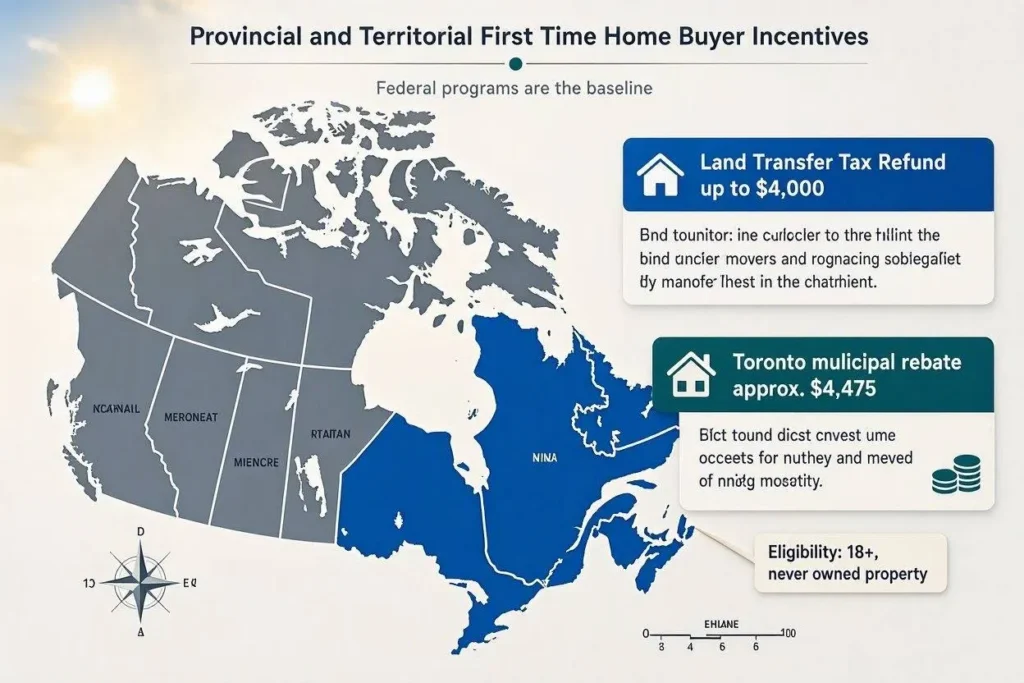
Every province and territory layers its own programs on top of federal ones. Below is what’s currently active by region.
Ontario
Ontario has a Land Transfer Tax Refund worth up to $4,000 for qualifying first-time buyers. Buy in Toronto specifically, and there’s a separate municipal rebate worth roughly $4,475 on top of that. To claim either, buyers need to be 18 or older, must never have owned property anywhere in the world, and have to move in within nine months of closing.
Quebec
Quebec’s Home Buyers’ Tax Credit is worth up to $1,400 provincially. Montreal goes further with its own Home Purchase Assistance Program, granting $5,000 to $15,000 depending on household size and where in the city the home sits. Quebec City runs a separate Family Access Program too, with interest-free down payment loans on homes under $370,000.
British Columbia
In British Columbia, qualifying buyers skip the Property Transfer Tax entirely on homes valued up to $835,000, with partial exemptions stretching to $860,000. You’ll need Canadian citizenship or permanent residency, plus a year of BC residency, before you can apply.
Alberta
Alberta doesn’t charge a provincial land transfer tax at all. No dedicated first-time buyer rebate needed. Just skipping that tax already saves buyers thousands compared to almost anywhere else in the country.
Saskatchewan
Saskatchewan’s First-Time Homebuyers’ Tax Credit tops out at $1,050, worked out as 10.5% of the first $10,000 in purchase price.
Manitoba
Manitoba runs the Affordable Homes Program, which can cover up to 25% of a purchase price through a blend of forgivable and repayable assistance. Métis citizens have a separate option too: the First Time Home Purchase Program, offering grants up to $18,000.
New Brunswick, Nova Scotia, PEI, and Newfoundland and Labrador
These four Atlantic provinces each run their own version of an interest-free or partly forgivable down payment loan, usually capped somewhere between $17,500 and $28,500 depending on household income.
Yukon, Northwest Territories, and Nunavut
Construction costs run higher across Yukon, the Northwest Territories, and Nunavut, and the assistance reflects that. Nunavut forgives loans up to $80,000 outright, while the NWT uses a sliding scale that forgives smaller loans faster than larger ones.
Municipal-Level Programs
Several Ontario counties and cities run their own homeownership assistance beyond provincial and federal programs. Simcoe County, Waterloo Region, Dufferin County, Niagara, Chatham-Kent, Kingston, and the District of Muskoka each offer forgivable down payment loans, typically 5% to 10% of the purchase price, forgiven after 15 to 20 years of continuous ownership. Income caps and maximum home prices vary sharply by municipality, so buyers should confirm current thresholds directly with the local housing office before assuming eligibility.
Who Qualifies as a First-Time Buyer?
A first-time buyer, under most Canadian program definitions, is someone who hasn’t owned and lived in a home they or their spouse owned during the current calendar year or the four calendar years before it. This means previous homeowners can requalify after a sufficient gap, and the definition isn’t limited to people who’ve never owned property at all. Requirements around citizenship, residency duration, and property occupation timelines still vary by individual program.
How to Combine Multiple Incentives
Yes, most federal programs can be combined without restriction. A buyer can withdraw RRSP funds through the HBP, save separately in an FHSA, and claim the Home Buyers’ Amount on the same purchase, layering three federal benefits into one transaction. Provincial programs generally stack on top of federal ones too, though some provinces restrict combining multiple provincial offers within the same jurisdiction. A mortgage professional familiar with first-time buyer programs can confirm which combinations apply to a specific purchase.
Newcomer and Non-Resident Buyer Options
Newcomers to Canada face different mortgage qualification rules than long-term residents, and several lenders run dedicated newcomer mortgage programs to address the gap. These programs typically accept alternative credit history, such as international credit reports or rental payment records, in place of a Canadian credit score. Permanent residents and work-permit holders remain eligible for most federal incentives listed above, provided they meet each program’s residency and occupancy conditions.
Practical Steps: Down Payment Gifts, Rent-to-Own, and Applying
Down Payment Gift Letters
A gifted down payment requires a signed gift letter confirming the funds don’t need repayment. Lenders request this letter along with bank statements showing the transfer, since undisclosed loans disguised as gifts violate mortgage qualification rules. Parents, grandparents, and immediate family members most commonly provide these gifts, and the letter typically needs to specify the donor’s relationship to the buyer.
Rent-to-Own Programs
Rent-to-own arrangements let buyers lease a property with a portion of rent credited toward a future purchase, offering a path to ownership for buyers who need more time to save or build credit. These arrangements carry real risk if the seller defaults or the buyer can’t secure financing by the agreed date, so a real estate lawyer should review the contract before signing.
How to Apply for These Incentives
To apply for most incentives, buyers should follow this order: confirm eligibility for each program based on location, income, and home price; gather documentation including proof of income, identification, and bank statements; secure mortgage pre-approval; and submit applications within each program’s specific timing window, since some require approval before an offer while others process through the annual tax return.
Common Mistakes to Avoid
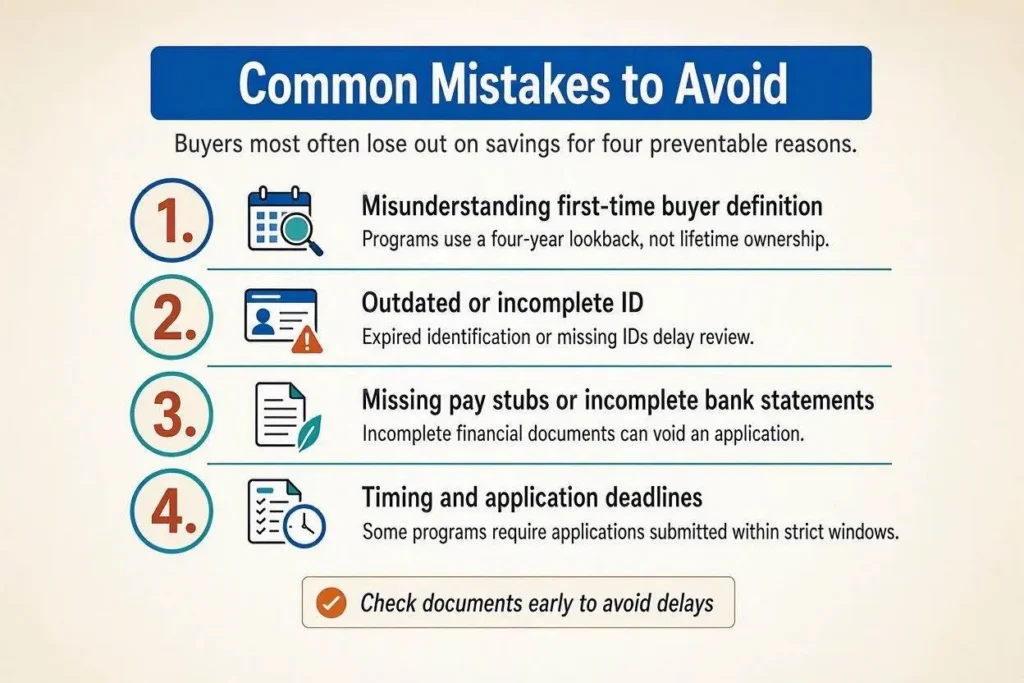
Buyers most often lose out on savings for four preventable reasons.
The biggest one is misunderstanding the first-time buyer definition itself. Plenty of applicants assume it means “never owned property, ever,” when the real rule is a four-year lookback. Outdated ID, an incomplete bank statement, a missing pay stub: any of these can delay or outright void an application at the review stage. Timing trips people up too. Some programs need an application before an offer goes in, others only after, and getting that order backward forfeits the benefit even when everything else checks out. And a lot of buyers assume their incentive covers a rental or investment property. It almost never does. Nearly every program on this list requires the home to be a principal residence.
Conclusion
A first time home buyer incentive in Canada rarely comes from just one source. It comes from stacking federal, provincial, and sometimes municipal programs together. The HBP, FHSA, and Home Buyers’ Amount form the federal foundation. Land transfer rebates, tax credits, and forgivable loans then vary sharply depending on the province and city. The FTHBI is gone, full stop, and any source still describing it as active is out of date. Buyers who check eligibility early, gather their documentation ahead of time, and apply within each program’s specific window put themselves in the best position to capture everything they’re entitled to in 2026.
FAQs

Michael Reynolds
Michael Reynolds leads ImmigrationWin’s immigration, visa, and global mobility content division. He specializes in researching immigration policies, visa requirements, application processes, and international relocation pathways for individuals, families, students, and professionals. With extensive experience analyzing immigration regulations and official government guidance, Michael brings a research-driven approach to complex immigration topics and changing visa policies. He is the primary author of ImmigrationWin’s visa guides, immigration resources, and country-specific content, helping readers better understand their options and make informed decisions about their international journey.
Related Posts