
How to Sell a House in Canada: Complete Step-by-Step Guide
Selling a house in Canada breaks down into seven moves: price it right, decide whether you want an agent or you’re going FSBO, get the property show-ready, list it on MLS®, sort through the offers that come in, negotiate, and close with a real estate lawyer. Most homes that are priced well sell within 30 days, though once you factor in the conditional period, the full run from listing to closing usually takes 60 to 90 days. A full-service agent will cost you 3.5% to 6% of the sale price in commission; sell privately through a flat-fee MLS listing and you’re looking at $299 to $999 CAD instead. Here’s how the whole process actually plays out, from your first pricing decision to signing on closing day.
What Does It Cost to Sell a House in Canada?
Budget 3.5% to 6% of the sale price for agent commission, another $500 to $1,500 CAD in legal fees, and whatever your lender charges to discharge the mortgage. Sell privately instead of through a full-service agent (more on that trade-off below) and you can often get the whole thing done for under $1,000 CAD, since there’s no seller’s agent commission to pay.
A few costs show up in almost every deal:
- Real estate commission, usually split between the buyer’s and seller’s agents
- Legal fees for the lawyer handling your closing
- Mortgage discharge fee from your lender
- A prepayment penalty, if you’re selling before your mortgage term is up
- Home inspection, typically $300 to $600 CAD
- Staging, anywhere from a $300 consultation to $2,000+ CAD for full furniture rental
- Moving costs, which depend entirely on distance and how much you’re hauling
Sell a $700,000 home through a full-service agent at 5% commission and you’re paying $35,000, split roughly evenly between the two agents. GST or HST doesn’t usually apply to a resale home itself, but it does apply to the commission in most provinces. If you’re in Alberta, no provincial sales tax means your effective cost is a bit lower than what you’d pay in Ontario or BC.
Should You Sell Privately or Hire a Real Estate Agent?

For most people, an agent is worth it. They know the local comps, they’ve got marketing reach you don’t, and they negotiate for a living. But if you’ve got time on your hands, a good read on your local market, and maybe a buyer already in mind, FSBO can save you 2% to 3% in commission.
Agents earn their fee in three ways. They price using real comparable-sales data instead of a guess. They handle the showings, the paperwork, and the back-and-forth with buyer agents, which eats up more time than most sellers expect. And because they negotiate offers all day every day rather than once a decade, they’re simply better at it than a first-time seller will be.
Going FSBO means keeping more of the sale price, but it also means doing real work for it. Only licensed brokerages can post directly to MLS®, so private sellers pay for a “mere posting” or flat-fee service instead, usually $299 to $999 CAD depending on the province. That gets your listing on REALTOR.ca while you keep the right to sell without paying a seller’s agent. Most FSBO sellers still offer 2% to 2.5% to the buyer’s agent, since skipping that tends to tank buyer interest fast.
How to Price Your Home Correctly
Base your price on a comparative market analysis (CMA), built from three to five similar homes that recently sold nearby, not on what you paid for the house or what you spent renovating it. In a seller’s market, price at or just below fair value and let competing offers push it up. In a slower market with more inventory, price closer to full value so you don’t come across as desperate.
A professional appraisal can add a useful data point, especially for a unique property without close comparables. And buyers respond to psychology as much as math: a listing at $599,900 pulls more search traffic than one at $605,000, because plenty of buyers filter by round-number price brackets. Overpricing has a real cost too. A home that sits for 60-plus days often ends up selling for less than it would have with the right price from day one, simply because buyers start wondering what’s wrong with it.
The Step-by-Step Process for How to Sell a House in Canada
- Research comparable sales and set a competitive asking price.
- Choose between a full-service agent, a discount brokerage, or FSBO.
- Declutter, repair, and stage the property for showings.
- List the home on MLS® and market it across online platforms.
- Review incoming offers for price, deposit, and conditions.
- Negotiate counteroffers until both sides agree.
- Close with a real estate lawyer handling the paperwork.
Skip or rush any one of these and the timeline tends to stretch, not shrink.
Step five deserves extra attention. Every offer comes with a purchase price, a deposit, and a set of conditions, often financing approval, a home inspection, or the sale of the buyer’s own place. A conditional offer lets the buyer walk if a condition isn’t met by the deadline, so read those deadlines as closely as the price itself. Once you accept, the deal sits as “sold conditional” until every condition has been waived in writing.
From there, closing is largely your lawyer’s job. They run a title search, put together the statement of adjustments to prorate taxes and utilities, pay out your mortgage, and register the transfer of title. Keys don’t change hands until the lawyer confirms the funds have actually landed.
What Taxes Apply When You Sell a House in Canada
If the home was your primary residence for every year you owned it, the principal residence exemption means no capital gains tax on the sale. If you rented out part of it, or used it to earn income, you’ll need to report that portion and pay capital gains tax on it.
Non-residents play by a different set of rules entirely. Canada withholds 25% of the gross sale price up front, and that money only comes back once the CRA has confirmed what’s actually owed. Add the Underused Housing Tax (UHT) or a provincial Non-Resident Speculation Tax (NRST) to the mix, and foreign owners have even more to report. If that’s you, a cross-border tax accountant is worth the fee. Penalties for a missed filing can easily outstrip the tax itself.
What Documents Do You Need to Sell a House in Canada?
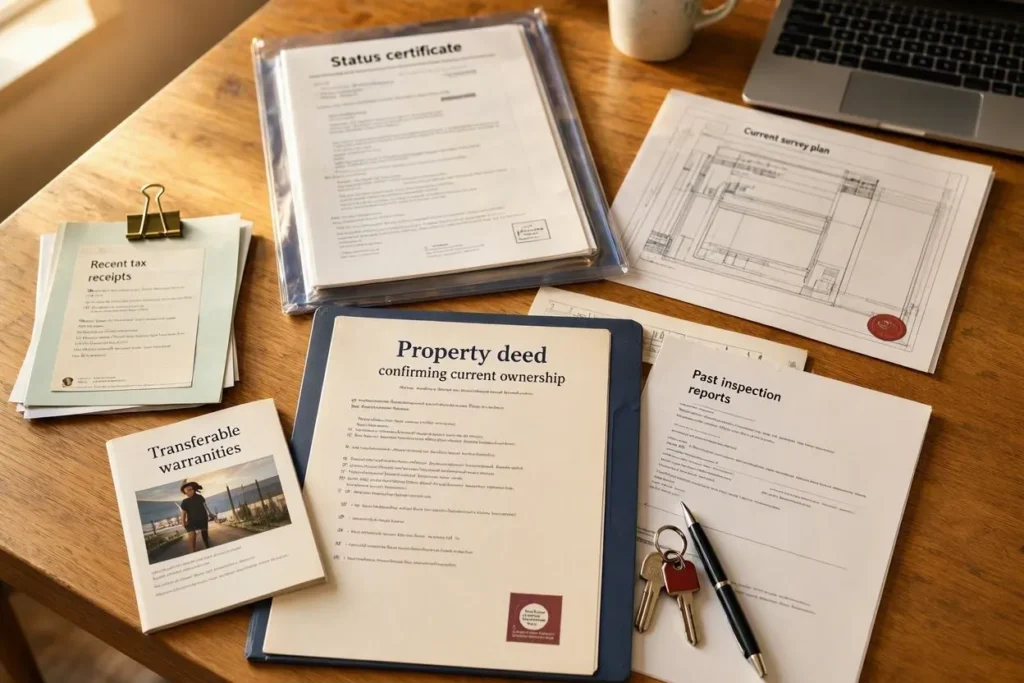
Before you sign a listing agreement, get your hands on the property deed, a current survey plan, recent tax receipts, transferable warranties, and any past inspection reports. Selling a condo? Add the status certificate, or the equivalent strata documents, since no buyer’s lawyer will close the file without them.
Round these up early instead of scrambling once an offer lands:
- Property deed confirming current ownership
- Survey plan outlining lot boundaries and structures
- Property tax receipts from the past 12 months
- Mortgage statement showing the current payout balance
- Renovation permits and contractor invoices for major work
- Transferable warranties on roofing, windows, or major systems
- Recent inspection reports, if any exist
An Ontario seller without an original survey plan often ends up paying $1,000 to $2,000 CAD for a new one mid-transaction, a cost that a quick document search before listing would have avoided entirely. Missing paperwork rarely kills a deal outright, but it does add days right when buyers expect things to move fastest.
What If You’re a US Resident Selling a House in Canada?
The process looks the same as it does for a Canadian seller, with one big exception: a mandatory 25% non-resident withholding tax collected at closing. File a Section 116 clearance certificate with the CRA before closing, though, and that withholding can often be reduced to match your actual capital gain instead of the full sale price.
This catches a lot of US sellers off guard. Sell a $500,000 CAD Vancouver condo without a clearance certificate and you’ll see $125,000 CAD withheld right away, refunded only once the CRA finishes processing your final return, which can take several months. The Canada-US tax treaty keeps you from being taxed twice on the same gain, but you’ll still need to file in both countries and claim a foreign tax credit on the US side.
Three things help. Hire a Canadian real estate lawyer who’s actually handled cross-border deals before, since not every provincial lawyer deals with non-resident withholding on a regular basis. Bring in an accountant who understands both CRA and IRS rules before you list, not after an offer shows up. And keep an eye on the CAD-to-USD exchange rate, because currency swings between listing and closing can shift your net proceeds by thousands of dollars.
How Provincial Rules Affect Your Sale
Closing costs, cooling-off periods, and disclosure requirements all shift depending on the province. Ontario, for instance, introduced a mandatory 10-day Home Buyer Rescission Period (HBRP) in 2023 for freehold homes, which sellers now need to factor in when picking a firm closing date.
Land transfer tax rates vary by province and sometimes by city. Toronto stacks a municipal land transfer tax on top of the provincial one. Condo sales bring their own paperwork depending on where you are: a status certificate in Ontario, Form B plus strata documents in BC, a similar package in Alberta. Order these early and you’ll dodge the last-minute delays that push back an otherwise firm closing date.
How Long Does It Take to Sell a House in Canada?
A well-priced house usually sells within 30 days. The full process, listing to closed sale, runs 60 to 90 days once you include the conditional period. Cross 90 days without an accepted offer and buyers stop seeing that as a coincidence.
A few things move that timeline. Season matters: spring and early fall bring noticeably more buyer activity than the dead of winter. Local inventory matters just as much, since a shortage of listings in a neighborhood shortens days on market while a glut stretches it out. And property type plays a role too. Move-in-ready homes in good school zones sell faster than ones that need real work.
How to Prepare and Market Your Home
Declutter, knock out the minor repairs, and hire a professional photographer before the listing goes live. If there’s room in the budget for one more thing, make it staging. Staged homes tend to sell closer to, or above, asking price compared to homes that aren’t.
Listings with professional photos tend to sell noticeably faster than ones without, and spend less time sitting on the market. Four rooms do most of the work during a showing: kitchen, primary bedroom, living room, and the entryway that forms a buyer’s first impression before they’ve even taken their shoes off. A pre-listing inspection catches problems while you still have time to fix them or disclose them, rather than letting a buyer’s inspector find them first and use it as leverage on price.
Marketing doesn’t stop at MLS®. Open houses, virtual tours, and targeted social promotion all widen the pool of people who see the listing. Sellers who rely on phone snapshots instead of professional photos routinely see fewer showings in that first week, which is exactly when buyer interest is highest.
How to Negotiate Offers and Close the Deal
Weigh price, deposit size, conditions, and closing date together, not price alone. If two offers land at similar numbers, the one with fewer conditions and a bigger deposit is usually the safer bet, since it’s less likely to fall apart.
A larger deposit is a signal of a serious buyer, though Canada has no standard minimum deposit nationwide. Read the inclusions and exclusions carefully too. Appliances, window coverings, and fixtures should all be spelled out so nothing disappears before possession day. Some sellers open to creative financing offer a vendor take-back mortgage (VTB), financing part of the sale price themselves, which can bring in buyers who fall just short of full bank approval.
Closing day itself tends to be pretty uneventful if everything before it went smoothly. Funds move, your lawyer registers the new title, and the keys change hands once the transaction is confirmed.
Common Mistakes That Slow Down a Sale
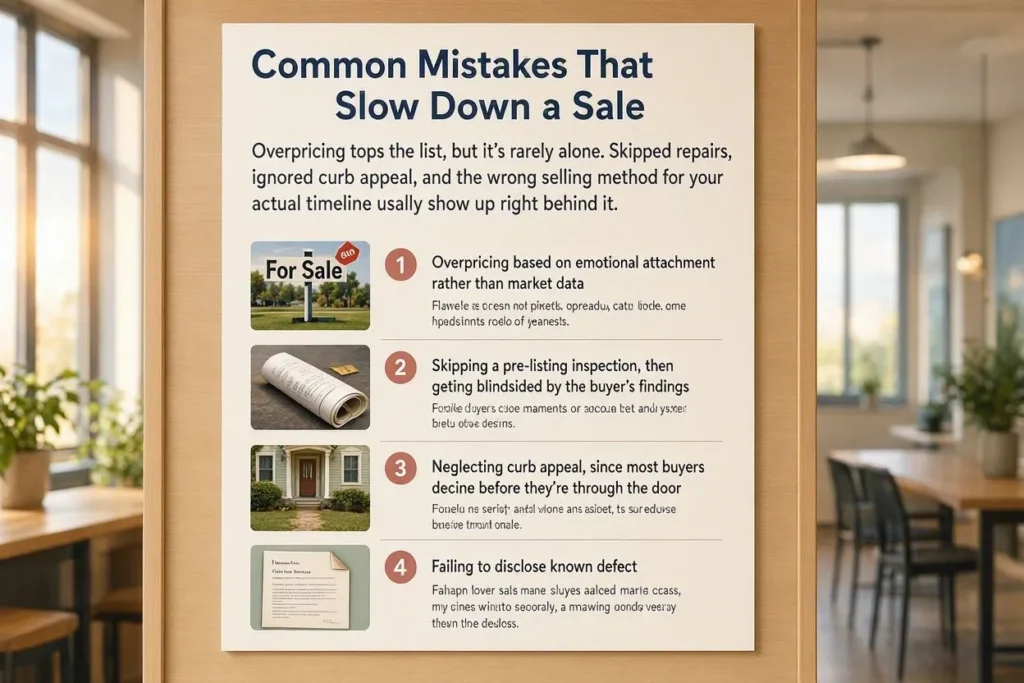
Overpricing tops the list, but it’s rarely alone. Skipped repairs, ignored curb appeal, and the wrong selling method for your actual timeline usually show up right behind it.
- Overpricing based on emotional attachment rather than market data
- Skipping a pre-listing inspection, then getting blindsided by the buyer’s findings
- Neglecting curb appeal, since most buyers decide before they’re through the door
- Failing to disclose known defects, which opens you up to legal exposure after closing
- Setting a closing date that clashes with the buyer’s financing timeline
- Choosing FSBO without the time or experience it actually demands
Every one of these does the same thing: it adds days on market, and extra days on market almost always mean a lower final price than getting it right the first time would have.
Conclusion
It really comes down to five decisions: price it accurately, pick the right selling method, prepare it properly, review offers carefully, and get a lawyer who closes cleanly. Sellers who nail the price in the first two weeks consistently do better than the ones who chase the market down after a slow start. A $700,000 home priced right on day one and a $700,000 home that sits for 90 days before a price cut don’t usually end up at the same number. That gap is almost always the avoidable kind.
FAQs

Michael Reynolds
Michael Reynolds leads ImmigrationWin’s immigration, visa, and global mobility content division. He specializes in researching immigration policies, visa requirements, application processes, and international relocation pathways for individuals, families, students, and professionals. With extensive experience analyzing immigration regulations and official government guidance, Michael brings a research-driven approach to complex immigration topics and changing visa policies. He is the primary author of ImmigrationWin’s visa guides, immigration resources, and country-specific content, helping readers better understand their options and make informed decisions about their international journey.
Related Posts