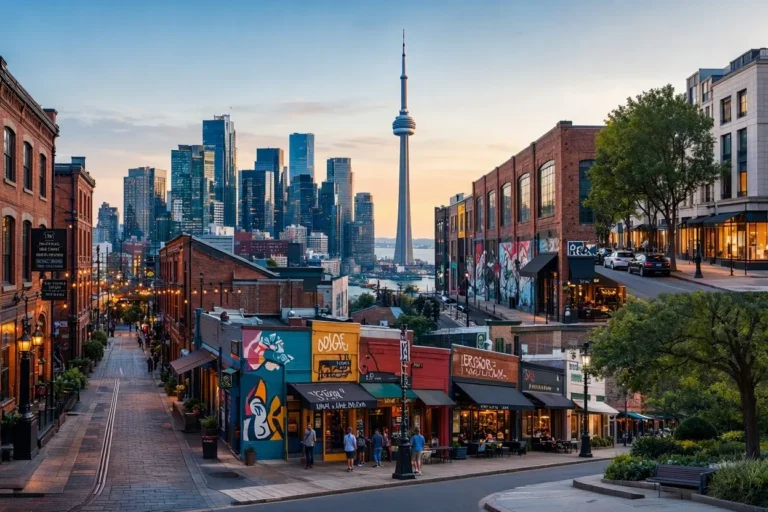
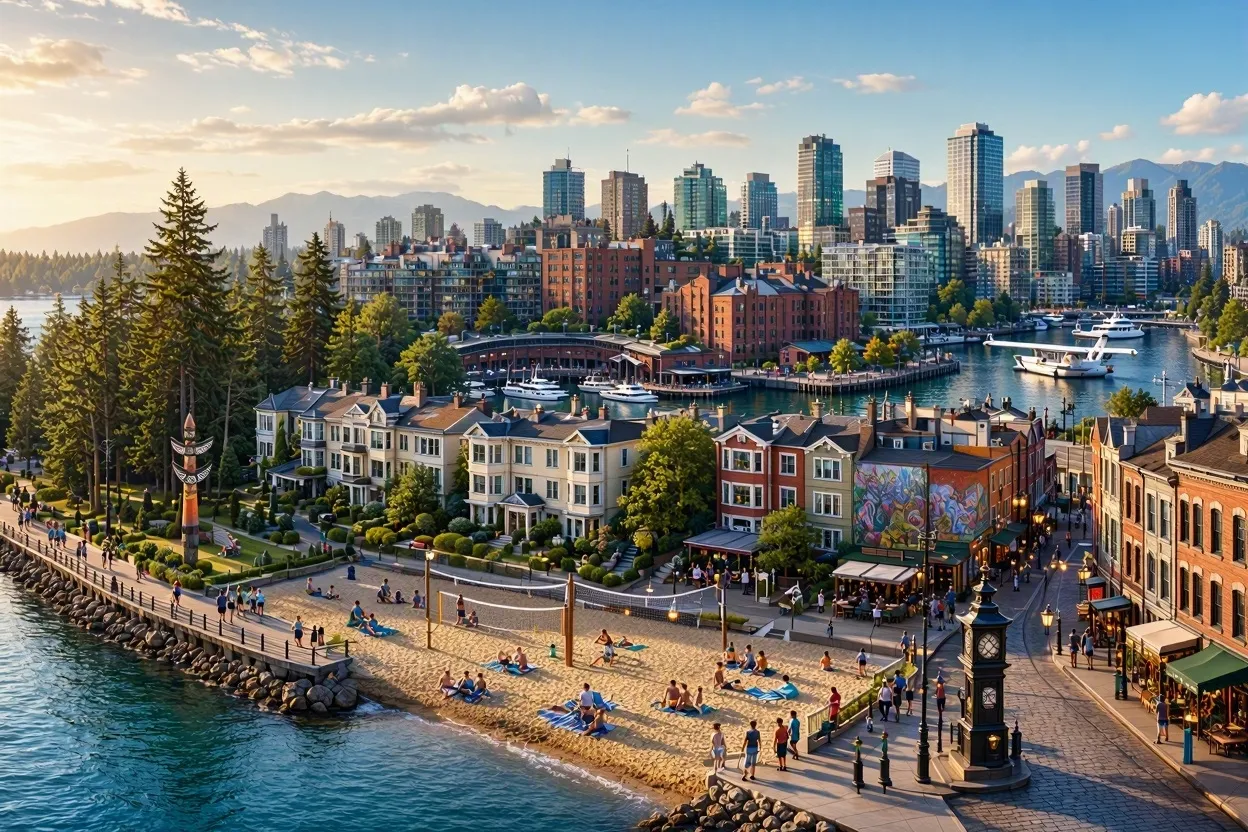
Best Neighborhoods in Vancouver: A Local Buyer’s Guide
There’s no single answer to “what’s the best neighborhood in Vancouver,” because Vancouver isn’t one housing market. It’s roughly 30 distinct neighbourhoods stitched together, each with its own price band, transit access, and personality, and picking the wrong one costs a lot more than a bad commute.
Kitsilano and Kerrisdale suit families who want space and school access. Yaletown and Coal Harbour suit people who want to walk everywhere and wake up to a skyline view. Mount Pleasant is for anyone chasing value without leaving the city core. A young professional relocating from Seattle wants something entirely different from a family of four moving out of Chicago, and this guide to where to live in Vancouver breaks down where each type of buyer or renter actually lands, whether you’re comparing Vancouver condos for sale, hunting for affordable neighbourhoods in Vancouver, or just trying to figure out Vancouver rent prices before you sign a lease. (Worth a mention up front: the city sits on the unceded territories of the Musqueam, Squamish, and Tsleil-Waututh Nations, part of why so many of these areas still feel like distinct villages rather than interchangeable postal codes.)
Vancouver Neighborhoods by Price Point
Condo entry prices range from about $600,000 in Main Street and Mount Pleasant up to $1.5 million or more in Coal Harbour. West Side detached benchmarks climb past $2 million in Kitsilano and beyond $4 million in Shaughnessy. City-core condo pricing typically runs $900 to $1,200 per square foot, while outer Metro Vancouver markets like Richmond and Surrey sit closer to $550 to $800 per square foot. SkyTrain access adds a real premium to condo pricing in most corridors, too.
| Neighborhood | Entry Price (CAD) | SkyTrain? |
| West End | $600K–$750K condo | No |
| Yaletown | $750K–$1.1M condo | Yes |
| Coal Harbour | $900K–$1.5M+ condo | Nearby |
| Gastown | $650K–$900K condo | Yes |
| Kitsilano | $2M+ detached | No |
| Kerrisdale | $2.5M+ detached | No |
| Dunbar | ~$3.4M detached | No |
| Shaughnessy | $4M+ detached | No |
| Mount Pleasant | $650K–$850K condo | Yes |
| Commercial Drive | $650K–$800K condo | Yes |
| Main Street | $600K–$800K condo | Nearby |
| Collingwood | ~$550K condo | Yes |
| Renfrew-Collingwood | Under $700K entry | Yes |
These figures reflect GVR and CREA benchmark data as of mid-to-late 2026. Treat this as a starting range, not a quote. Building age, view, unit size, and strata fees all move the number, sometimes by a lot.
What Are the Best Neighborhoods in Vancouver Right Now?
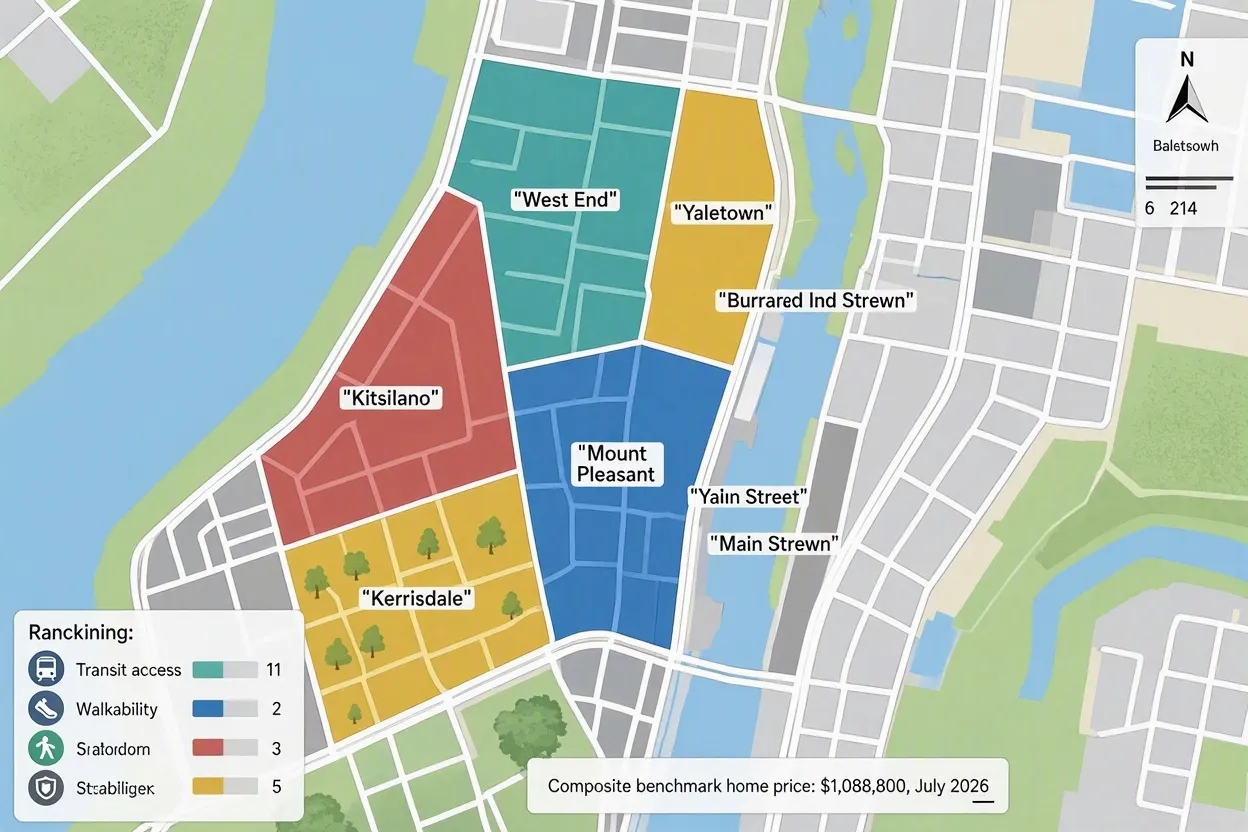
If you want a shortlist: West End, Kitsilano, Mount Pleasant, Yaletown, and Kerrisdale. They rank as the five strongest all-around picks in the city based on transit access, walkability, and price stability.
Greater Vancouver’s composite benchmark home price sat at $1,088,800 in July 2026, according to Greater Vancouver REALTORS® (GVR) data reported through the Canadian Real Estate Association (CREA). Condo apartments carried a benchmark of $688,000 citywide, while detached homes averaged $1,822,900. Those three numbers explain most of the neighborhood math in this guide to the Vancouver housing market: neighbourhoods built around detached housing stock, think Shaughnessy, Dunbar, Kerrisdale, sit well above the citywide benchmark, while condo-heavy areas like the West End, Mount Pleasant, and Downtown sit closer to or below it.
Four things separate a strong pick from a weak one:
- Vancouver walkability. In Walk Score’s original Canada-wide city ranking, Vancouver posted a 78, “very walkable,” ahead of Seattle and Portland on the same scale at the time. At the neighbourhood level, current Walk Score data has West End (95), Fairview (93), and Kitsilano (92) all rated a “Walker’s Paradise,” where daily errands don’t require a car.
- Vancouver SkyTrain access. The Expo, Millennium, and Canada Lines add measurable resale value to condos within a 10-minute walk of a station, and Transit Score follows the same pattern: West End scores 89 and Kensington-Cedar Cottage (further east, covered below) scores 73 despite much lower home prices.
- School catchment quality. West Side buyers pay a real premium for catchments like Point Grey Secondary and Prince of Wales Secondary. Catchment strength drives family decisions specifically in that part of the city, which is why Vancouver school catchments are worth confirming block by block, not neighbourhood by neighbourhood.
- Bike Score. Vancouver rewards two-wheeled commuting almost as much as walking. Strathcona (91), Kitsilano (90), and South Cambie (88) all rank as a biker’s paradise, where daily errands can be handled on a bike lane network rather than a car.
Downtown Core Neighbourhoods
Downtown Vancouver isn’t a single neighbourhood. Several distinct pockets sit inside the peninsula, West End, Yaletown, Coal Harbour, Gastown, and Chinatown, and each one serves a different kind of buyer. The core is also home to BC Place and Rogers Arena, the shopping strip along Robson Street and Pacific Centre Mall, and the False Creek Seawall that ties the whole peninsula together on foot or by bike.
West End
If you want walkability without paying Yaletown or Coal Harbour prices, this is your neighbourhood, and Walk Score backs that up: West End posts a 95 Walk Score, a 89 Transit Score, and an 84 Bike Score, making it the single most walkable neighbourhood in the city. Bordered by Stanley Park, English Bay, and Sunset Beach, the West End holds a mix of older high-rise condos, low-rise walk-up apartments, and heritage rental stock. Davie Village, Vancouver’s LGBTQ+ commercial strip, runs through the neighbourhood’s core along Davie Street, and Denman Street carries one of the city’s most international restaurant rows in a few short blocks.
The catch: no SkyTrain station of its own. Residents rely on bus routes or a 15-to-20-minute walk into the downtown core. That gap is exactly why prices sit below Yaletown’s, which makes the West End a common landing spot for renters, retirees, and first-time condo buyers. One-bedroom unfurnished rents in the West End averaged around $2,396 a month as of spring 2026, down noticeably from the year before, and citywide asking rents kept easing into summer.
Yaletown
Yaletown is for people who want polished dining, direct Canada Line access, and a seawall walk along False Creek. Converted rail-yard warehouses now house restaurants and lofts, and newer glass high-rise condo towers line Mainland and Hamilton Streets. Yaletown-Roundhouse Station gets you to Vancouver International Airport (YVR) in under 30 minutes, which matters more than people expect once they’re actually living there.
Two-bedroom condos here typically list above the citywide $688,000 apartment benchmark. That’s the premium you pay for the location.
Coal Harbour
Water views and proximity to the Vancouver Convention Centre. That’s Coal Harbour, full stop, and it’s why buyers pick it over neighbourhood character. The area sits between downtown and Stanley Park, and its high-rise towers house a mix of retirees, executives, and short-term corporate tenants. Coal Harbour carries some of the highest per-square-foot condo pricing in the city, and that premium buys direct seawall access plus a five-minute walk to Waterfront Station.
Gastown and Chinatown
Gastown fits buyers drawn to heritage architecture and nightlife over quiet residential streets. It’s Vancouver’s oldest neighbourhood, dating to 1867, and it mixes cobblestone blocks and Victorian-era brick buildings with a dense concentration of restaurants and bars. Immediately south, Chinatown carries its own heritage designation and a wave of newer restaurants and residential infill alongside the original produce markets and family associations. One thing worth knowing before you tour either area: both border the Downtown Eastside (DTES) along East Hastings Street, so walk the western blocks near Waterfront Station before assuming the whole neighbourhood shares the same character.
West Side Neighbourhoods for Families and Long-Term Value
Vancouver’s West Side holds the city’s highest-priced detached housing stock, along with its strongest school catchments and lowest crime rates.
Kitsilano
Beach access without leaving the city. Kitsilano Beach anchors the neighbourhood, and West 4th Avenue carries the main commercial strip of boutique shops and health-focused restaurants. Kitsilano posts a 92 Walk Score and a 90 Bike Score, a biker’s paradise even without direct SkyTrain service, so residents depend on buses or a 15-minute ride into downtown instead. Detached single-family homes here routinely exceed $2 million, though renters can still find shared houses starting around $1,000 per room per month, one of the better deals left on the West Side. One-bedroom unfurnished rents averaged roughly $2,171 a month as of spring 2026, well below the citywide premium areas.
West Point Grey and UBC
West Point Grey and the University of British Columbia (UBC) campus area sit at the far western tip of the peninsula, closest to Spanish Banks, Wreck Beach, and Jericho Beach, and closest to the Museum of Anthropology on the UBC grounds. Despite falling rents almost everywhere else in the city, West Point Grey / UBC held the highest one-bedroom rents in Metro Vancouver as of spring 2026, averaging close to $2,790 a month, driven by proximity to campus and a tight supply of purpose-built student housing. Heritage homes and newer duplexes dominate West Point Grey itself, while UBC’s own neighbourhoods, like Wesbrook Village, lean toward condo and townhome rentals aimed at faculty, grad students, and young professionals.
Fairview and South Cambie
Fairview and South Cambie sit between the West Side and downtown, and Walk Score rates both among the city’s most pedestrian-friendly: Fairview scores a 93 Walk Score, second in the city, and South Cambie scores 82. Fairview’s Granville Island market anchors the area’s south shore, while South Cambie sits along the Cambie Street corridor with easier Canada Line access than most of the West Side proper. Expect a mix of low-rise apartments, townhomes, and older single-family homes converted into basement suites.
Cambie and Oakridge
The wider Cambie corridor, running through Oakridge, has absorbed a wave of new high-rise condo development tied to Canada Line rezoning and the redevelopment of Oakridge Centre into a mixed-use retail and residential hub. It’s a practical pick for buyers who want new construction and Canada Line access without West Side prices, though inventory still leans toward larger family-sized units than studios.
Arbutus Ridge, MacKenzie Heights, and Quilchena
These three small, quiet enclaves sit between Kitsilano and Kerrisdale, and they trade walkability for privacy: Arbutus Ridge posts a 71 Walk Score and an 84 Bike Score, respectable but well below the downtown peninsula. Detached single-family homes dominate all three, aimed at established families and empty nesters who already know the West Side and want a specific street, not a specific price point.
Kerrisdale
A quieter, village-style commercial strip with strong school access, centered along 41st Avenue. The neighbourhood mixes older detached homes with newer condo towers aimed at retirees, and it posts a 65 Walk Score, “somewhat walkable,” alongside an 80 Bike Score. Kerrisdale sits a 15-to-20-minute bus ride from Kitsilano and roughly 25 to 30 minutes from downtown by transit.
Dunbar
Dunbar is for families who care more about school catchment quality and low turnover than walkability to downtown. The neighbourhood has held its character for decades, anchored by the Dunbar Theatre and Stong’s grocery store. Detached benchmark pricing on the West Side, Dunbar included, sits near $3.4 million as of September 2026, well above the citywide detached average of $1,822,900.
Shaughnessy
Shaughnessy has the largest lots and the most protected housing stock in the city. A 1922 zoning designation still restricts teardowns of historic homes in First Shaughnessy, and that’s kept the tree canopy and architecture intact in a way few other Vancouver neighbourhoods can match. Half-acre lots aren’t unusual here. That scarcity alone puts Shaughnessy among the highest price points in Greater Vancouver, and among the lowest crime rates.
South Vancouver, Southlands, and S.W. Marine
South of Kerrisdale and Dunbar, the Southlands and S.W. Marine pockets hold onto a semi-rural character, complete with riding stables and larger acreage lots, that’s disappeared almost everywhere else inside city limits. Broader South Vancouver, further east, mixes older single-family homes with a growing number of duplexes and laneway houses under BC’s new provincewide zoning rules, and it remains one of the more affordable ways onto the West Side property ladder.
East Side Neighbourhoods for Value and Culture
East Vancouver trades some of the West Side’s polish for lower prices and a stronger concentration of independent businesses, and it holds most of the city’s remaining affordable neighbourhoods.
Mount Pleasant
One of the strongest value-to-location trade-offs on the east side. Mount Pleasant sits along the Canada Line and Broadway corridor, and Olympic Village, built for 2010 athlete housing, now anchors its southern edge with waterfront condos along False Creek. You can walk to a dozen breweries, a farmers market, and a SkyTrain station without crossing a major arterial road.
Commercial Drive (Grandview-Woodland)
Known locally as “The Drive,” this is the neighbourhood for buyers who want a walkable, multicultural commercial strip with real community ties. The street runs through Grandview-Woodland and carries Italian coffee bars, Latin American groceries, and East African restaurants side by side, all within reach of Trout Lake and its farmers market. Grandview-Woodland posts an 88 Walk Score, and the Commercial-Broadway SkyTrain station serves two lines, giving the area unusually strong transit access for its price point.
Riley Park and Kensington-Cedar Cottage
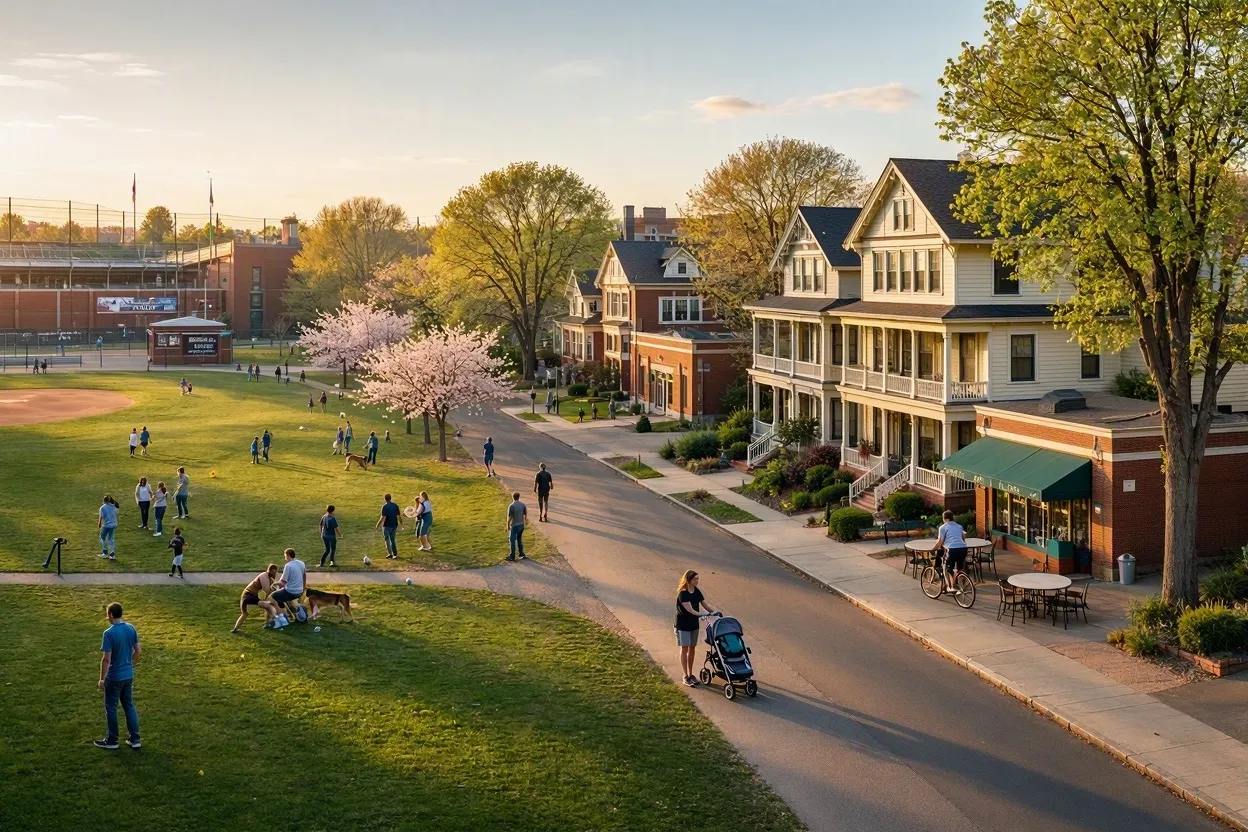
Riley Park, home to Queen Elizabeth Park and Nat Bailey Stadium, posts an 86 Walk Score, the sixth-highest in the city, and offers a lower-cost alternative for families willing to trade some West Side polish for green space and a shorter commute than the far East Side. Neighbouring Kensington-Cedar Cottage scores 80 on the same index and holds one of the East Side’s largest populations, with a housing mix of older single-family homes, basement suites, and rowhouses.
Renfrew-Collingwood, Killarney, Fraser, and Victoria-Fraserview
Collingwood, along the Joyce-Collingwood SkyTrain corridor, is one of the most affordable entry points into the Vancouver housing market: recent MLS-tracked sales put the median sold price near $550,000 and roughly $870 per square foot. The wider Renfrew-Collingwood district posts a 72 Walk Score and an unusually strong 81 Transit Score for its price point, and it’s seen heavy densification near Kingsway and Central Park. Killarney and the Fraser and Fraserview pockets nearby, plus Victoria-Fraserview further south, follow the same pattern: older bungalows, growing basement-suite and duplex stock, and some of the last sub-$700,000 entry points left inside city limits.
Hastings-Sunrise and Champlain Heights
Hastings-Sunrise, along the East Hastings corridor away from the DTES core, posts a 70 Walk Score and mixes character homes with newer infill housing. Champlain Heights, tucked against Fraserview golf course near the Fraser River, is one of the quietest, most suburban-feeling pockets still inside Vancouver city limits, popular with families who want a yard without leaving the city.
Main Street
Independent boutiques and a walkable corridor, minus Yaletown-level pricing. The strip runs from Gastown south through Chinatown and continues into Mount Pleasant, carrying design studios, vintage shops, and family-run restaurants along its length. Rowhouses and low-rise apartments dominate the housing stock here, which is why entry prices stay below the West Side.
Beyond City Limits: North Vancouver, Burnaby, and Richmond
Vancouver proper isn’t the only place people mean when they say “Vancouver.” Several neighbouring cities offer a genuinely different lifestyle within commuting distance.
North Vancouver
North Vancouver, across Burrard Inlet, trades some walkability for mountain access: Grouse Mountain, the Capilano Suspension Bridge, and Lynn Canyon all sit within a short drive, and the SeaBus connects Lonsdale Quay to downtown Vancouver in about 12 minutes. In Walk Score’s original city-level rankings, North Vancouver placed among the most walkable cities in the region outside Vancouver itself, and it’s a common landing spot for buyers who want mountain views without a downtown price tag.
Burnaby
Burnaby’s Brentwood and Metrotown town centres have grown into dense, SkyTrain-connected hubs in their own right, with malls, high-rise condo towers, and increasingly competitive rents: one-bedroom unfurnished units in both areas were averaging just over $2,160 to $2,190 a month as of spring 2026, holding roughly steady rather than falling as fast as the downtown core. Burnaby also scored well ahead of most of the region in that same early Walk Score city ranking, helped by its own SkyTrain-oriented town centre planning.
Richmond and Steveston
Richmond sits on Lulu Island, 15 minutes from downtown Vancouver by Canada Line, and it’s home to YVR itself along with one of the strongest East and Southeast Asian food scenes in North America. Brighouse, Richmond’s downtown core, is the most condo-heavy and transit-connected part of the city, with condo pricing often starting in the high $700,000s. Steveston, at Richmond’s southwest corner, is the historic fishing village: a working harbour, heritage detached homes, and a character commercial strip that feels a world away from Brighouse’s towers, with pricing well above a million dollars for the character-home stock that defines it.
Best Neighborhoods in Vancouver for Investment Property
Back inside city limits, the sharpest investment case right now belongs to Mount Pleasant, Grandview-Woodland, and Marpole, driven by transit-oriented rezoning and unit-count reform. British Columbia’s Bill 44 now permits up to four units on most single-family lots province-wide, and Vancouver’s Broadway Plan has added significant density along the Canada Line corridor. Investor activity in land assembly and multiplex conversion has concentrated in these three areas since the rezoning took effect.
A few numbers matter more to investors than to owner-occupiers. Per current BC strata-fee data, Metro Vancouver strata fees typically run $0.55 to $0.90 per square foot, or roughly $440 to $720 a month on an 800-square-foot condo, and they climb faster in older buildings facing a special levy for roof, plumbing, or building-envelope repairs. Price per square foot varies enormously by corridor: recent listings put it at $900 to $1,200 in the downtown core and West Side, versus $550 to $800 in outer Metro Vancouver markets like Richmond or Surrey. Before running any numbers, check current mortgage rates with a lender such as Scotiabank or a mortgage broker, since Canadian lenders stress-test every borrower against a qualifying rate set above the actual contract rate.
A few costs apply specifically to investment buyers, and they’re easy to miss if you’re used to a U.S. market. British Columbia charges a Speculation and Vacancy Tax of 2% for foreign owners and 0.5% for citizens or permanent residents who leave a home vacant. Vancouver’s Empty Homes Tax, sometimes called the “empty house tax” locally, adds 3% of assessed value on top of that. A Home-Flipping Tax applies to resales within two years, and condo buyers should also budget for strata fees and for the cost of hiring a property management company if the unit will be a rental rather than a primary residence.
Best Neighborhoods in Vancouver for Families
Kitsilano, Kerrisdale, and Dunbar lead the pack among the best Vancouver neighbourhoods for families, based on school catchment strength, park access, and low turnover. Point Grey Secondary and Prince of Wales Secondary both draw families specifically for catchment boundaries, and detached-home pricing in those zones reflects the demand directly. Riley Park and Champlain Heights, on the city’s east-central and southeast sides, offer lower-cost alternatives for families willing to trade some West Side polish for proximity to Queen Elizabeth Park, Nat Bailey Stadium, or a bigger yard.
One thing families relocating from the U.S. should plan around: British Columbia’s Medical Services Plan enrollment doesn’t kick in the moment you arrive, so budget for a gap. School registration also runs on a different calendar than most U.S. districts, and confirming catchment boundaries with the Vancouver School Board before signing a lease or purchase agreement will save you from a mid-year school change.
Renting in Vancouver’s Best Neighborhoods
Renters get the widest selection in the West End, Mount Pleasant, and Commercial Drive, where older building stock keeps monthly rents below the newer glass towers downtown. According to rental platform liv.rent’s monthly Metro Vancouver rent reports, one-bedroom unfurnished units in Downtown Vancouver and the West End were both running in the $2,380-to-$2,400-a-month range as of spring 2026, down noticeably year over year, while West Point Grey and the UBC area held the highest rents in the region at close to $2,790 a month. Kitsilano sat comfortably below both, around $2,170 a month for the same unit type. By mid-2026, Rentals.ca was tracking the broader region’s asking rents still easing further, so treat these as a starting point and check the latest monthly report before you set a budget.
Shared houses in Kitsilano and Commercial Drive offer a lower entry point, from $1,000 a month per room, and basement suites remain one of the more affordable rental formats across the East Side. One practical note: Vancouver landlords still often post paper “For Rent” signs alongside listings on Craigslist, PadMapper, and Kijiji. A completed reference package on day one beats a strong application submitted a week later, every time, especially if a property management company rather than an individual landlord is screening applicants.
Neighborhoods to Approach With Caution
The Downtown Eastside (DTES), centered on East Hastings Street between Carrall and Main, carries the highest concentration of homelessness, addiction, and mental health crisis response in the city. Gastown and Chinatown both border this stretch. If you’re considering either neighbourhood, tour the actual blocks, not the neighbourhood name in general, before committing to anything. Strathcona, immediately east of Chinatown, has seen renewed investment in recent years and now posts one of the city’s highest Walk Scores at 92, though it still shares a border with the same corridor.
And a word on the far suburbs: Surrey and parts of the Fraser Valley offer far lower entry prices and rents (one-bedroom units in areas like Newton or Abbotsford often run $1,500 a month or less), but commute times into the city core can run 45 minutes or more during peak traffic. If your job or lifestyle depends on downtown proximity, the time cost of a cheaper suburb often outweighs what you save on purchase price or rent.
What US Buyers Should Know Before Moving
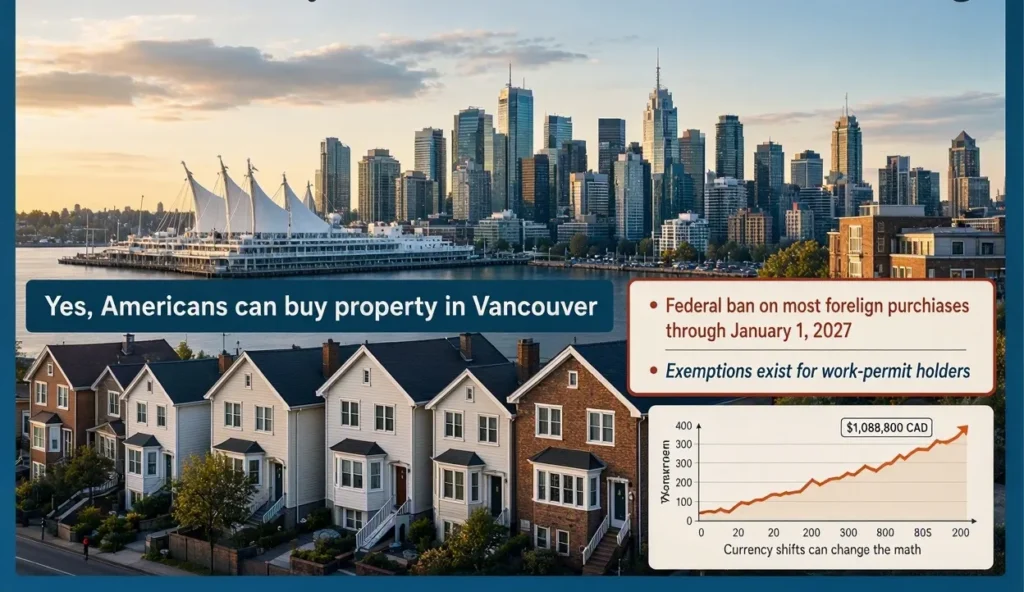
Yes, Americans can buy property in Vancouver. But a federal ban on most foreign purchases of Canadian residential property is still in effect through January 1, 2027, so confirm your status before making an offer. Exemptions exist for work-permit holders and a few other categories, so it’s worth checking rather than assuming.
Currency exchange shifts the math more than most buyers expect. A $1,088,800 CAD benchmark home swings by tens of thousands of dollars in USD depending on the exchange rate at closing. Canadian lenders also stress-test borrowers against a qualifying rate above the actual contract rate, and non-resident buyers often face down payment requirements of 35% or more. Property tax rates run lower than many U.S. states on paper, but the Empty Homes Tax, Speculation and Vacancy Tax, and Home-Flipping Tax described above apply specifically to non-primary-residence buyers, so they can eat into that advantage fast.
How to Choose the Best Neighborhood in Vancouver for Your Situation
Pick your top constraint first, budget, school catchment, or commute, rather than trying to optimize all three at once. You won’t find a neighbourhood that wins on everything.
- Budget-first buyers: a $700,000 condo budget with no car fits Mount Pleasant, Collingwood, or the West End far better than stretching for a West Side detached home.
- School-first families: confirm catchment boundaries with the Vancouver School Board directly. Catchment lines shift, and they don’t always match neighbourhood names.
- Yield-focused investors: prioritize Broadway Plan and transit-oriented development zones over prestige addresses. Density reform, not neighbourhood prestige, is what’s actually driving near-term price movement.
- Newcomers still deciding on a city: compare Vancouver against North Vancouver, Burnaby, and Richmond before locking in city limits. Transit access has narrowed the practical difference more than people expect.
- Before signing anything: walk any shortlisted neighbourhood at two different times of day. A street that feels quiet at 10 a.m. can feel completely different at 11 p.m.
Conclusion
Vancouver rewards buyers and renters who match their priorities to a specific neighbourhood instead of chasing a citywide reputation. A downtown condo near a SkyTrain station is a different life than a detached home on a tree-lined West Side street, or a townhome in Richmond a short Canada Line ride from YVR, and that $1,088,800 citywide benchmark hides a real range, from $550,000 condos in Collingwood to $4 million-plus West Side detached homes in Shaughnessy. Start with your hardest constraint, walk the actual blocks at different times of day, and confirm school catchments, strata fees, or Walk Scores before you sign anything.
FAQs

Michael Reynolds
Michael Reynolds leads ImmigrationWin’s immigration, visa, and global mobility content division. He specializes in researching immigration policies, visa requirements, application processes, and international relocation pathways for individuals, families, students, and professionals. With extensive experience analyzing immigration regulations and official government guidance, Michael brings a research-driven approach to complex immigration topics and changing visa policies. He is the primary author of ImmigrationWin’s visa guides, immigration resources, and country-specific content, helping readers better understand their options and make informed decisions about their international journey.
Related Posts