

Tenant Insurance Toronto: Costs, Coverage and Landlord Rules
Tenant insurance in Downtown Toronto averages $26 per month ($313 per year) and is the home insurance policy renters use to cover their belongings, personal liability and additional living expenses after a fire, flood or break-in. Rates.ca calculated that downtown premium from Q1 2026 home insurance quote data and puts the city-wide average, which includes Scarborough, North York, East York and Etobicoke, at $309 per year. Your actual insurance quote depends on your postal code, building, deductible and claims history.
Most Toronto leases require a tenant insurance policy, so renters usually compare home insurance quotes the week they sign. Below, you’ll find what tenant insurance for Toronto renters actually pays for, how insurance premiums shift between neighbourhoods, and the four coverage gaps that catch policyholders out: condo deductibles, sewer backup, roommates and e-bikes.
What Is Tenant Insurance?
Tenant insurance is a home insurance policy for renters that repairs or replaces your belongings, covers accidental injury or damage you cause to others, and pays for temporary housing after a covered loss. Insurers sell the same home insurance product under the names renters insurance, apartment insurance and contents insurance. Like homeowners insurance, a tenant policy bundles contents coverage, personal liability coverage and additional living expenses coverage. The difference is that your landlord’s home insurance policy protects the building structure, while your tenant policy protects the sofa, laptop and winter coat inside your unit.
Contents Coverage
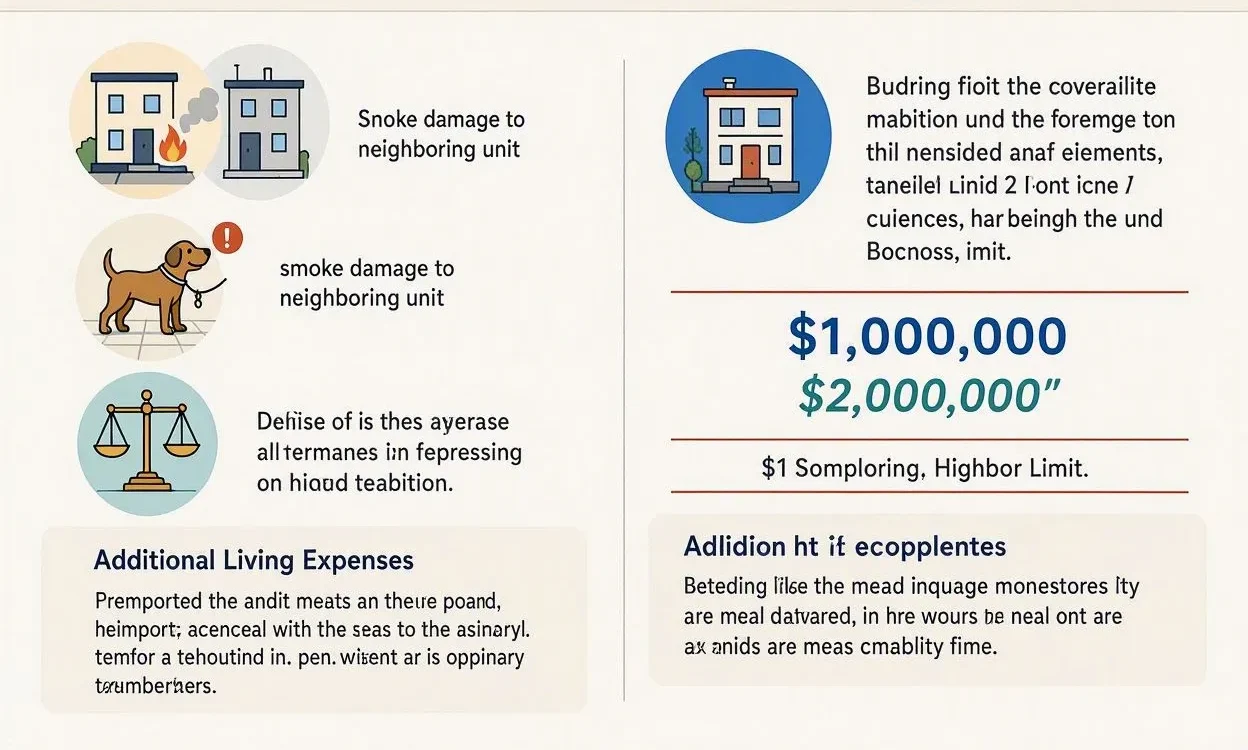
Contents coverage pays to repair or replace personal belongings, such as furniture, electronics, clothing and medication, after theft, fire or another insured peril. Toronto Community Housing puts the average cost to replace everything in a one-bedroom unit at $20,000. Toronto tenant insurance policies typically start at $30,000 in contents coverage, which leaves room for a growing household.
Personal Liability Coverage
Personal liability coverage pays legal fees and damages if you are held responsible for injuring someone or damaging their property. A grease fire that spreads smoke into the unit next door is a liability insurance claim. So is a dog bite in the building lobby. Standard liability limits sit at $1,000,000, and policyholders can raise the limit to $2,000,000 with most insurers for a small added premium.
Additional Living Expenses
Additional living expenses (ALE) coverage pays for a hotel, short-term rental and extra meal costs if a covered loss makes your unit unlivable. Toronto Community Housing pegs a one-night hotel stay at $200, so a 30-day displacement after a building fire costs $6,000 before food. TD Insurance builds its average Ontario home insurance policy for tenants around $15,000 in ALE coverage.
How Much Does Tenant Insurance Cost in Toronto?
Tenant insurance in Downtown Toronto costs an average premium of $313 per year ($26 per month), about 4% above the Ontario average of $302. Rates.ca based those averages on the three lowest insurance quotes for a single test profile: a 40-year-old renter in a 40-year-old duplex with natural gas heat. TD Insurance reports a higher Ontario premium of $364 per year for new customers in affiliated alumni and professional groups as of July 2025, based on $30,000 in contents coverage, a $1,000 deductible, $15,000 in ALE coverage and $1,000,000 in liability coverage.
Real insurance quotes vary more than the averages suggest. On September 18, 2026, Rates.ca’s live tracker showed the cheapest Toronto tenant insurance quotes at $29 per month ($348 per year) for both low-rise and high-rise units, while average quotes ran from $44 to $56 per month ($527 to $677 per year). These live quotes use different profiles than the Q1 2026 averages in the table below, which is why they run higher.
| Area | Average annual premium | Average monthly premium |
| King City (cheapest in the GTA) | $144 | $12 |
| Ajax | $264 | $22 |
| Brampton | $271 | $23 |
| Etobicoke | $297 | $25 |
| Mississauga | $298 | $25 |
| North York | $308 | $26 |
| Scarborough | $310 | $26 |
| Downtown Toronto | $313 | $26 |
| East York | $315 | $26 |
| Orono (most expensive in the GTA) | $322 | $27 |
Why Your Postal Code Changes the Price
Your postal code changes the premium because home insurers rate each forward sortation area (FSA), the first three characters of a postal code, by its local theft, fire and water damage claims. Downtown, tenant insurance premiums range from $293 per year in M5J, the Union Station and waterfront area, to $375 per year in M5E, the St. Lawrence and Esplanade neighbourhood. M6J, which covers Little Portugal and Trinity Bellwoods, averages $339. Two policyholders with identical belongings can pay $82 apart per year based on postal code alone.
What Else Affects Your Premium
Six rating factors outside your postal code drive your tenant insurance premium: building age, claims history, contents value, insurance score, deductible and endorsements.
- Building age: Older buildings with aging plumbing and wiring produce more water damage and fire claims.
- Claims history: Filing more than one insurance claim every three years raises your premium with most insurers.
- Contents value: Insuring $60,000 in belongings costs more than insuring $30,000.
- Insurance score: Ontario home insurers discount premiums for strong credit-based insurance scores, but only after you consent to a check.
- Deductible: A $1,000 deductible produces a lower premium than a $500 deductible.
- Endorsements: Sewer backup coverage, higher liability limits and identity theft coverage each add to the premium.
Can Your Landlord Require Tenant Insurance in Ontario?
No, Ontario law does not require tenant insurance, but a landlord can make a tenant insurance policy a condition of the lease. The Ontario Standard Lease includes a tenant insurance section stating whether coverage is required and at what liability limit, so check your insurance requirements before you sign.
How Much Liability Do Toronto Landlords Ask For?
Toronto landlords typically require $1,000,000 in personal liability coverage. Some condo owners renting out their units ask for $2,000,000 to match the condo corporation’s insurance requirements. A policy below the stated liability limit counts as non-compliant, so match your coverage to the figure in your lease.
How Do You Prove Coverage to Your Landlord?
You prove coverage by sending your landlord the policy declarations page or a certificate of insurance showing your name, rental address, liability limit and policy dates. Ask your insurer to list the landlord as an “additional interest,” which sends the landlord a notice if the insurance policy lapses or gets cancelled.
What Does Tenant Insurance Cover in Toronto?
Tenant insurance covers theft, fire, smoke, burst pipes, vandalism and sudden accidental damage to your belongings, plus personal liability and additional living expenses. Contents coverage follows your belongings off the premises too. A phone stolen from a Queen Street café falls under the same home insurance policy, usually at a reduced off-premises limit.
All-Risks vs. Named Perils Policies
An all-risks policy covers every cause of loss not specifically excluded, while a named perils policy covers only the perils listed in the policy wording. Square One and TD Insurance both sell all-risks tenant insurance policies. Knock a can of paint onto your own rug and an all-risks policy can respond. Under a named perils policy, the same accident goes unpaid unless accidental spills appear on the list of insured perils.
Replacement Cost vs. Actual Cash Value
Replacement cost coverage pays the price of a comparable new item today, while actual cash value coverage pays the depreciated worth of the item you lost. Take a four-year-old laptop that cost $1,800. On an actual cash value basis, the insurer might pay $500; a replacement cost policy pays for a comparable new model. Confirm which settlement basis your policy uses before you buy, because the difference shows up on every claim.
What Does Tenant Insurance Not Cover?
Tenant insurance does not cover the building structure, wear and tear, gradual leaks, pests, illegal activity, or high-value items above the policy’s sub-limits.
- Building structure: Walls, floors and landlord-owned appliances, such as the fridge and stove, belong on the landlord’s home insurance policy.
- Wear and tear: Mould from a slow leak, a sagging mattress and faded furniture fall outside coverage.
- Pests: Bed bugs, mice and cockroaches are excluded under standard policy wording.
- Sewer backup and overland water: Both require separate endorsements.
- Business property above a small limit: Inventory for an online shop or client equipment needs added coverage.
- Items above sub-limits: Jewellery, watches and collectibles carry coverage caps that fall well below their value.
Water Damage and Sewer Backup Coverage for Toronto Renters
Base tenant insurance policies cover sudden water damage, such as a burst pipe or an overflowing dishwasher upstairs, but exclude sewer backup and overland flooding unless you add those endorsements. Toronto’s July 2024 flash floods pushed stormwater and sewage into basements across the city. Policyholders without a sewer backup endorsement paid to replace their own belongings.
Four Types of Water Damage in Tenant Policies
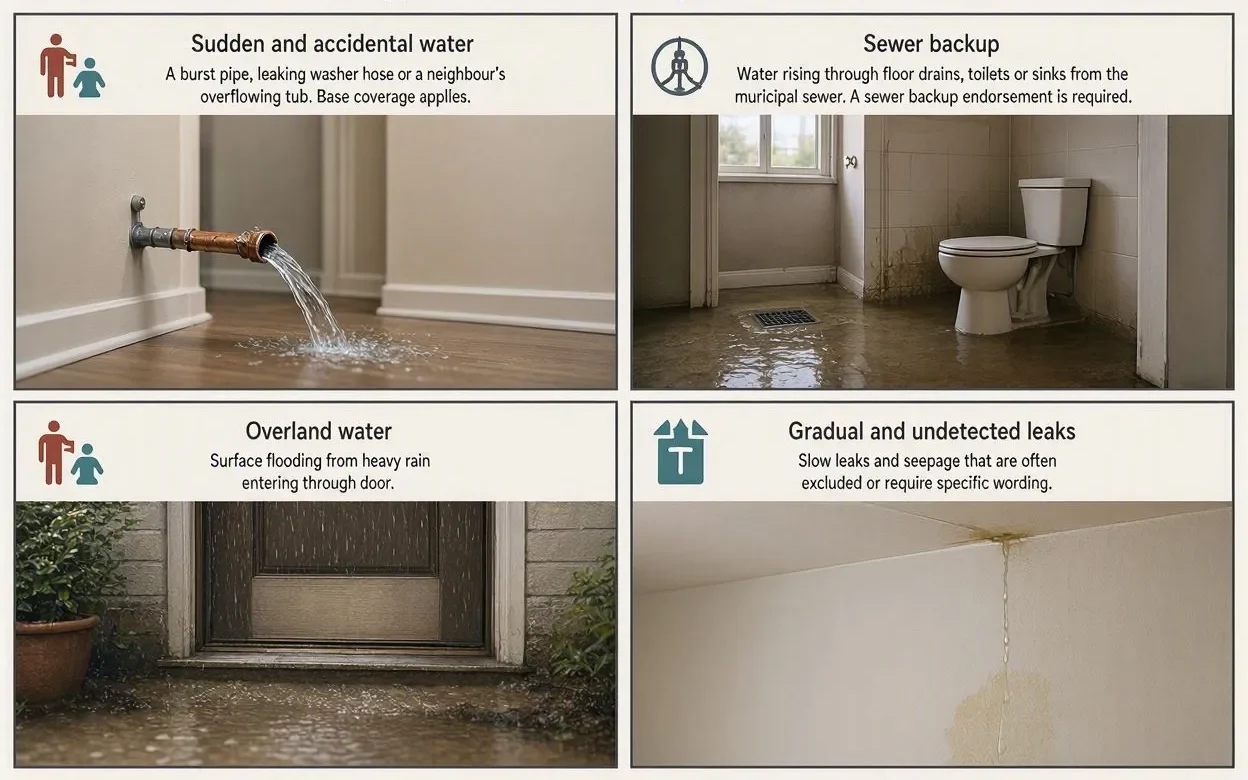
Four types of water damage appear in Canadian tenant insurance policies, and each gets different treatment:
- Sudden and accidental water: A burst pipe, leaking washer hose or a neighbour’s overflowing tub. Base coverage applies.
- Sewer backup: Water rising through floor drains, toilets or sinks from the municipal sewer. A sewer backup endorsement is required.
- Overland water: Surface flooding from heavy rain entering through doors or windows. An overland water endorsement is required.
- Groundwater seepage: Water entering slowly through foundation cracks. Most home insurance policies exclude seepage entirely.
Basement apartment tenants in neighbourhoods like East York, the Junction and parts of Scarborough carry the highest water damage exposure. Get two insurance quotes, one with the sewer backup endorsement and one without, to see the exact premium difference for your unit.
Tenant Insurance for Condo Renters in Toronto
Condo renters need liability coverage that responds to a condo corporation deductible, because the corporation can charge its insurance deductible back to the unit owner when damage starts in the unit, and many Toronto condo leases pass that cost to the tenant. An overflowing bathtub in a 600 sq ft (56 m²) CityPlace unit that soaks three units below can trigger a $25,000 deductible chargeback. Tenant insurance policies in Toronto differ on whether liability coverage pays that chargeback, sometimes listed as loss assessment coverage or condo deductible coverage, so get your insurer’s answer in writing. The unit owner’s condo insurance policy covers only their improvements, flooring and appliances, never your belongings.
Tenant Insurance for Roommates, Students and Newcomers
Roommates, students and newcomers can all buy tenant insurance in Toronto, but each group follows a different coverage rule: unrelated roommates need separate policies, students may have partial coverage under a parent’s home insurance policy, and newcomers can buy coverage without Canadian insurance history. Each situation changes who the policy protects as the named insured, how much contents coverage you need and what your first-year premium costs.
Roommates
Unrelated roommates usually need separate tenant insurance policies, because most insurers cover only the named insured, a spouse and relatives living in the same household. Two friends splitting a two-bedroom in Leslieville each buy their own policy. Separate policies keep one roommate’s insurance claim off the other’s record, and each person picks a contents coverage limit that matches what they own.
Students
Students renting away from home may have limited coverage under a parent’s home insurance policy, often capped at a percentage of the parents’ contents coverage limit. A student near the University of Toronto with a $2,000 laptop, a $1,200 bike and textbooks can quickly exceed that cap. Read the parents’ policy wording first, then buy a separate tenant insurance policy if the student-away coverage falls short.
Newcomers to Canada
Newcomers can buy tenant insurance without Canadian insurance history, although first-year premiums sometimes run higher. Bring a letter from your previous home insurer abroad showing claims-free years. Several Canadian insurers accept foreign insurance history as proof of low risk, which can bring the premium down.
Bikes, E-Bikes, Storage Lockers and High-Value Items
Bikes and E-Bikes
Standard tenant insurance policies cover regular bicycles against theft up to a coverage sub-limit, but many policies exclude e-bikes classified as motorized vehicles. Square One reports that 8% of its policyholders add an endorsement for bicycles and sporting equipment. Ask your insurer whether the policy covers fire damage from a charging lithium-ion battery, since some home insurance wordings treat e-bike batteries differently.
Storage Lockers and Bike Rooms
Belongings in a condo storage locker or building bike room get coverage as off-premises property, often at a reduced limit, such as 10% of your contents coverage. Theft claims from shared bike rooms in Toronto buildings are common. Store high-value gear inside your unit or schedule the items individually on your policy.
Jewellery, Instruments and Art
High-value items need a personal articles floater, a policy endorsement that lists each item and its appraised value. Among Square One policyholders, 18% insure jewellery and watches, 7% insure musical instruments and 6% insure fine art, collectibles or rugs. Expect the insurer to request appraisals for rings, watches and artwork worth several thousand dollars.
How Much Tenant Insurance Do You Need?
A typical Toronto one-bedroom renter needs $30,000 to $50,000 in contents coverage and $1,000,000 to $2,000,000 in liability coverage. Add up your belongings before choosing a coverage limit. A $2,500 sofa set, $3,000 in electronics, $6,000 in clothing and shoes, and $4,000 in kitchenware and small appliances reach $15,500 before counting furniture, books and bedding.
How to Build a Home Inventory
Build a home inventory for your insurance policy in five steps:
- Record a video walk-through of every room, opening closets and drawers.
- List big-ticket items with brand, model and purchase price.
- Save receipts and serial numbers to cloud storage.
- Price each item at today’s replacement cost, not the original price.
- Update the inventory each year at policy renewal.
How to Get Cheaper Tenant Insurance in Toronto
Comparing at least three insurance quotes cuts tenant insurance premiums fastest; Rates.ca found an average gap of $138.16 between the lowest and next-lowest Ontario tenant insurance quotes in 2025.
- Compare home insurance quotes from direct insurers, banks and brokers.
- Bundle tenant and car insurance with one insurer for a multi-policy discount.
- Raise your deductible from $500 to $1,000.
- Buy online; TD Insurance takes 10% off the first policy term outside Quebec.
- Ask about alumni, employer and professional association insurance rates.
- Consent to an insurance score check if your credit is strong.
- Stay claims-free by paying small losses yourself.
How to Make a Tenant Insurance Claim in Toronto
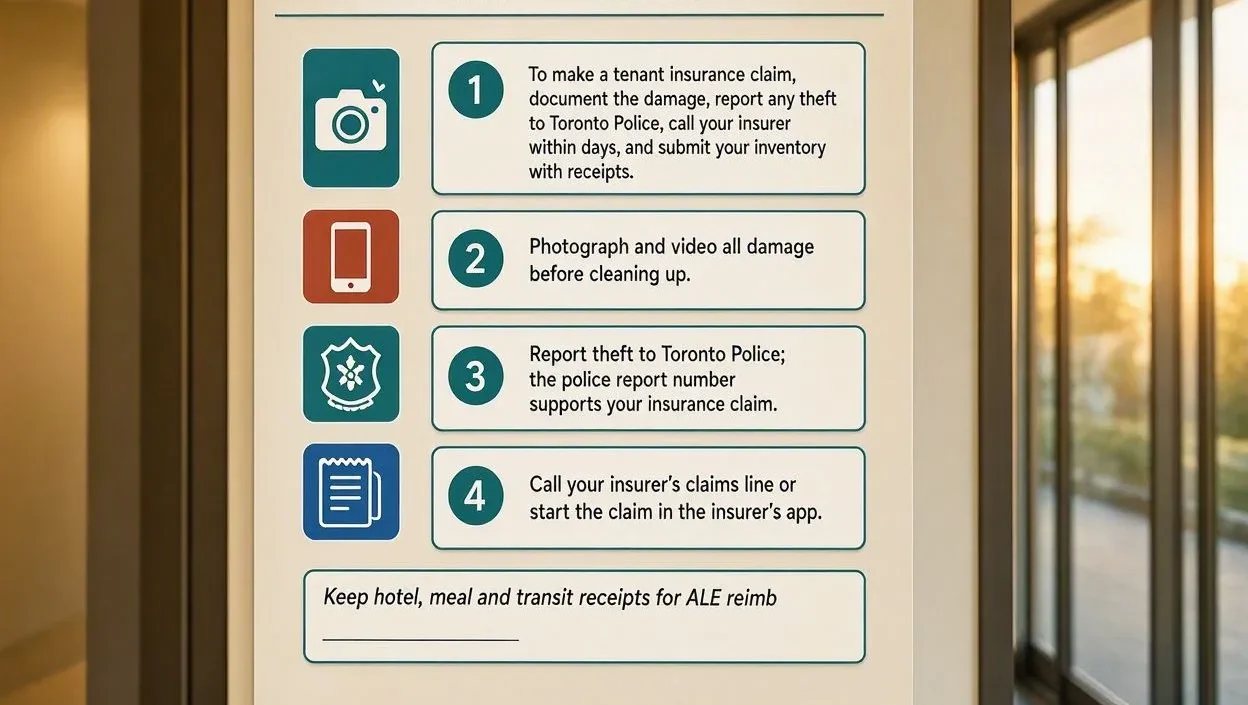
To make a tenant insurance claim, document the damage, report any theft to Toronto Police, call your insurer within days, and submit your inventory with receipts.
- Photograph and video all damage before cleaning up.
- Report theft to Toronto Police; the police report number supports your insurance claim.
- Call your insurer’s claims line or start the claim in the insurer’s app.
- Keep hotel, meal and transit receipts for ALE reimbursement.
- Send your inventory, receipts and the police report number to the insurance adjuster.
Here’s how the math works. A thief takes a $1,400 road bike and a $900 tablet from your unit. With a $500 deductible and replacement cost coverage, the insurer pays $1,800. A loss worth $700 barely clears that same deductible, and the claim on your insurance record can outweigh the $200 payout.
Tenant Insurance Help for Social Housing and Low-Income Renters
Toronto Community Housing (TCHC) leases require tenant insurance, and renters receiving Ontario Works or ODSP may have the insurance premium covered. The Housing Services Corporation (HSC) offers a low-cost tenant insurance program built for social housing residents.
Where to Complain if a Tenant Insurance Claim Stalls
If an insurance claim stalls, escalate to your insurer’s internal complaints officer, then to the General Insurance OmbudService (GIO), a free service for home and auto insurance disputes. Concerns about an insurer’s conduct go to FSRA, Ontario’s insurance regulator.
Conclusion
Tenant insurance is the most affordable form of home insurance in Toronto, yet the coverage gaps in a cheap policy show up only after a loss. Price your policy by postal code, confirm the liability coverage limit your lease requires, and add a sewer backup endorsement for any basement unit. Condo renters face a separate risk: ask in writing whether your liability coverage pays a condo corporation deductible chargeback. Downtown Toronto renters paid an average tenant insurance premium of $313 per year in Q1 2026, and the gap between the cheapest and most expensive downtown postal codes reached $82.
Frequently Asked Questions

Michael Reynolds
Michael Reynolds leads ImmigrationWin’s immigration, visa, and global mobility content division. He specializes in researching immigration policies, visa requirements, application processes, and international relocation pathways for individuals, families, students, and professionals. With extensive experience analyzing immigration regulations and official government guidance, Michael brings a research-driven approach to complex immigration topics and changing visa policies. He is the primary author of ImmigrationWin’s visa guides, immigration resources, and country-specific content, helping readers better understand their options and make informed decisions about their international journey.
Related Posts