Can Foreigners Buy Property in Canada? Ban Rules & Taxes
No, most foreigners cannot buy a house or condo in a Canadian city or town before January 1, 2027, the date the federal foreign buyer ban is scheduled to expire. Exemptions exist, though. Seven groups of non-Canadians, from work permit holders to spouses of citizens, can still buy inside Canada’s urban regions, while anyone can purchase a rural home sitting outside them. Taxes form the second hurdle, and Toronto shows how steep it gets: the city and the province together charge foreign buyers 35% of the price.
Can foreigners buy property in Canada without an exemption? Yes, in 2 ways. You can pick property the ban doesn’t touch, such as a fourplex or a lakeside cottage beyond any census metropolitan area (CMA), or wait for the ban’s scheduled end, which Ottawa has been formally reviewing since December 2025.
| Quick fact | Status in October 2026 |
| Is the ban in force? | Yes, until January 1, 2027 |
| Who is banned? | Non-Canadians: anyone who isn’t a citizen, permanent resident (PR) or person registered under the Indian Act |
| What’s covered? | Residential buildings of 1 to 3 units inside CMAs and census agglomerations (CAs) |
| Penalty | Fine up to $10,000 CAD (about $7,040 USD) plus a possible court-ordered sale |
| Highest foreign buyer tax | 35% in Toronto (Ontario’s 25% plus the city’s 10%) |
USD figures in this guide use 1 USD = 1.42 CAD, the mid-market rate on October 3, 2026.
What Does Canada’s Foreign Buyer Ban Cover?
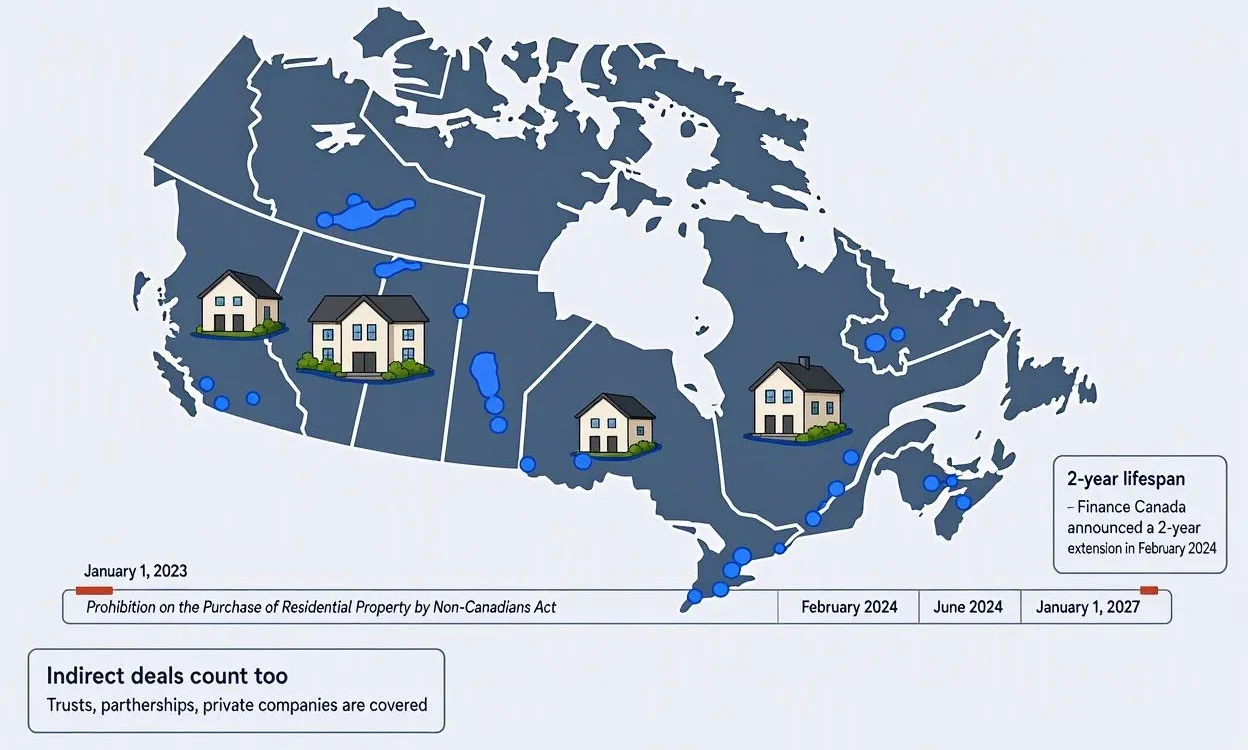
The foreign buyer ban stops non-Canadians from buying residential buildings of up to 3 units located inside a CMA or CA. Its legal name is the Prohibition on the Purchase of Residential Property by Non-Canadians Act, and the law took effect on January 1, 2023 with a 2-year lifespan. Ottawa doubled that. Finance Canada announced a 2-year extension in February 2024, and Parliament wrote the new January 1, 2027 end date into law that June.
Indirect deals count too. Buying through a trust, a partnership or a private company doesn’t get a non-Canadian around the rule.
Who Counts as a Non-Canadian?
A non-Canadian is any person who is not a Canadian citizen, a permanent resident or someone registered under the Indian Act. Companies get caught as well. A private corporation formed in Canada counts as non-Canadian if non-Canadians hold 10% or more of its equity value or voting rights, though companies listed on a Canadian stock exchange sit outside the rule. Two Texas investors who set up an Ontario numbered company to buy a Mississauga townhouse are still buying as non-Canadians.
Which Properties Fall Under the Ban?
The ban covers detached houses, semi-detached houses, townhouses, condo units and any building with 3 or fewer dwelling units. Bigger buildings are a different story. A 4-unit building isn’t “residential property” under the Act, so a non-Canadian can buy a Montréal fourplex today. Vacant land has been exempt since March 27, 2023, when amended regulations also cleared purchases made to build new housing. Renting stays untouched, because signing a lease isn’t a purchase.
Where Does the Ban Apply?
The ban applies inside Statistics Canada’s census metropolitan areas and census agglomerations, which take in every major city and most towns with 10,000 or more people in their core. A CMA needs a total population of at least 100,000, with 50,000 or more living in the core. CAs are smaller. Each needs a core population of at least 10,000.
Boundaries rarely follow city limits, so a hobby farm well past the last suburb can still sit inside a CMA. Canada Mortgage and Housing Corporation (CMHC) runs a free address lookup map that settles the question in seconds. Run every address through it before you make an offer, since a listing agent’s assurance carries no legal weight.
What Happens If You Break the Ban?
A conviction carries a fine of up to $10,000 CAD (about $7,040 USD), and a court can order the property sold. The same fine applies to anyone who knowingly helps, which puts agents and lawyers on the hook alongside the buyer. Expect your lawyer to ask for proof of status, such as a passport and work permit, before the deal firms up.
Rules for Foreigners Buying Property in Canada: 7 Exempt Groups
Seven groups of non-Canadians can legally buy residential property inside a CMA or CA, with work permit holders and long-term international students the two most common. CMHC publishes the conditions below, drawn from the Act’s regulations.
| Exempt group | Main conditions |
| Temporary workers | Valid work permit (or work authorization) with 183+ days of validity left on the purchase date |
| International students | Enrolled at a designated learning institution (DLI); tax returns filed for each of the 5 prior years; 244+ days in Canada in each of those years; price of $500,000 CAD (about $352,000 USD) or less |
| Spouses and common-law partners | Buying jointly with a citizen, PR or exempt non-Canadian |
| Refugees and protected persons | Protection granted under the Immigration and Refugee Protection Act (IRPA) |
| Refugee claimants and people fleeing crises | Claim referred to the Refugee Protection Division, or temporary residence granted on humanitarian grounds |
| Diplomats | Accredited members of foreign missions holding a valid acceptance from Canada’s Chief of Protocol |
| Indigenous rights holders | Purchases tied to rights under Section 35 of the Constitution Act, 1982 |
Workers and students get one purchase each while the ban lasts. A second home stays off the table for them until it expires.
Can International Students Buy a House in Canada?
Yes, international students can buy one house in Canada, but only after 5 years of tax filing and physical presence, and only at a price of $500,000 CAD or less. The presence test is strict. A student needs 244 days in Canada in each of the 5 calendar years before the purchase year, plus an income tax return filed for every one of those years. Someone who arrived in September 2021 fails the test for a 2026 purchase, since 2021 gave them roughly 120 days in the country.
Price is the other wall. Toronto and Vancouver detached houses sit far above the $500,000 cap, and Ontario’s 25% Non-Resident Speculation Tax (NRST) lands on top, because the province ended its NRST rebate for international students in October 2022.
Can Work Permit Holders Buy a Home in Canada?
Yes, work permit holders can buy one home in Canada if their permit has at least 183 days of validity remaining on the purchase date. Open and employer-specific permits both qualify. There’s no minimum time already worked here, since the March 2023 amendments scrapped the earlier rule requiring 3 of the previous 4 years in full-time Canadian employment.
Timing still bites. A nurse whose permit expires on June 30, 2027 must complete the purchase by December 29, 2026 to keep exactly 183 days of validity. In Ontario, the 25% NRST applies to work permit holders as well.
Can a Foreign Spouse Buy With a Canadian Partner?
Yes, a non-Canadian can buy a home jointly with a spouse or common-law partner who is a citizen, a PR or an exempt non-Canadian. Both partners go on title. Provincial treatment splits sharply here: Ontario waives its 25% NRST when the foreign national buys with a citizen or PR spouse, while British Columbia (BC) charges its 20% foreign buyer tax on the foreign partner’s share of the property.
Can Non-Residents Buy Property in Canada?
Yes, non-residents can buy property in Canada, and Canadian citizens or PRs living abroad face no ban at all. The federal law targets non-Canadians, not non-residents. A Canadian citizen living in Dallas can buy a Toronto condo tomorrow, and Ontario’s NRST skips them too, since that tax applies to foreign nationals. Tax residency still matters after closing. That Dallas owner pays non-resident withholding on any rent collected.
What Can Non-Canadians Buy Outside the Ban?
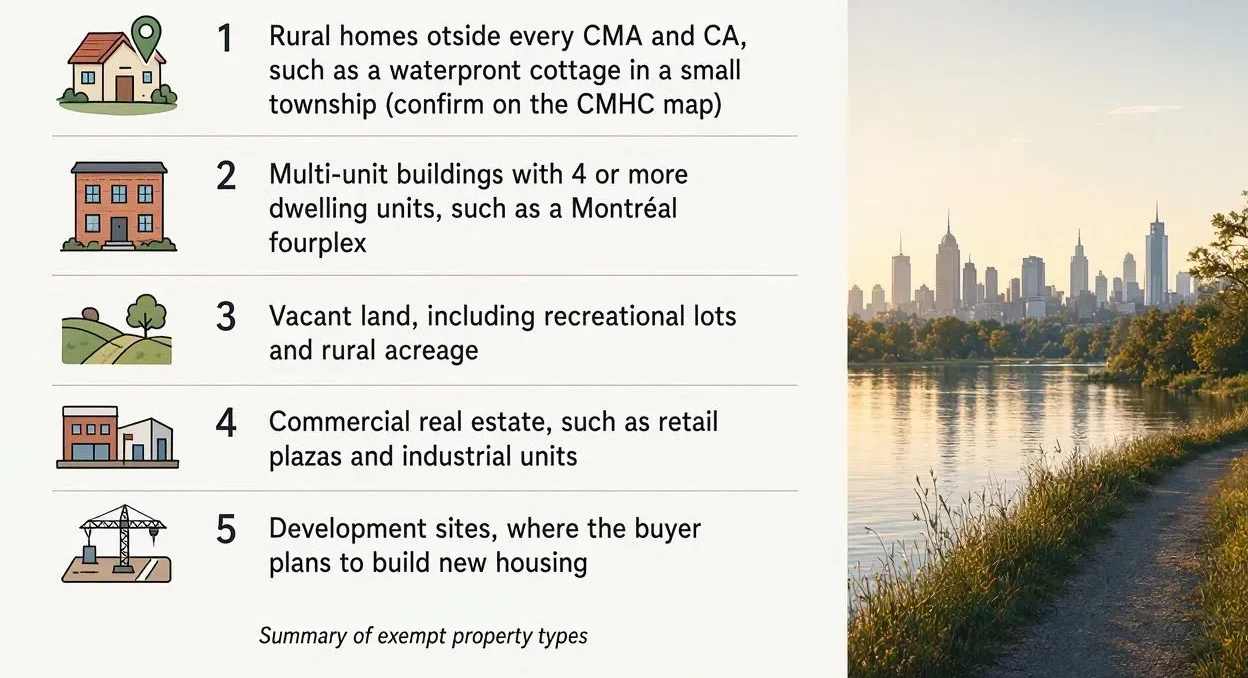
Non-Canadians can buy 5 types of property without any exemption:
- Rural homes outside every CMA and CA, such as a waterfront cottage in a small township (confirm on the CMHC map)
- Multi-unit buildings with 4 or more dwelling units, such as a Montréal fourplex
- Vacant land, including recreational lots and rural acreage
- Commercial real estate, such as retail plazas and industrial units
- Development sites, where the buyer plans to build new housing
Recreational use earns no exemption by itself. Location decides: a ski chalet inside a CA is banned, while the same chalet one boundary over is open to anyone.
Which Provinces Limit Land Ownership by Non-Residents?
Prince Edward Island (PEI), Saskatchewan and Alberta cap how much land non-residents can hold, on top of the federal ban.
| Province | Limit | Metric equivalent |
| PEI | Approval needed above 5 acres or 165 feet of shore frontage; application fee of $550 or 1% of the price, whichever is higher | 2.02 hectares (ha) or 50.3 metres (m) |
| Saskatchewan | Non-Canadians limited to 10 acres of farmland | 4.05 ha |
| Alberta | Foreign-controlled owners limited to 20 acres of controlled land | 8.09 ha |
PEI’s Lands Protection Act counts land you already own. A buyer holding 2 acres who adds a 3.5-acre lot reaches 5.5 acres and needs approval, even though the new parcel alone sits under the limit.
When Does the Foreign Buyer Ban End?
The foreign buyer ban ends on January 1, 2027, and Ottawa had announced no further extension as of October 3, 2026. Without new legislation, the prohibition simply lapses on that date. Housing Minister Gregor Robertson confirmed a formal review of the ban in December 2025.
Australia is the model under study. That system lets foreign buyers purchase new construction and vacant land while keeping them out of the resale market for existing homes. Most analysts don’t expect a straight extension of the current ban, and a July 2026 analysis from law firm Borden Ladner Gervais (BLG) expects any replacement to turn on property type and development intent.
Ottawa’s review decides how the answer to “can foreigners buy property in Canada” reads after New Year’s Day. Provincial taxes sit outside that decision. Ontario’s 25% NRST, BC’s 20% tax and Nova Scotia’s 10% levy are separate provincial laws, so a buyer targeting a 2027 closing should make any offer conditional on a lawyer’s review of the rules in force on the closing date.
Can Americans Buy Property in Canada?
No, US citizens get no special exemption, so Americans face the same ban as every other non-Canadian until January 1, 2027. Most US readers searching “can foreigners buy property in Canada” fit one of 3 profiles, and each has a workable route:
- Cottage buyers can purchase recreational property outside every CMA and CA.
- Cross-border professionals can qualify through a work permit, including permits under the Canada-United States-Mexico Agreement (CUSMA) that skip the Labour Market Impact Assessment (LMIA).
- Investors can buy buildings with 4 or more units, or commercial property.
US tax follows the owner north. The Internal Revenue Service (IRS) taxes citizens on worldwide income, so Canadian rent and any gain on sale go on the US return, with Form 1116 claiming a credit for Canadian tax paid. Canadian bank accounts holding more than $10,000 USD combined at any point in the year require a Foreign Bank Account Report (FBAR). The home itself isn’t FBAR-reportable, and directly held real estate is excluded from Form 8938 as well.
Lending works differently up north. Canadian banks don’t read US FICO scores, so expect to supply a US credit report, a reference letter from your bank and 2 years of tax returns. A deed grants no residency either: a US citizen can usually visit for up to 6 months at a time, owner or not.
Tax on Foreign Buyers in Canada by Province
Ontario, BC and Nova Scotia charge foreign buyers an extra tax of 10% to 35% of the purchase price, on top of regular land transfer tax (LTT). The other 7 provinces charge no foreign buyer surcharge.
| Province or city | Foreign buyer tax | Who pays | Annual vacancy tax |
| Ontario | 25% NRST | Foreign nationals and foreign corporations, province-wide | None at the provincial level |
| Toronto | Extra 10% Municipal NRST (since January 1, 2025) | Same buyers, on top of Ontario’s 25% | Vacant Home Tax: 3% |
| British Columbia | 20% Additional Property Transfer Tax (APTT) | Foreign entities in specified regions, including Metro Vancouver and Greater Victoria | Speculation and Vacancy Tax (SVT): 3% for foreign owners from 2026; Vancouver Empty Homes Tax: 3% |
| Nova Scotia | 10% non-resident deed transfer tax (agreements signed from April 1, 2025) | Anyone not resident in Nova Scotia, including Canadians from other provinces | None |
| Quebec, Alberta, Saskatchewan, Manitoba, New Brunswick, Newfoundland and Labrador, PEI | None | Not applicable | None |
Nova Scotia’s tax catches Canadians off guard. A Calgary family buying a Halifax condo pays the 10% unless they move to Nova Scotia within 6 months of closing.
Regular LTT hits every buyer. Ontario charges 0.5% to 2.5% in brackets, and Toronto adds a matching municipal LTT that doubles the bill there. BC’s Property Transfer Tax runs from 1% to 3%, plus 2% on the residential portion above $3 million. Alberta charges no land transfer tax at all, only land title registration fees.
One federal levy is gone. The 1% Underused Housing Tax (UHT) no longer applies from the 2025 calendar year onward, after the Budget 2025 Implementation Act received royal assent on March 26, 2026, though returns and payments for 2022 to 2024 remain due.
How Much Does a Foreign Purchase Cost in Ontario?
A work permit holder buying an $800,000 CAD Toronto condo needs $584,950 CAD (about $411,900 USD) in cash at closing, before legal fees. Compare a $500,000 cottage outside any CMA in rural Ontario, where the federal ban doesn’t apply but the NRST does.
| Cost item (CAD) | Toronto condo, $800,000 | Rural Ontario cottage, $500,000 |
| Down payment (35%) | $280,000 | $175,000 |
| Ontario LTT | $12,475 | $6,475 |
| Toronto municipal LTT | $12,475 | $0 |
| Ontario NRST (25%) | $200,000 | $125,000 |
| Toronto Municipal NRST (10%) | $80,000 | $0 |
| Cash needed at closing | $584,950 (about $411,900 USD) | $306,475 (about $215,800 USD) |
Leaving the city cuts the cash needed nearly in half. Even so, the NRST makes up 41% of the cottage buyer’s closing cash, because escaping a CMA removes the federal barrier, not Ontario’s.
How to Buy Property in Canada as a Foreigner
To buy property in Canada as a foreigner, confirm the purchase is legal first, then line up financing and a Canadian lawyer before you make an offer.
- Check the address on CMHC’s CMA and CA lookup map.
- Document your exemption with a work permit, tax returns or travel records showing days in Canada.
- Get a mortgage pre-approval from a Canadian lender, since most won’t accept a foreign credit score on its own.
- Open a Canadian bank account and move funds early, because a 2% swing in the exchange rate changes a $280,000 down payment by $5,600.
- Hire a licensed real estate agent and a real estate lawyer (a notary in Quebec) who has handled non-Canadian purchases.
- Make an offer with conditions for financing, inspection and a legal review of your eligibility.
- Close the purchase, with your lawyer verifying identity under Financial Transactions and Reports Analysis Centre of Canada (FINTRAC) rules and registering title.
Most deals close 30 to 60 days after acceptance. Buyers abroad can sign remotely or give a trusted person power of attorney. Without a Social Insurance Number (SIN), you’ll need an Individual Tax Number (ITN) from the Canada Revenue Agency (CRA), requested on Form T1261, before filing any Canadian return.
How Much Down Payment Do Non-Residents Need?
Non-residents need a down payment of at least 35% with most major Canadian banks, compared with as little as 5% for Canadian residents. Lenders can’t easily verify foreign income or credit, and the larger deposit covers that risk. Every uninsured borrower faces the federal stress test from the Office of the Superintendent of Financial Institutions (OSFI), which sets the qualifying rate at 5.25% or your contract rate plus 2%, whichever is higher. A buyer offered 4.5% must qualify at 6.5%. On a 25-year amortization, that lifts the qualifying payment by about 21%.
What Taxes Do Foreign Owners Pay After Buying and When Selling?
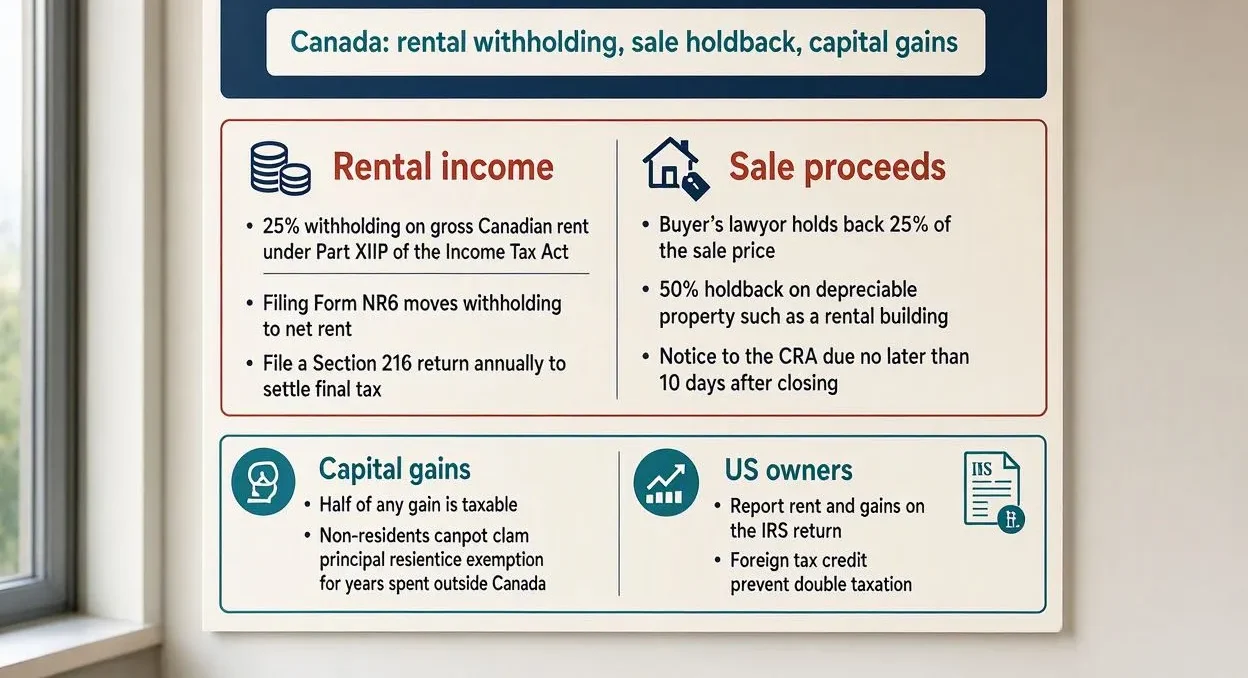
Foreign owners face 25% withholding on gross Canadian rent and a 25% holdback on the sale price, unless they file the right forms with the CRA.
- Rental income: Your tenant or property manager withholds 25% of gross rent under Part XIII of the Income Tax Act. Filing Form NR6 moves that withholding to net rent, and a Section 216 return settles the final tax each year.
- Sale proceeds: The buyer’s lawyer holds back 25% of the price, or 50% on depreciable property such as a rental building, until the CRA issues a Section 116 clearance certificate. Notice to the CRA is due no later than 10 days after closing.
- Capital gains: Half of any gain is taxable, and non-residents can’t claim the principal residence exemption for years spent living outside Canada.
- US owners: Rent and gains go on the IRS return too, with a foreign tax credit preventing the same income from being taxed twice.
Conclusion: The Bottom Line for Foreign Buyers
So, can foreigners buy property in Canada? Yes, but before January 1, 2027, only through an exemption or a property the ban does not cover. Taxes decide the real cost. A Toronto purchase carries a 35% surcharge, while a cottage in rural Ontario still carries 25%, so the province matters as much as the federal rule.
The ban’s end date is less than 3 months away, and Ottawa hasn’t said what replaces it. Before signing anything, check the address on CMHC’s map and have a Canadian real estate lawyer confirm both your eligibility and the taxes in force on your closing date.
FAQs

Michael Reynolds
Michael Reynolds leads ImmigrationWin’s immigration, visa, and global mobility content division. He specializes in researching immigration policies, visa requirements, application processes, and international relocation pathways for individuals, families, students, and professionals. With extensive experience analyzing immigration regulations and official government guidance, Michael brings a research-driven approach to complex immigration topics and changing visa policies. He is the primary author of ImmigrationWin’s visa guides, immigration resources, and country-specific content, helping readers better understand their options and make informed decisions about their international journey.
Related Posts