
New Home Checklist for Moving into a New House

A new home checklist is a phased task list that guides buyers from the final walkthrough through the first year of ownership. Work through it in order. Confirm insurance and utilities before closing, secure the house and test safety alarms on day one, update your address in week one, then set a maintenance schedule.
Key Takeaways
- Confirm a homeowners insurance policy and schedule utility transfers 2 to 3 weeks before closing so power, water and internet work on move-in day.
- Rekey or replace every exterior lock in the first 24 hours, because previous owners, agents and contractors may still hold keys.
- Test smoke and carbon monoxide (CO) alarms and locate the main water shut-off and breaker panel before unpacking boxes.
- File a United States Postal Service (USPS) change of address, update the Department of Motor Vehicles (DMV) and mail Internal Revenue Service (IRS) Form 8822 within the first week.
- Apply for your state’s homestead exemption early, since many counties set firm annual filing deadlines.
- Buy safety gear, cleaning supplies and a basic tool kit first, and wait on furniture and decor until you have lived in the space.
What Is a New Home Checklist?
A new home checklist is an ordered list of tasks and purchases that a homeowner completes from closing through the first year in a house. The list sorts admin work, safety checks, cleaning, shopping and maintenance into timed phases. Nothing important slips while boxes pile up.
The table below shows each phase of the new home checklist with its timing and main goal.
| Phase | Timing | Main Goal |
|---|---|---|
| Before Closing | 2 to 4 weeks out | Insurance, utilities, final walkthrough |
| Closing Day | Day 0 | Sign documents, collect keys and codes |
| First 24 Hours | Move-in day | Locks, alarms, shut-offs, first night |
| First Week | Days 2 to 7 | Address updates, home systems, unpacking |
| First 30 Days | Weeks 2 to 4 | Tax exemption, repairs, records binder |
| First Year | Months 2 to 12 | Seasonal maintenance schedule |
Treat the table as a printable checklist for new home tasks, and check off every item in one phase before you start on the next. Order matters.
Renters can use the same moving into a new home checklist. Skip two parts: closing and property tax. Every other phase, from move-in day all the way through the first-year maintenance routine, still applies when you’re moving into a rental.
Buying a New Home Checklist Before Closing
Before closing, a buyer needs to lock in a homeowners insurance policy, review the Closing Disclosure, schedule utility transfers and complete a final walkthrough. Federal rules require lenders to deliver the Closing Disclosure at least 3 business days before closing. Use that gap. It’s your chance to compare the disclosure against the Loan Estimate and question anything that changed before signing day arrives. Still shopping? Start with our home buying checklist.
Complete these steps in the 2 to 4 weeks before closing:
- Buy a homeowners insurance policy and send proof of coverage to your lender, since most mortgage lenders require it before funding the loan.
- Review the Closing Disclosure line by line and ask your lender to explain any fee that changed from the Loan Estimate.
- Call each utility provider to transfer or start service on closing day.
- Book movers or a rental truck, and reserve elevator or parking time if a homeowners association (HOA) governs the property.
- Request the HOA rulebook, fee schedule and move-in rules in writing.
- Confirm wire instructions with your title company by phone, using a number you look up yourself, because wire fraud schemes target homebuyers.
Final Walkthrough Checks
The final walkthrough usually happens within 24 hours of closing, and its job is to confirm that the house still matches the purchase contract. Don’t skip it.
- Confirm that agreed repairs are complete, and ask for receipts or contractor invoices.
- Run every faucet, shower and toilet, then check under sinks for leaks.
- Turn on the furnace, air conditioner and every appliance that conveys with the sale.
- Open and close every window, exterior door and the garage door.
- Verify that the sellers removed their belongings and debris.
- Flip each light switch and test outlets with a plug-in outlet tester.
Documents to Gather
Collect these items at or before closing and store them in one home records binder:
- Closing Disclosure, deed and settlement statement
- Home inspection report
- Homeowners insurance declarations page
- Appliance manuals and transferable warranties
- HOA bylaws, rules and contact list
- Property survey and any building permits
- Paint color names and leftover paint from the sellers
When Should I Set up Utilities for a New Home?
Set up utilities for a new home 2 to 3 weeks before move-in day, and schedule each service to start on closing day or the day before you arrive. Internet installation slots tend to book out furthest. Call that provider first. After that, reach out to the electric, gas, water, sewer and trash companies to line up the rest of your service start dates.
The table below lists common utilities, who usually provides them and how service starts.
| Utility | Typical Provider | How to Start |
|---|---|---|
| Electricity | Local utility or retail supplier | Transfer to your name by closing day |
| Natural Gas | Local gas utility | Schedule start; some need a technician visit |
| Water and Sewer | City or county utility | Call the utility office; deposit possible |
| Trash and Recycling | City or private hauler | Confirm pickup day and bin delivery |
| Internet | Cable, fiber or 5G provider | Book installation as early as possible |
| Home Security | Private monitoring company | Cancel seller’s contract or start new |
Ask the sellers or your agent for a list of current providers, because the right water or trash company depends on the exact address. It saves guesswork.
Texas works differently. In deregulated electricity markets, which cover much of the state, you pick a retail electricity provider while the local utility still delivers the power.
On move-in day, photograph the electric and water meters, and the gas meter too if the house has one, so you’ve got a dated record. Those photos show the starting readings. They settle the matter if a final bill splits incorrectly between you and the sellers.
What Should I Clean Before Moving into a New Home?
Deep clean the kitchen, bathrooms, floors, closets and cabinets before moving into a new home, because empty rooms are faster to clean than furnished ones. Work from the top down. Dust ceiling fans, light fixtures, vents and door frames before touching the counters, and save the floors for last so falling dust doesn’t land on clean surfaces.
- Dust ceiling fans, light fixtures and the tops of door frames.
- Wipe cabinet interiors and drawers, then add shelf liner.
- Clean the refrigerator, oven, microwave and dishwasher inside and out.
- Scrub toilets, tubs, showers and sinks, and replace toilet seats if you prefer new ones.
- Wash windows, sills and sliding door tracks.
- Vacuum the air return vents and install a fresh filter in the heating, ventilation and air conditioning (HVAC) system.
- Steam clean carpets or mop hard floors last.
Short on time between closing and moving day? Hire a move-in cleaning service. Book the crew before the movers show up, since cleaners need clear access to every surface and that disappears once boxes fill the rooms.

Moving Day and First 24 Hours
In the first 24 hours, secure the house, test every smoke and CO alarm, locate the main water shut-off and breaker panel, and unpack a first night box. The four tasks protect people and property before anyone spends a night under the new roof, so they come before unpacking a single piece of furniture. Furniture can wait.
A moving into a new house checklist starts with photos of every empty room before the movers arrive. Get wide shots and close-ups. Those images document existing scuffs and dents, which matters if you ever need to file a damage claim against the moving company.
Tape a simple floor plan to the front door. It directs movers without constant questions. Labeling each box by room means every carton lands in the right space the first time, with no second round of hauling. First home? Our guide for first-time home buyers in Canada covers what to budget.
What Goes in a First Night Box
Pack one clearly labeled box or tote that rides in your car, not on the moving truck:
- Toilet paper, hand soap, paper towels and trash bags
- Phone chargers and a power strip
- Bedding, pillows and one towel per person
- Medications, glasses and contact lens supplies
- A change of clothes and toiletries
- Snacks, bottled water, paper plates and a can opener
- Box cutter, flashlight and a multi-bit screwdriver
- Shower curtain and rings
- Pet food, bowls, leash and litter
- Closing documents, keys and garage door remotes
Safety Checks on Day One
Complete these checks before the first night in the house:
- Test every smoke alarm and CO alarm by pressing its test button.
- Locate the main water shut-off valve, usually near the water meter, in a basement, crawl space, garage or utility closet, and turn it off and on once.
- Find the circuit breaker panel and confirm that every breaker has a clear label.
- Find the gas shut-off at the meter if the home uses natural gas.
- Mount a fire extinguisher in the kitchen, away from the stove.
- Store a first aid kit where every adult in the house can find it.
The National Fire Protection Association (NFPA) recommends a smoke alarm inside every bedroom and another outside each sleeping area. Every level needs coverage too, basement included. Alarms also wear out, and NFPA advises replacing each one 10 years after the manufacture date printed on the back of the unit.
CO alarms belong outside each sleeping area and on every level of the house, and they should be replaced on whatever schedule the manufacturer sets. Check the label. Many states require them in homes with fuel-burning appliances or attached garages.
Smell rotten eggs? Get out of the house immediately, then call the gas utility once you’re outside, because that odor signals a natural gas leak.
Should I Change the Locks on a New House?
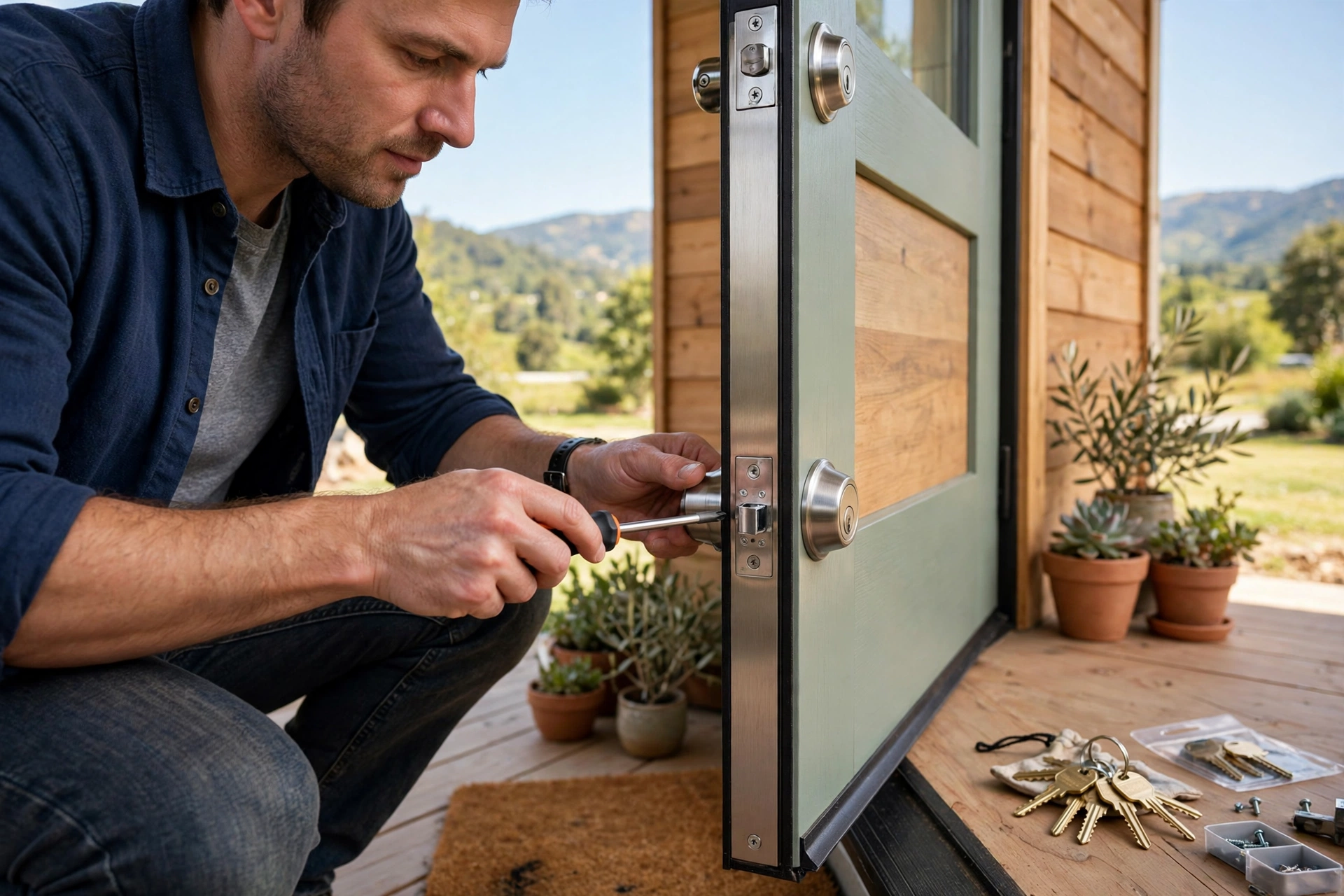
Yes, change or rekey every exterior lock on a new house within the first 24 hours, because previous owners, neighbors, agents, cleaners and contractors may still hold copies of the keys. Rekeying swaps the pins inside the existing lock so the old keys stop working. Replacement means new hardware entirely.
The table below compares rekeying, replacing and upgrading to a smart lock.
| Option | Best For | Relative Cost | DIY Friendly |
|---|---|---|---|
| Rekeying | Locks in good working condition | Lower; reuses existing hardware | Yes, with rekeyable lock brands |
| Replacing | Worn, outdated or mismatched locks | Higher; buys new hardware | Yes, for standard deadbolts |
| Smart Lock | Keyless entry and access logs | Highest of the three | Yes, most fit standard doors |
Some lock lines, such as Kwikset SmartKey, let homeowners rekey the lock themselves with the original working key and a tool. No locksmith required.
Reset every other access point at the same time:
- Reprogram the garage door opener and exterior keypad code.
- Change the alarm system code and monitoring account password.
- Remove the sellers from any smart thermostats, doorbells or cameras.
- Request new gate, pool or amenity fobs from the HOA.
- Check for spare keys hidden under mats, rocks or planters.
First Week Checklist When Moving to a New Home
In the first week, update your address with every agency and account, learn how the home’s heating, cooling and water systems work, and unpack the kitchen, bathrooms and bedrooms first. Those three rooms carry your daily routine. Getting them done first takes the pressure off while the remaining boxes wait their turn.
Change Your Address with Every Agency
The table below lists where to update your address, how to do it and when.
| Agency or Account | How to Update | Timing |
|---|---|---|
| USPS | Online at usps.com or PS Form 3575 | Up to 3 months before moving |
| State DMV | Online or in person, by state | By your state’s deadline |
| IRS | Form 8822 by mail | Right after the move |
| Voter Registration | vote.gov or state election office | Before the next registration deadline |
| Social Security | my Social Security account, if receiving benefits | Right after the move |
| Banks and Credit Cards | Online account settings | First week |
| Employer Payroll | HR portal or payroll form | First week; state tax may change |
USPS forwards First-Class Mail for 12 months under a standard change of address. Filing online costs a little. The web form charges a small identity verification fee to a credit or debit card, while the paper PS Form 3575 at a post office costs nothing.
Watch out for lookalikes. Use only usps.com for an online change of address, because third-party sites tack on extra fees for the exact same service.
Each state sets its own DMV deadline. Crossing a state line adds more work: apply for a new driver’s license and vehicle registration, and update your auto insurance policy as well.
Learn the Home’s Systems
Spend one hour in the first week learning how the house runs:
- Record the HVAC filter size printed on the filter frame, and buy a multipack.
- Set the water heater to 120°F (49°C), the setting the U.S. Department of Energy (DOE) recommends for safety and energy savings.
- Pour a bucket of water into the sump pit, if the house has one, to confirm the sump pump turns on.
- Press Test, then Reset, on each ground fault circuit interrupter (GFCI) outlet in kitchens, bathrooms, the garage and outdoor areas.
- Program the thermostat schedule and the sprinkler controller.
- Write down the trash and recycling pickup days.
Do I Need to Tell the IRS I Moved?
Yes, tell the IRS you moved by filing Form 8822, Change of Address, so refunds, notices and tax documents reach your new home. There’s a second route. Put the new address on your next federal tax return, and the IRS updates its records once that return is processed.
You can’t file Form 8822 online. It goes by mail, and the IRS notes that processing a change of address can take 4 to 6 weeks, so send it soon after the move.
Moving a business location? File Form 8822-B instead. Your state tax agency needs its own separate notice too, because the IRS doesn’t pass address changes along to state revenue departments.
How Do I Apply for a Homestead Exemption?
Apply for a homestead exemption through your county property appraiser or assessor office after you move in, using proof that the house is your primary residence. In states that offer it, the exemption lowers the taxable value of an owner-occupied home. Counties enforce a firm annual filing deadline.
- Search your county name plus “homestead exemption” and open the official .gov website.
- Confirm the eligibility rules for ownership, primary residence and occupancy date.
- Gather your deed or closing statement and a driver’s license showing the new address.
- Add a vehicle registration or voter registration card if your county requires one.
- Submit the application online, by mail or in person.
- Check your next property tax bill to confirm the exemption appears.
Deadlines vary by state. Florida, for instance, requires homestead applications by March 1 of the tax year, which is why checking your own county’s date right after closing pays off.
Paying property taxes through escrow? Then a lower tax bill trims the escrow amount at the lender’s next annual escrow analysis, rather than right away.

New House Necessities and Essentials to Buy
The new house necessities to buy first are safety gear, cleaning supplies, a basic tool kit, bathroom basics and window coverings, because these items keep the home safe, clean and private from the first night. Bigger purchases can wait. Furniture, decor, rugs and upgrades make more sense once you know how each room actually works day to day.
Most new house stuff to buy is stocked at Home Depot, Lowe’s, Target, Walmart and Costco, so one or two shopping trips cover the full list. No specialty stores needed.
Buy Before Move-In Day
The table below groups new home essentials by category, with examples and the reason to buy each one first.
| Category | Must-Have Items | Why Buy First |
|---|---|---|
| Safety | Fire extinguisher, first aid kit, flashlights, alarm batteries | Emergencies happen before unpacking ends |
| Cleaning Supplies | Vacuum, mop, all-purpose cleaner, sponges, trash bags | Deep clean empty rooms |
| Tool Kit | Hammer, screwdrivers, tape measure, level, utility knife, drill | Furniture assembly and hanging items |
| Bathroom | Shower curtain, plunger, bath mat, towels | Daily use from night one |
| Kitchen | Dish soap, basic cookware, utensils, food storage | Avoid takeout every night |
| Window Coverings | Blinds or curtains for bedrooms and bathrooms | Privacy after dark |
| Laundry | Detergent, hamper, drying rack | Keeps the weekly routine going |
These smaller items are easy to forget and cheap to buy early:
- Light bulbs in the sizes the fixtures use
- Step ladder
- Extension cords and surge protectors
- Doormats for each exterior door
- Garden hose and nozzle
- Picture hanging kit
What Can Wait Until After Moving In
Hold off on sofas, rugs, art, patio furniture and smart home upgrades until you’ve lived in the house for a few weeks. Time teaches you things. You’ll see how light moves through each room and how your household really uses it.
Don’t guess at sizes. Measure every room and doorway before buying large furniture, then save the numbers in your phone so they’re on hand at the store.
Keep some cash set aside for repairs rather than spending it all on furnishings. How much? No verified figure exists for a universal repair reserve, so base yours on the inspection report and the age of the roof, HVAC system and water heater. Our home inspection checklist shows what to look at in each system.
First 30 Days and First Year Maintenance
In the first 30 days, fix the top items from the home inspection report, build a home records binder and set a seasonal maintenance schedule for the first year. Write it down. A schedule on paper turns scattered chores into a predictable routine that protects both the house and what it’s worth.
Complete these tasks in the first 30 days:
- Rank inspection findings by safety first, water intrusion second and cosmetic issues last.
- Test for radon if the inspection skipped it; the U.S. Environmental Protection Agency (EPA) recommends fixing homes at or above 4 picocuries per liter (pCi/L).
- Follow lead-safe work practices before sanding or scraping paint in homes built before 1978.
- Call 811 before digging for fence posts, gardens or trees, so utility lines get marked for free.
- Schedule a pest inspection if the purchase did not include one.
- File manuals, warranties, receipts and the inspection report in the home records binder.
The table below lists the main maintenance tasks for each season and recurring interval.
| Timing | Key Tasks |
|---|---|
| Spring | Clean gutters, service air conditioner, inspect roof and exterior caulk |
| Summer | Check irrigation, trim plants away from siding, inspect deck |
| Fall | Clean gutters, service furnace, drain outdoor hose bibs |
| Winter | Watch for ice dams, insulate exposed pipes, test sump pump |
| Monthly | Test smoke and CO alarms, check HVAC filter |
| Yearly | Flush water heater, clean dryer vent, check extinguisher gauge |
Adjust the schedule to your climate. In cold northern states, frozen pipes and ice dams top the list, while Gulf Coast owners spend more of their effort on humidity, pests and hurricane preparation.
Is a Home Warranty Worth It for a New House?
Yes, a home warranty is worth it for buyers of older homes with aging appliances and a thin repair fund, and no for new construction already covered by a builder warranty. A home warranty is a service contract that pays to repair or replace covered systems and appliances, minus a service fee per visit. It isn’t insurance.
The table below compares home warranties with homeowners insurance and builder warranties.
| Coverage Type | Covers | Does Not Cover | Required |
|---|---|---|---|
| Homeowners Insurance | Damage from covered perils like fire and theft | Flood, wear and tear | Usually, by lenders |
| Home Warranty | Breakdowns of covered systems from normal wear | Preexisting conditions, code upgrades, exclusions | No |
| Builder Warranty | Workmanship and material defects in new construction | Homeowner damage, normal wear | No; many builders include one |
Read the fine print before signing. Every home warranty contract spells out its coverage caps, exclusions and service fees, and those details decide whether a claim actually pays. Sellers sometimes cover a first-year home warranty as a closing concession, so have your agent ask for one.
Standard homeowners policies exclude flood damage. Buy flood coverage through the National Flood Insurance Program (NFIP) or a private insurer if the home sits in a flood-prone area.
Conclusion
A new home checklist does the most good when you treat it as a living document rather than a one-time list. Store it in the home records binder. Date each task as you finish it, and add new items whenever repairs or projects come up.
After the first year, the seasonal schedule becomes your permanent maintenance plan. That binder pays off later, too. Keeping every manual and warranty in one place, receipts included, makes insurance claims and refinancing far simpler, and it’ll smooth out an eventual sale. Once you’re settled, these strategies help you pay off your mortgage faster.
Start with the locks and alarms tonight. The rest of the house will fall into order one phase at a time, just as the checklist lays it out.
Frequently Asked Questions
Sources
- National Fire Protection Association, Smoke Alarms: https://www.nfpa.org/education-and-research/home-fire-safety/smoke-alarms
- National Fire Protection Association, Carbon Monoxide: https://www.nfpa.org/education-and-research/home-fire-safety/carbon-monoxide

Johnson
Johnson leads real estate content at Civic Homes, covering home buying, selling, mortgages, renting, and market trends across Canada. He researches provincial rules, mortgage regulations, and city-by-city housing data to explain the Canadian market in plain, practical terms. His guides help buyers, sellers, renters, and investors make smarter housing decisions.
Related Posts