Best Neighbourhoods in Ottawa: A Complete Guide for Homebuyers and Renters
The best neighbourhoods in Ottawa are Westboro, The Glebe, Barrhaven, Kanata, Alta Vista, Old Ottawa South, and Manotick, each suited to a different budget, commute, and life stage. Westboro draws professionals who want river access and café culture. Barrhaven and Kanata pull families in for school choice and lot size. Manotick and Alta Vista suit retirees chasing quiet streets and a short drive to care.
This guide matches Ottawa’s real estate market to real buyer and renter profiles instead of vague “up-and-coming” claims. You’ll find home prices, commute times, transit access, school zones, and safety data for thirteen neighbourhoods in the City of Ottawa, Ontario, plus a one-minute comparison table.
Population figures below are approximate, drawn from City of Ottawa planning-boundary data and the most recent published census; verify current figures before making a purchase decision, as they shift with each census cycle.
Ottawa Neighbourhoods Comparison Table
| Neighbourhood | Distance from Downtown | Avg. Price (CAD) | Best For | Transit Access |
| Westboro | ~5 km / 3 mi | (~$950K+) | Professionals | LRT + bus routes |
| The Glebe | ~2.5 km / 1.5 mi | (~$950K+) | Families, professionals | Bus routes, canal path |
| Rockcliffe Park | ~2.7 km / 1.7 mi | (~$950K+) | Retirees, estate buyers | Bus routes |
| Barrhaven | ~17 km / 10.5 mi | (~$500K–$700K) | Families | Bus rapid transit |
| Kanata | ~20 km / 12.4 mi | (~$700K–$950K) | Tech workers, families | Bus + Highway 417 |
| Alta Vista | ~5 km / 3 mi | (~$700K–$950K) | Health workers, families | Bus routes |
| Manotick | ~25 km / 15.5 mi | (~$700K–$950K) | Retirees | Limited, car-dependent |
| Old Ottawa South | ~3.5 km / 2 mi | (~$950K+) | Retirees, professors | Bus routes, canal path |
| Centretown | ~1.5 km / 1 mi | (~$700K–$950K) | Government workers | Full LRT access |
| Sandy Hill | ~1.5 km / 1 mi | (~$700K–$950K) | Students, investors | Full LRT access |
| ByWard Market | ~1 km / 0.6 mi | (~$500K–$950K) | Nightlife, young singles | Full LRT access |
| Vanier | ~3.5 km / 2 mi | (under $500K) | Budget buyers | Bus routes |
| South Keys | ~8 km / 5 mi | (~$500K–$700K) | Value seekers | Bus + LRT nearby |
| Carleton Place | ~40 km / 25 mi | (~$500K–$700K) | Nature lovers, commuters | Car-dependent |
Price tier legend (approximate, CAD): $ = under $500,000 · $$ = $500,000–$700,000 · $$$ = $700,000–$950,000 · $$$$ = $950,000 and up. These are relative bands, not confirmed averages; verify current pricing with a local listing service or agent before budgeting.
Geographic Reference: Where Each Neighbourhood Sits
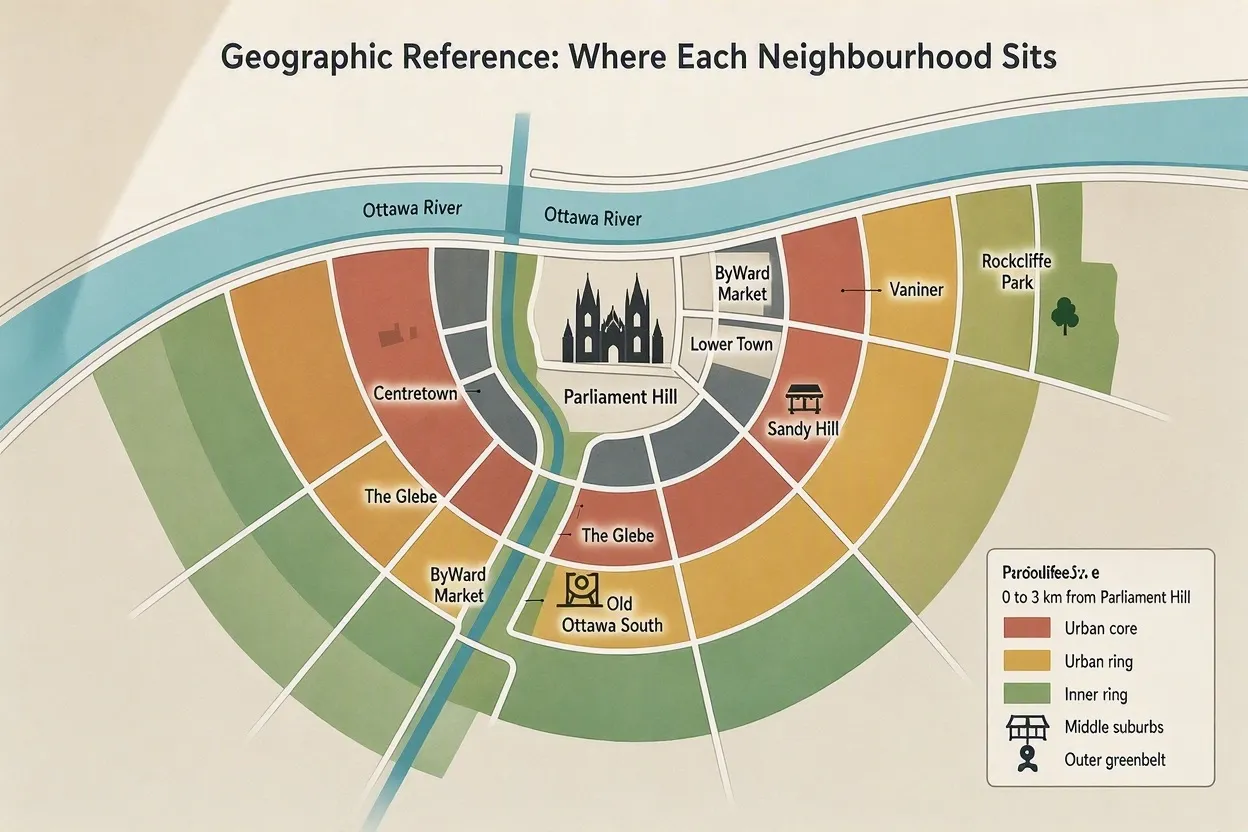
Ottawa’s geography splits roughly into four bands radiating out from the Ottawa River and Parliament Hill:
- Urban core, north bank of the Rideau Canal: ByWard Market and Lower Town, bordered by the Ottawa River to the north and the Rideau Canal to the west
- Inner ring, along the Rideau Canal and Ottawa River: Centretown, Sandy Hill, The Glebe, Old Ottawa South, Vanier, and Rockcliffe Park, all within roughly 3 km of Parliament Hill
- River-adjacent western suburbs: Westboro and Hintonburg, running along the south shore of the Ottawa River west of downtown
- Outer suburban and rural wards: Barrhaven (southwest), Kanata (west, bordering the Greenbelt), Alta Vista (southeast), South Keys and the former township of Gloucester (southeast), Manotick (rural south, on the Rideau River), and Carleton Place (a separate municipality in Lanark County, roughly 40 km west of Ottawa’s city limits)
Ottawa itself sits in eastern Ontario, Canada, on the south bank of the Ottawa River directly across from Gatineau, Quebec, and serves as the seat of Canada’s federal government within the National Capital Region.
What Makes a Neighbourhood One of the Best in Ottawa?
Five measurable factors separate a strong Ottawa neighbourhood from a mediocre one:
- Commute time to Parliament Hill or the nearest major employment hub
- Average home price, ranging from under $500,000 CAD in outer suburbs to over $1 million CAD in The Glebe or Westboro
- School access, both board ratings and walking distance
- Walkability: how many daily errands a resident can run without a car
- Green space: a riverside path, a park, or acreage bordering the Greenbelt
A short commute means little if the schools are weak. Low prices lose their appeal if the nearest grocery store is a 20-minute drive away. A detached home in Kanata can cost $250,000 CAD less than a similar property in Westboro, even though both sit roughly 20 minutes from downtown by car.
Best for Families: Barrhaven, Kanata, Alta Vista
| Neighbourhood | Population | Distance from Parliament Hill | Housing Type | Standout Feature |
| Barrhaven | ~103,000 | 17 km / 10.5 mi | New-build subdivisions | Greenbelt trail access |
| Kanata | ~137,000 (with Stittsville) | 20 km / 12.4 mi | Condos to detached homes | Tech-sector employment hub |
| Alta Vista | ~75,000 | 5 km / 3 mi | Bungalows, detached houses | Close to CHEO, strong highway access |
Barrhaven’s new-build subdivisions mean fewer surprise renovations, and the Greenbelt runs right along its edge. Kanata is anchored by the tech sector. Commute times for workers employed locally are often shorter than the neighbourhood’s overall distance from downtown would suggest. Alta Vista sits close to two hospitals, including the Children’s Hospital of Eastern Ontario (CHEO), and its bungalow-heavy streets make it one of the easier suburbs to leave during rush hour.
Families weighing all three should ask: is proximity to a specific school or hospital non-negotiable? If so, Alta Vista wins. If square footage and newer construction matter more, Barrhaven or Kanata pull ahead.
Best for Young Professionals: Westboro, Hintonburg, Centretown
- Westboro: ~23,000 residents, river-path access, top price tier, full LRT and bus routes
- Hintonburg: lower cost than Westboro, arts and music scene, close to Great Canadian Theatre Company
- Centretown: 1.5 km / 1 mi from Parliament Hill, full LRT access, Ottawa’s Gay Village, dense nightlife
Westboro runs along the Ottawa River and holds close to 23,000 residents. Prices sit at the top of the city’s range here, but the payoff is real: Westboro Beach, biking trails, and a commute under 15 minutes to downtown. Hintonburg costs less and sits a few kilometres closer to downtown, built on an arts and music identity that the Great Canadian Theatre Company still anchors. Centretown sits closest to Parliament Hill and stays lively after office hours, unlike a lot of government districts, thanks to its mix of civil servants and young professionals. Ottawa’s Gay Village falls within its boundaries too.
Best for Retirees and Empty-Nesters: Manotick, Rockcliffe Park, Old Ottawa South
- Manotick: 25 km / 15.5 mi from Parliament Hill, riverside village feel, car-dependent transit
- Rockcliffe Park: 2.7 km / 1.7 mi from Parliament Hill, embassies and estate homes, top price tier
- Old Ottawa South: ~6,000 residents, canal-path walkability, community gardens and outdoor rinks
Manotick sits along the Rideau River and keeps a small-village feel despite falling within city limits. Riverside properties, boutique shops, and events like the Manotick Shiverfest give retirees an easy way to stay connected without a long commute. Rockcliffe Park ranks among the most affluent pockets in the city, lined with embassies and estate homes. It’s quiet, almost to a fault. Old Ottawa South pairs heritage character with genuine walkability: community gardens, tennis courts, outdoor rinks, and splash pads all sit within a short walk of most residents.
Closest to Downtown: ByWard Market, Sandy Hill, Centretown
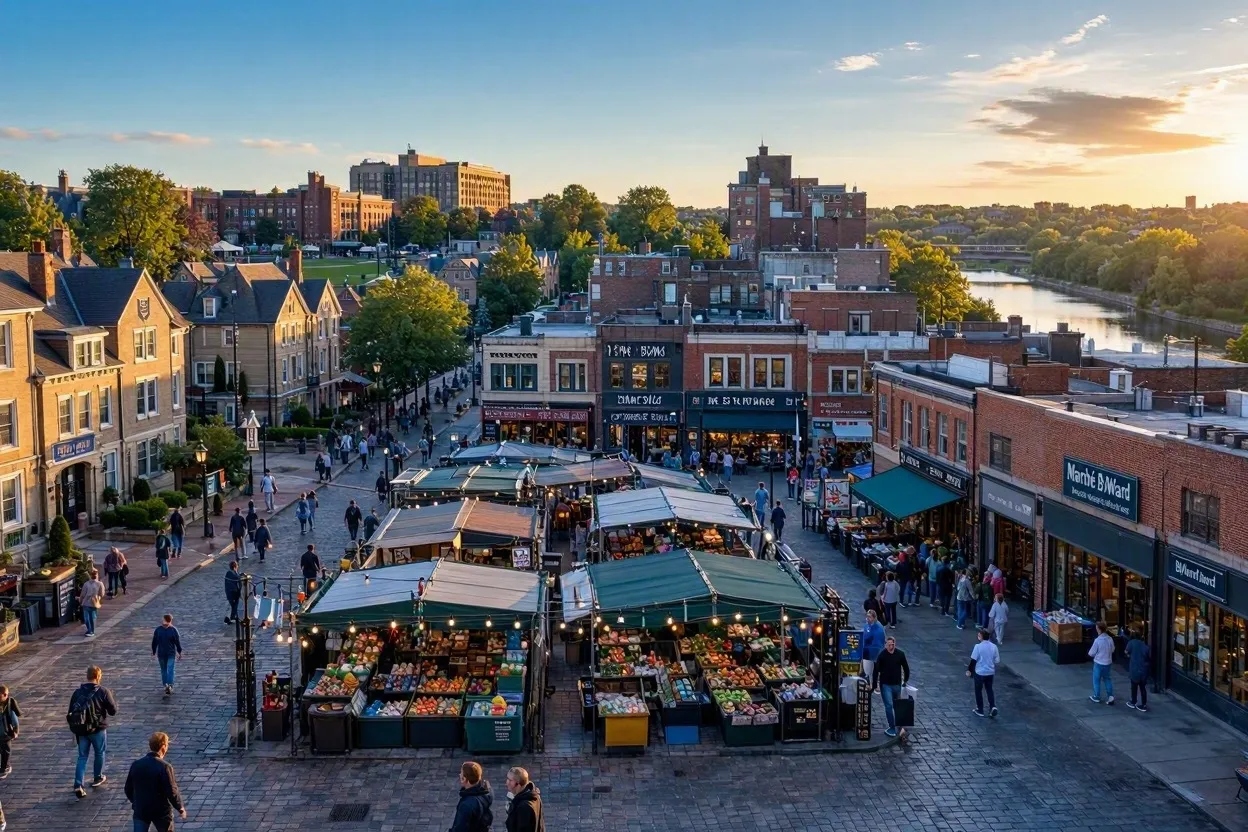
ByWard Market functions differently depending on the hour: farmers’ markets and boutique shopping by day, bars and late-night eateries after dark. Lower Town, just north of the Market, adds a bilingual character where French and English blend on nearly every block. Sandy Hill sits beside the University of Ottawa, which shapes almost everything about it, from student rentals mixed with heritage homes to the Rideau Canal bordering one edge. Centretown (see Young Professionals, above) rounds out the trio, offering full LRT access and a government-worker population base.
Buyers who care about walkability above all else usually end up in one of these three. A car becomes optional rather than necessary, which is a real monthly saving suburban buyers often forget to factor in.
Most Affordable: Vanier, South Keys, Carleton Place
- Vanier: 3.5 km / 2 mi from Parliament Hill, lowest price tier, gradual gentrification underway
- South Keys: 8 km / 5 mi from Parliament Hill, grouped with Gloucester, strip-mall convenience over boutique charm
- Carleton Place: 40 km / 25 mi from Parliament Hill, ~12,500 residents, small-town downtown along the Mississippi River
Vanier sits just across the Rideau River from downtown and carries a reputation shaped more by its past than its present. Recent development has pushed prices up gradually, but it remains one of the least expensive areas bordering the core. South Keys, grouped with the former township of Gloucester, trades character for practicality. Strip malls and chain stores replace boutique shopping, but buyers get considerably more house for the same dollar than in the Glebe or Westboro. Carleton Place sits outside Ottawa proper, and its population has grown as commuters chase lower prices. A vibrant small downtown with river views along the Mississippi adds appeal that affordability alone doesn’t explain.
How Transit and the LRT Affect Rankings
Ottawa’s rapid transit network, operated by the City of Ottawa within the province of Ontario, runs on two lines through the urban core. Transit access tends to raise property values near a Confederation Line or Trillium Line station. Centretown, Sandy Hill, and Tunney’s Pasture all benefit, with residents able to reach downtown offices in under 15 minutes without driving. The Confederation Line runs east-west, connecting ByWard Market to Tunney’s Pasture and beyond. The Trillium Line runs north-south, linking Bayview to Riverside South. Neighbourhoods without a nearby station, including Manotick and Carleton Place, remain largely car-dependent, and that trade-off shows up in their lower average prices.
Buyers should check station proximity early. A home two blocks from an LRT stop can command a noticeably higher price than a similar home ten blocks away, even within the same neighbourhood boundary. Transit proximity is one of the more consistent price drivers within a single area.
How Safe Are Ottawa’s Best Neighbourhoods?
Per Ottawa Police Service ward data, downtown-adjacent neighbourhoods, including ByWard Market and Lower Town, report higher rates of street-level incidents than suburban areas like Barrhaven, Kanata, and Manotick. Nightlife density tends to correlate with late-night disturbances more than with violent crime specifically.
Two tools help verify this before making an offer:
- Ottawa Neighbourhood Study (ONS): tracks livability and vulnerability indicators at the neighbourhood level, run through a partnership between the City of Ottawa and local health and research organizations
- Ottawa Police Service ward data: publishes reported incidents by ward
Safety shouldn’t be the only filter, though. A neighbourhood with slightly higher reported incidents but excellent transit and schools can still outperform a quieter suburb on day-to-day quality of life, depending on what the buyer needs most.
Ottawa’s Housing Market Context for Buyers Right Now
Ottawa’s housing market currently favours buyers in the suburbs and stays tighter in the urban core. Bank of Canada rate movements are one of the more direct levers on monthly affordability. Check the current rate before setting a budget: even a modest shift can move a buyer’s price range from one neighbourhood tier to another.
Three cost factors that change a buyer’s monthly math beyond the sticker price:
- Bank of Canada rate movements
- Property tax by ward (Ottawa calculates rates by ward, not neighbourhood name)
- New-build corridor availability, concentrated in Riverside South and western Barrhaven rather than fixed older neighbourhoods
Riverside South continues to expand with new-build detached homes at lower entry prices, and Barrhaven’s western edge follows the same pattern, while a fixed, century-old neighbourhood like The Glebe or Centretown grows mainly through teardown-and-rebuild. Property tax adds another layer many first-time buyers miss: a lower list price in an outer suburb can lose its advantage once tax and a longer commute are added back into the math.
Renters face a different calculus. Sandy Hill and Centretown stay in high demand year-round because of student populations from the University of Ottawa and Carleton University, which keeps vacancy rates low even when ownership prices soften elsewhere. That’s exactly why investors concentrate there.
How to Choose the Right Ottawa Neighbourhood for You
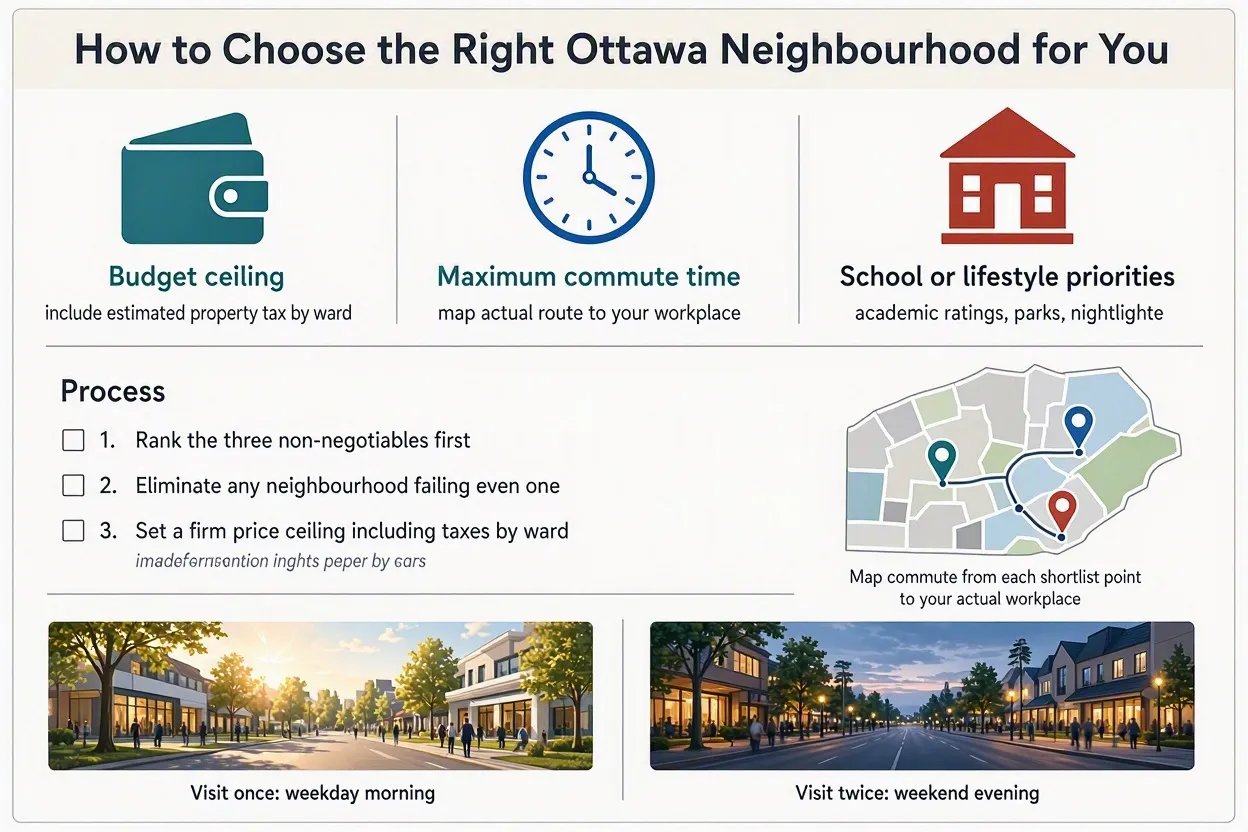
Rank three non-negotiables first: budget ceiling, maximum commute time, and school or lifestyle priorities. Then eliminate any area that fails even one.
- Set a firm price ceiling, including estimated property tax by ward
- Map your actual daily commute from each shortlisted neighbourhood to your real workplace, not just “downtown” in general
- Visit twice, once on a weekday morning and once on a weekend evening, since a neighbourhood’s character shifts between the two
- Cross-check school boundaries directly with the Ottawa-Carleton District School Board or Ottawa Catholic School Board rather than relying on a real estate agent’s summary
Buyers who skip step two regret it most. A neighbourhood might sit 20 km from Parliament Hill on a map, yet the actual drive during rush hour on Highway 417 can stretch past 45 minutes. Distance on paper and distance in traffic rarely match.
Conclusion
Ottawa doesn’t have one best neighbourhood. It has thirteen strong ones, and the right choice depends on what a buyer refuses to compromise on: commute, school access, price, or walkability. Families gravitate toward Barrhaven and Kanata. Professionals lean into Westboro and Centretown. Retirees settle into Manotick and Rockcliffe Park, where the pace slows without sacrificing access to the rest of the city.
Treat the comparison table above as a starting filter, not a final answer. Visit each finalist in person, check the transit map against a real commute, and confirm school boundaries directly with the district board before signing anything.
FAQs

Michael Reynolds
Michael Reynolds leads ImmigrationWin’s immigration, visa, and global mobility content division. He specializes in researching immigration policies, visa requirements, application processes, and international relocation pathways for individuals, families, students, and professionals. With extensive experience analyzing immigration regulations and official government guidance, Michael brings a research-driven approach to complex immigration topics and changing visa policies. He is the primary author of ImmigrationWin’s visa guides, immigration resources, and country-specific content, helping readers better understand their options and make informed decisions about their international journey.
Related Posts