Buying a Condo in Toronto: The Complete Buyer’s Guide

Buying a condo in Toronto is a real estate purchase that gives you title to one unit plus a shared interest in the building’s common elements, governed by Ontario’s Condominium Act, 1998. Expect two land transfer taxes. You’ll move from mortgage pre-approval through a status certificate review to closing day, when both taxes come due.
Key Takeaways
- Buying a condo in Toronto triggers two land transfer taxes: the Ontario Land Transfer Tax (LTT) and the Toronto Municipal Land Transfer Tax (MLTT).
- A status certificate reveals a condo corporation’s fees, reserve fund health, special assessments and lawsuits, so buyers make offers conditional on a lawyer’s review of it.
- Resale condos suit buyers who need certainty and a fixed move-in date, while pre-construction condos suit buyers with a long horizon and cash for staged deposits.
- Most foreign nationals cannot currently buy residential property in Toronto under the federal foreign-buyer prohibition, and exempt foreign buyers in Ontario still face the Non-Resident Speculation Tax (NRST).
- First-time buyers can combine a First Home Savings Account (FHSA) with the Registered Retirement Savings Plan (RRSP) Home Buyers’ Plan (HBP) to build a larger down payment.
- The right Toronto neighborhood depends on commute: downtown areas for core workers, subway hubs such as Yonge and Eglinton for transit commuters, and outer areas for value.
What Buying a Condo in Toronto Involves
Buying a condo in Toronto means owning a private unit and sharing ownership of hallways, amenities and building systems with every other owner, who together form a condominium corporation run by an elected board. Its board answers to the owners. The corporation sets monthly fees and manages the reserve fund, and it enforces the building’s governing documents on every owner.
Ontario’s Condominium Act, 1998 governs every condo corporation in Toronto. It’s the law that matters most. Owner meetings, reserve funds and buyer disclosure all fall under it, along with the status certificate that resale buyers rely on.
The Condominium Authority of Ontario (CAO) publishes guides for buyers and owners. It also runs the Condominium Authority Tribunal (CAT), an online tribunal that settles certain owner disputes, such as records requests and nuisance complaints. Both are worth knowing.
Three governing documents shape every condo corporation. First comes the declaration, which defines the units and the common elements. Bylaws then set out how the board operates. Daily life falls to the rules, which govern pets and renovations and can decide whether you’re allowed to rent the unit at all.
Planning to rent? Read those rules before you buy. Many Toronto buildings restrict short-term rentals, and the City of Toronto separately limits short-term rentals to a host’s principal residence.
Toronto condos come in two common forms. Most buyers picture condo apartments in mid-rise and high-rise towers, but condo townhouses managed by a shared corporation are common too. The same legal framework covers both.
Is It Worth Buying a Condo in Toronto?
Yes, buying a condo in Toronto is worth it for buyers who plan to stay several years, want transit access and cannot afford a detached house, because a condo builds equity while costing less to enter than freehold property in the same area. It’s a weaker bet for short holding periods. See the full condo vs house in Canada comparison.
Owning beats renting if you stay put. Every mortgage payment chips away at the principal, and the closing costs you pay on day one get spread across more years of ownership.
Selling early hurts. Between the land transfer taxes and legal fees you pay going in and the agent commissions you pay on the way out, a sale within a few years can lose a large share of any price gain.
Investors face tighter math. Rent has to cover the mortgage, condo fees, property tax and, if the unit sits empty, Vacant Home Tax exposure. Ontario’s rent increase guidelines apply to some units but not others, depending on when the unit was first occupied.
Market timing isn’t a plan. No verified forecast of Toronto condo prices is available, so base the call on your budget and job security, and on how many years you expect to stay. Check the latest Toronto real estate market trends before you decide.
Condo vs House in Toronto
A freehold house is the stronger long-term investment for buyers who can afford one, because the owner holds the land. A condo makes the better entry point if you care most about price and location, with low maintenance as a bonus.
This table weighs a Toronto condo against a freehold house on the factors that drive the decision.
| Factor | Condo | Freehold House |
|---|---|---|
| Entry Price | Lower in the same area | Higher in the same area |
| Land Ownership | Shared interest in common elements | Owner holds the lot |
| Monthly Fees | Condo fees every month | No condo fees |
| Maintenance | Corporation handles exterior and systems | Owner handles everything |
| Rules | Declaration, bylaws and rules apply | City bylaws only |
| Special Assessments | Possible if reserve fund falls short | N/A |
Condo townhouses sit between the two. You get more space and often a private entrance, though you’ll still pay condo fees and live under corporation rules.

How to Buy a Condo in Toronto Step by Step
To buy a condo in Toronto, follow a set sequence: secure mortgage pre-approval, hire a registered agent and a real estate lawyer, choose a neighborhood, make a conditional offer, review the status certificate, firm up the deal and close through your lawyer. Each step guards your deposit and your financing.
- Set a budget that covers the down payment, closing costs, condo fees and property tax, not only the purchase price.
- Get a mortgage pre-approval from a lender or mortgage broker to confirm your maximum price and hold an interest rate.
- Hire a buyer’s agent registered with the Real Estate Council of Ontario (RECO), and sign a written buyer representation agreement.
- Retain a real estate lawyer licensed by the Law Society of Ontario before you make an offer.
- Shortlist neighborhoods by commute, transit lines and budget.
- Tour units and confirm the parking, locker, exposure, monthly fee and interior size in square feet and square metres.
- Make an offer through your agent with conditions for financing and status certificate review.
- Pay the deposit within the deadline set in the agreement of purchase and sale.
- Review the status certificate with your lawyer, and book a home inspection if the offer allows one.
- Waive the conditions in writing once the financing and the status certificate check out.
- Close the deal through your lawyer, who transfers the funds, pays the land transfer taxes and registers the title.
Expecting multiple offers? Get the status certificate before you bid. Sellers in competitive Toronto buildings often hand it over upfront, which lets you review it with your lawyer and still make a firm offer.
How Long Closing Takes
The closing date for a Toronto resale condo is the date the buyer and seller agree on in the agreement of purchase and sale. There’s no fixed legal timeline. No verified average figure is available either.
Pre-construction is different. Closing follows the builder’s schedule, which runs through interim occupancy first and reaches final closing only after the building registers as a condominium.
How Much Do You Need to Buy a Condo in Toronto?
You need a down payment that meets federal minimums, cash for closing costs, and income high enough to pass the mortgage stress test to buy a condo in Toronto, and the down payment percentage rises in tiers as the purchase price increases. Lenders count condo fees in your debt ratios, too.
Federal rules make lenders qualify you at a rate above your contract rate. That’s the stress test. For uninsured mortgages at federally regulated lenders, the Office of the Superintendent of Financial Institutions (OSFI) sets it through Guideline B-20, while federal mortgage insurance rules apply a similar test to insured mortgages.
The qualifying rate formula changes over time. Confirm the current rule at osfi-bsif.gc.ca, then use a pre-approval to see how the test affects your price ceiling before you start shopping.
Look past the mortgage payment. Your real monthly cost also includes condo fees, property tax, home insurance and any utilities the fees don’t cover.
When lenders calculate your debt service ratios, they add those costs to your mortgage payment, so every dollar of them counts against you. High fees shrink your budget. A building with steep condo fees lowers the maximum price you’ll qualify for.
Minimum Down Payment in Canada
The minimum down payment in Canada is a tiered percentage of the purchase price, with a higher percentage on the portion above set price thresholds. No verified current thresholds are listed here, because federal rules change. Check the tiers at canada.ca or cmhc-schl.gc.ca.
Put down less than the conventional mortgage threshold and you’ll need mortgage default insurance, which Canada Mortgage and Housing Corporation (CMHC) and private insurers provide. The premium usually rides on the mortgage.
There’s a catch. Ontario charges retail sales tax on mortgage default insurance premiums, and because that tax can’t be added to the mortgage, your lawyer collects it from you at closing.
First-Time Buyer Savings Programs
First-time buyers in Canada can save for a down payment with the First Home Savings Account (FHSA) and the RRSP Home Buyers’ Plan (HBP), and both can fund the same purchase. Limits on contributions and withdrawals change, so confirm them with the Canada Revenue Agency (CRA).
With an FHSA, your contributions are tax-deductible and qualifying withdrawals for a first home come out tax-free, so the account works in your favour on both ends. Nothing gets repaid.
The HBP works differently. It lets you withdraw from your Registered Retirement Savings Plan (RRSP) to buy a first home, but you must pay that money back into the RRSP on a set schedule.
Here’s how the two programs compare on the features that matter most.
| Feature | FHSA | RRSP HBP |
|---|---|---|
| Tax Deduction on Deposit | Yes | Yes, as RRSP contribution |
| Repayment Required | No | Yes, over a set schedule |
| Tax on Qualifying Withdrawal | None | None if repaid on time |
| Combine With Other Program | Yes | Yes |

What Are the Closing Costs for a Toronto Condo?
The closing costs for a Toronto condo include the Ontario Land Transfer Tax, the Toronto Municipal Land Transfer Tax, legal fees, title insurance and closing adjustments, and Toronto buyers pay both transfer taxes because the city charges its own tax on top of the provincial one. Both taxes use graduated rates tied to the purchase price.
This table lists the main closing costs, who charges each one and when it’s paid.
| Cost | Charged By | When Paid |
|---|---|---|
| Ontario Land Transfer Tax | Province of Ontario | At closing |
| Municipal Land Transfer Tax | City of Toronto | At closing |
| Legal Fees and Disbursements | Real estate lawyer | At closing |
| Title Insurance | Title insurer | At closing |
| Status Certificate Fee | Condo corporation | Before firming the offer |
| Home Inspection | Inspector | During conditional period |
| Mortgage Insurance Sales Tax | Province of Ontario | At closing |
| Prepaid Tax and Fee Adjustments | Seller credit | At closing |
Run the numbers on the official calculators. This guide shows no verified rates, because Ontario and the City of Toronto update their brackets and a stale figure could throw your budget off.
Pre-construction buyers face extra adjustments. Builders often pass along development charges and Tarion enrolment fees, and utility connection fees can show up too, so read the adjustments schedule before you sign.
Land Transfer Tax Rebates for First-Time Buyers
Yes, first-time buyers in Toronto can claim rebates on both the Ontario Land Transfer Tax and the Toronto Municipal Land Transfer Tax. Each rebate has its own maximum and eligibility rules, and no verified current amounts are listed here.
Your lawyer usually claims both rebates when registering the transfer. Qualifying is your job. You must meet each program’s definition of a first-time buyer, which includes the intent to live in the unit yourself.
Are Condo Fees in Toronto High?
No, condo fees in Toronto are not high by default, because each condo corporation sets its fees from its own budget, and the amount depends on the building’s age, amenities, staffing, included utilities and reserve fund needs, so fees per square foot vary widely between buildings. No verified citywide average is available.
In most Toronto buildings, your monthly fee pays for common element maintenance and building insurance, plus reserve fund contributions and shared amenities. Some go further. Heat, water, hydro or concierge service may be included as well.
This table shows what condo fees commonly cover and what owners usually pay on their own.
| Item | Usually in Fees | Notes |
|---|---|---|
| Common Area Maintenance | Yes | Hallways, lobby, elevators |
| Building Insurance | Yes | Owner still needs unit insurance |
| Reserve Fund Contribution | Yes | Funds major future repairs |
| Amenities and Concierge | Varies | Gyms, pools, security staff |
| Hydro, Water, Heat | Varies | Check the listing and certificate |
| Property Tax | No | Billed by the City of Toronto |
| In-Suite Insurance | No | Owner buys a condo policy |
Low fees aren’t always good news. When a building underfunds its reserve fund, it can face a special assessment, which is a one-time charge billed to every owner.

What Is a Status Certificate?
A status certificate is a document a condo corporation issues under the Condominium Act, 1998 that discloses a unit’s fees, any arrears, the reserve fund balance, the latest reserve fund study, planned fee increases, special assessments, insurance and legal actions, and buyers use it to judge the corporation’s financial health. Resale buyers should never firm an offer without it.
Timing and cost are both regulated. Once someone requests the certificate, the corporation has a set period to deliver it, and the Act caps the fee it’s allowed to charge.
Have a lawyer review the full package. Beyond the certificate itself, that package holds the declaration, bylaws, rules, budget, financial statements and reserve fund study for the building.
Red Flags in a Status Certificate
The biggest red flags in a status certificate are a planned special assessment, a reserve fund below the study’s recommendation, lawsuits against the corporation and major repairs with no funding plan. Any one of these can raise your costs after closing.
Watch for these specific warning signs:
- Arrears on the unit you are buying.
- Planned fee increases noted in the budget.
- A reserve fund study that is out of date.
- Legal action involving the builder or a contractor.
- Rules that restrict pets, rentals or renovations you plan.
- Insurance deductibles that owners must cover after water damage.
Should You Buy Pre-Construction or Resale?
Resale is the better choice for most buyers, because you see the finished unit, know the real condo fees, read a status certificate and get a firm closing date, while pre-construction suits buyers with a long horizon, savings for staged deposits and tolerance for delays and occupancy fees. The trade-offs look like this.
This table sets pre-construction and resale condos side by side.
| Factor | Pre-Construction | Resale |
|---|---|---|
| Deposit | Staged deposits before completion | Single deposit on acceptance |
| Cooling-Off Period | Yes, under the Condominium Act | No |
| Warranty | Tarion new home warranty | No new-build warranty |
| Fee Certainty | Estimated fees only | Actual fees known |
| Move-In Date | Can be delayed | Fixed in the agreement |
| Occupancy Fees | Yes, before final closing | N/A |
| Exit Option | Assignment sale if permitted | Resell after closing |
Tarion Warranty Corporation runs Ontario’s new home warranty program. Its coverage applies to defined defects for set periods, and it offers some deposit protection, though only up to its limits. Read the fine print.
What Are Occupancy Fees?
Occupancy fees are monthly payments a pre-construction buyer makes to the builder after moving in but before the building registers as a condominium and the final closing happens. The payment covers interest on the unpaid balance, plus estimated common expenses and estimated property tax.
Occupancy fees don’t build equity. They work like rent, so a long gap between occupancy and registration adds cost without lowering the price you owe.
How Assignment Sales Work
An assignment sale lets a pre-construction buyer sell the purchase contract to a new buyer before the final closing. The new buyer steps into the contract with the builder and closes in the original buyer’s place.
Check the builder’s terms first. Most builders require written consent and charge an assignment fee. Any profit can trigger income tax and Harmonized Sales Tax (HST) obligations, and the federal residential property flipping rule may also apply, so confirm the tax treatment with an accountant and the CRA.
What Is the Best Area to Buy a Condo in Toronto?
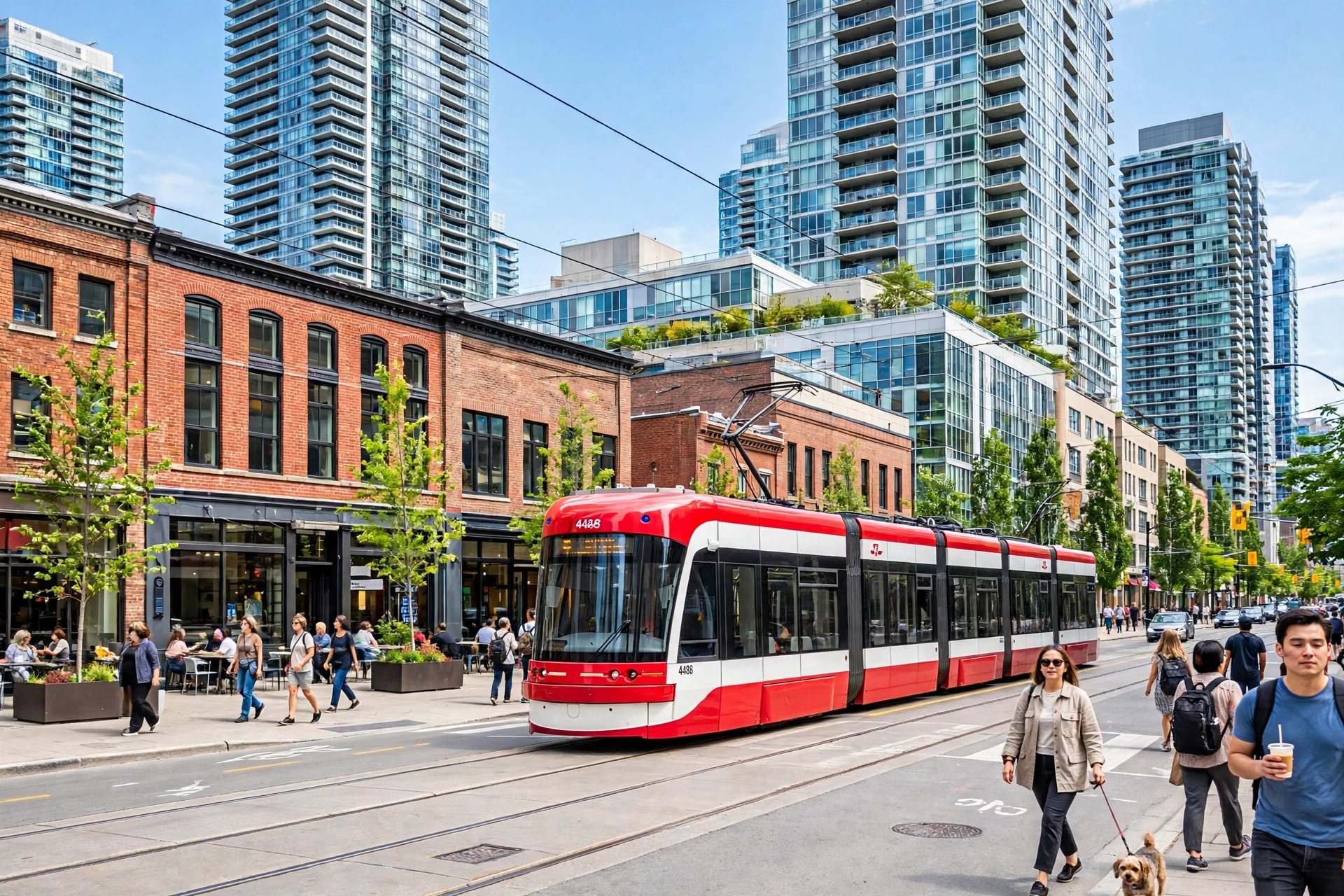
The best area to buy a condo in Toronto depends on your commute and budget: downtown neighborhoods such as King West and St. Lawrence suit core workers, Yonge and Eglinton and North York Centre suit subway commuters, and Etobicoke and Scarborough suit buyers who want more space for the money. Transit access matters most. Compare commutes and prices in our guide to the best neighborhoods in Toronto.
This table compares popular Toronto condo areas by the type of buyer each suits, its transit access and its lifestyle, but it leaves prices out. No verified figures are available.
| Neighborhood | Best For | Transit Access | Lifestyle |
|---|---|---|---|
| King West | Young professionals | King streetcar, Line 1 nearby | Restaurants and nightlife |
| St. Lawrence | Core workers | Union Station, King streetcar | Historic market, walkable |
| CityPlace | Downtown renters turning owners | Spadina and Bathurst streetcars | High-rise, waterfront access |
| Liberty Village | First-time buyers | King streetcar, Exhibition GO | Lofts and newer towers |
| Yonge and Eglinton | Subway commuters | Line 1, Eglinton Crosstown corridor | Midtown shops and dining |
| North York Centre | Value near the subway | Line 1, Line 4 | Suburban, city services |
| Humber Bay Shores | Space and lake views | Lake Shore streetcar, Mimico GO | Waterfront parks and trails |
| Scarborough City Centre | Budget-focused buyers | Bus routes, planned Line 2 extension | Shopping hub, newer towers |
Best Neighborhoods for First-Time Buyers
Liberty Village, North York Centre and Humber Bay Shores are strong areas for first-time buyers, because each offers newer condo stock, transit links and more space for the price than the downtown core. Within each area, compare fees per square foot from building to building.
Check future transit plans before you buy. The Ontario Line and the Eglinton Crosstown corridor are reshaping access in several neighborhoods, which can change demand over time.
Downtown Toronto Condos for Commuters
Condos in downtown Toronto suit buyers who work in the Financial District, because a walk or short streetcar ride replaces a car and a parking spot. Units downtown are usually smaller, so check the interior size in square feet and square metres.
Downtown Toronto condos near Union Station also connect to GO Transit, which helps buyers who head out to suburban offices. Keep a car? Confirm parking before you offer, since many downtown units sell without it.
Can a Foreigner Buy a Condo in Toronto?
No, most foreign nationals cannot buy a condo in Toronto right now, because the federal Prohibition on the Purchase of Residential Property by Non-Canadians Act bars non-Canadians from buying residential property in census metropolitan areas such as Toronto, though citizens, permanent residents and certain exempt groups can still buy. The ban is temporary. Read whether foreigners can buy property in Canada for the full rules.
Check the ban’s current end date at canada.ca. This guide gives no expiry date, because the federal government has extended the ban before and the date it lists today may not hold.
Exemptions to the Foreign-Buyer Ban
The foreign-buyer ban exempts several groups, including certain temporary residents who meet work or study conditions, protected persons and refugee claimants, diplomats, and non-Canadians buying with a Canadian citizen or permanent resident spouse or common-law partner. Each exemption has specific conditions set in the regulations.
Talk to a Canadian immigration or real estate lawyer before you sign anything. The stakes are real. A purchase that breaks the Act can lead to fines, and a court can also order the property sold.
Non-Resident Speculation Tax (NRST)
The Non-Resident Speculation Tax (NRST) is an Ontario tax on residential property bought by foreign nationals, foreign corporations and taxable trustees, and it applies across the province, including Toronto. You pay it on top of both land transfer taxes, and no verified current rate is listed here.
Some groups qualify for NRST exemptions, such as nominees under the Ontario Immigrant Nominee Program, and buyers who later become permanent residents may be able to claim a rebate. Confirm the rules at ontario.ca.
Toronto Vacant Home Tax for Investors
The Toronto Vacant Home Tax is an annual city tax on residential units that stay empty beyond the threshold set in the city bylaw. Every owner must declare the unit’s occupancy status each year, even when the unit is occupied.
Investors with gaps between tenants should track occupancy dates closely. Miss the declaration and the city can deem the unit vacant and tax it, even if a tenant lived there all year. Don’t skip it.
Do You Need a Lawyer to Buy a Condo in Ontario?
Yes, you need a real estate lawyer to buy a condo in Ontario in practice, because a licensed lawyer reviews the status certificate, searches title, arranges title insurance, handles the mortgage funds, pays the land transfer taxes and registers the transfer in Ontario’s electronic land registration system. Lenders also require a lawyer.
Hire a lawyer licensed by the Law Society of Ontario. Get the quote in writing. It should split legal fees from disbursements, so you can see what the lawyer charges and what gets passed through from third parties.
When the Lawyer Gets Involved
The lawyer should get involved before you sign an offer, so the lawyer can review the agreement terms and conditions. Most of the work happens during the status certificate review and in the weeks before closing.
Buying pre-construction? Send the builder’s agreement to a lawyer during the cooling-off period, while you can still walk away, so unfair closing adjustments and delay clauses get flagged before the deal becomes binding.

How to Search Condos for Sale in Toronto
To search condos for sale in Toronto effectively, combine a public listings portal such as realtor.ca with your agent’s MLS access, filter by neighborhood, monthly fee and parking, and check every listing for what the fees include, the building’s age and whether a status certificate is available. Doing so weeds out weak buildings early.
The Toronto Regional Real Estate Board (TRREB) runs the local Multiple Listing Service (MLS) system. Ask about alerts. Your agent can set them up so the new condos for sale Toronto buyers are watching for land in your inbox the moment they list.
Follow these steps for each condo for sale Toronto listing you shortlist:
- Compare the monthly fee per square foot with similar Toronto condos nearby.
- Confirm whether parking and a locker are owned, leased or excluded.
- Check the walking distance to the nearest TTC station.
- Ask the agent whether the seller has a status certificate ready.
- Review recent sales in the same building through your agent.
Conclusion
Buying a condo in Toronto rewards buyers who prepare: a pre-approval, a lawyer, a clean status certificate and a neighborhood that fits the commute. Those four checks beat market timing.
Watch two trends as you plan. New transit lines, including the Ontario Line and the Eglinton Crosstown corridor, will shift which neighborhoods count as the best place to buy a condo in Toronto. Foreign-buyer rules at the federal and provincial levels may change too, which affects demand as well as international buyers.
Start this month. Work through your budget and the official tax calculators, then shortlist Toronto condos in two or three neighborhoods and compare their status certificates before you commit.
Frequently Asked Questions
Sources
- Condominium Act, 1998, S.O. 1998, c. 19 (Government of Ontario): https://www.ontario.ca/laws/statute/98c19
- Land Transfer Tax (Government of Ontario): https://www.ontario.ca/document/land-transfer-tax
- Non-Resident Speculation Tax (Government of Ontario): https://www.ontario.ca/document/non-resident-speculation-tax

Johnson
Johnson leads real estate content at Civic Homes, covering home buying, selling, mortgages, renting, and market trends across Canada. He researches provincial rules, mortgage regulations, and city-by-city housing data to explain the Canadian market in plain, practical terms. His guides help buyers, sellers, renters, and investors make smarter housing decisions.
Related Posts