Cheapest Places to Live in BC: 10 Towns Ranked by Cost
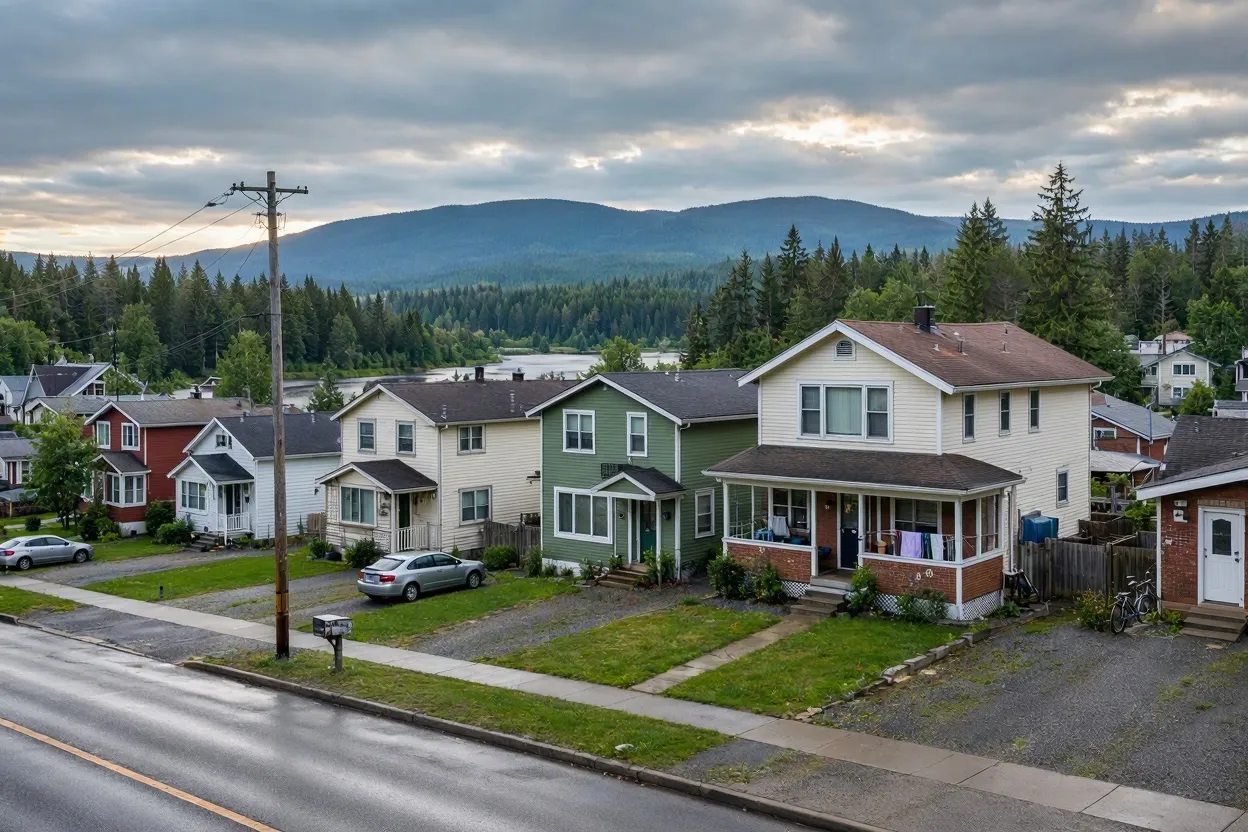
Dawson Creek is the cheapest place to live in BC among cities with more than 7,000 residents. On July 1, 2025, BC Assessment put its typical single-family home at $291,000, about 14% of the City of Vancouver’s $2,092,000. That’s a gap of about $1.8 million. Fort St. John, Quesnel, Kitimat, and Trail fill out the five cheapest.
The cheapest places to live in BC are municipalities that pair the province’s lowest home values with a job base big enough to carry a full-time household and the hospital and school services that household needs. One dataset drives this ranking. Because every town is measured against BC Assessment’s 2026 roll, a price in Trail lines up fairly with one in Kitimat.
Key Takeaways
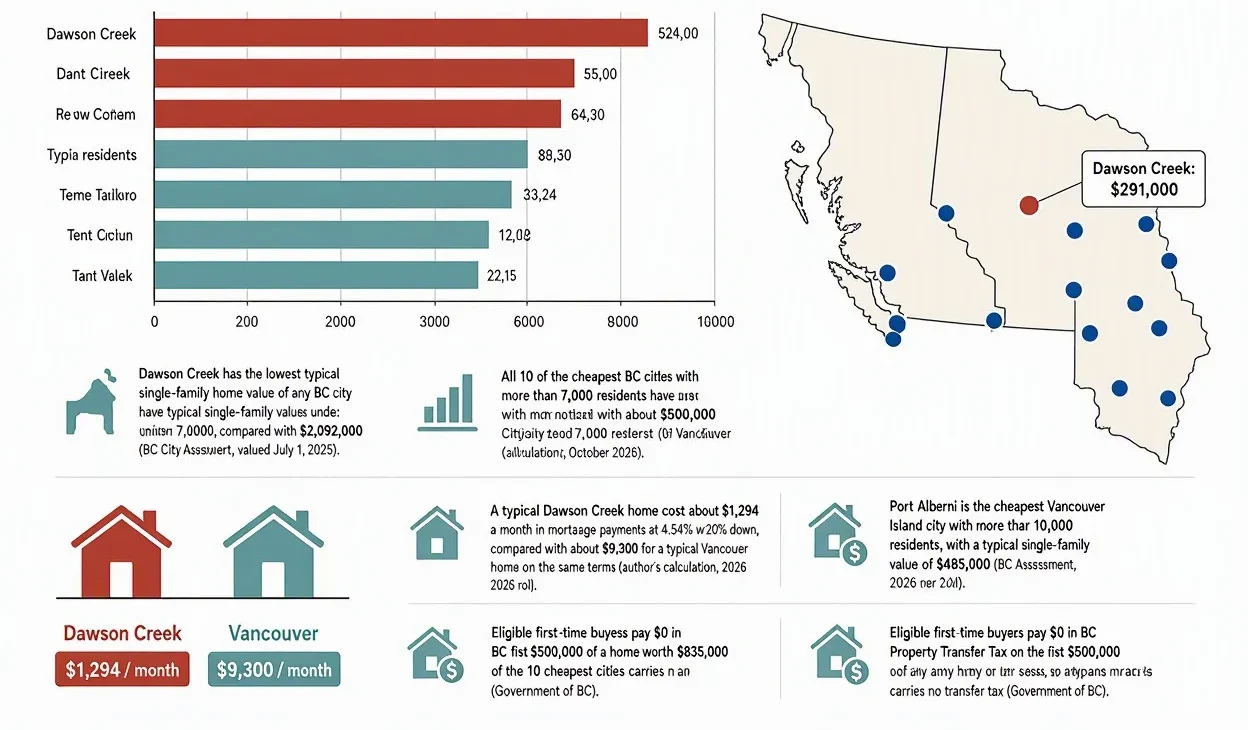
- Dawson Creek has the lowest typical single-family home value of any BC city with more than 7,000 residents: $291,000 (BC Assessment, valued July 1, 2025).
- All 10 of the cheapest BC cities with more than 7,000 residents have typical single-family values under $500,000, compared with $2,092,000 in the City of Vancouver (BC Assessment 2026 roll).
- A typical Dawson Creek home costs about $1,294 a month in mortgage payments at 4.54% with 20% down, compared with about $9,300 for a typical Vancouver home on the same terms (author’s calculation, October 2026).
- Port Alberni is the cheapest Vancouver Island city with more than 10,000 residents, with a typical single-family value of $485,000 (BC Assessment, 2026 roll).
- Eligible first-time buyers pay $0 in BC Property Transfer Tax on the first $500,000 of a home worth $835,000 or less, so a typical home in any of the 10 cheapest cities carries no transfer tax (Government of BC).
What Is the Cheapest Place to Live in BC?
Dawson Creek is the cheapest place to live in BC, with a typical single-family home value of $291,000 on BC Assessment’s 2026 roll, valued July 1, 2025. No city over 7,000 residents beats it. That works out to 14% of the City of Vancouver’s typical value of $2,092,000.
Rents are low too. In CMHC’s October 2025 survey, Dawson Creek’s average rent was $1,098 a month, about $725 below the BC average of $1,823.
Smaller communities go lower still. BC Assessment valued the typical home in the District of Mackenzie at $184,000 and in the Village of Burns Lake at $273,000. Neither town matches Dawson Creek, a city of 12,323 people, for jobs or specialist care.
The 10 Cheapest Places to Live in BC, Compared
The 10 cheapest places to live in BC are Dawson Creek, Fort St. John, Quesnel, Kitimat, Trail, Prince Rupert, Williams Lake, Merritt, Prince George, and Port Alberni, ranked by BC Assessment’s typical assessed value for a single-family home among cities with more than 7,000 residents. Seven sit in Northern BC. See how BC compares in our guide to the real estate market by province.
| Rank | City | Region | Population (2021 Census) | Typical single-family value (July 1, 2025) | Change from 2025 roll | Monthly mortgage payment* |
| 1 | Dawson Creek | Peace | 12,323 | $291,000 | +3% | $1,294 |
| 2 | Fort St. John | Peace | 21,465 | $352,000 | +2% | $1,565 |
| 3 | Quesnel | Cariboo | 9,889 | $352,000 | +4% | $1,565 |
| 4 | Kitimat | North Coast | 8,236 | $364,000 | +6% | $1,618 |
| 5 | Trail | Kootenays | 7,920 | $376,000 | 0% | $1,672 |
| 6 | Prince Rupert | North Coast | 12,300 | $429,000 | +3% | $1,907 |
| 7 | Williams Lake | Cariboo | 10,947 | $440,000 | +5% | $1,956 |
| 8 | Merritt | Thompson-Nicola | 7,051 | $450,000 | -2% | $2,001 |
| 9 | Prince George | North Central | 76,708 | $459,000 | +2% | $2,041 |
| 10 | Port Alberni | Vancouver Island | 18,259 | $485,000 | -3% | $2,156 |
| For comparison | City of Vancouver | Lower Mainland | 662,248 | $2,092,000 | -5% | $9,300 |
*Principal and interest only, with 20% down, a 25-year amortization, and a 4.54% five-year fixed rate. Values: BC Assessment 2026 releases, published January 2, 2026. Populations: Statistics Canada 2021 Census.
How This Ranking Works
This ranking uses one source for every town: BC Assessment’s typical single-family value on the 2026 roll, set as of July 1, 2025. Every value shares one date and one property type, so the 10 cities line up directly against each other. Averages from mixed MLS boards can’t.
Small-town sales data is thin. In the first quarter of 2026, the BC Northern Real Estate Board reported only 7 sales in Mackenzie, so a single lakefront listing can drag the average by tens of thousands of dollars.
Small towns don’t make the cut. Below 7,000 residents (2021 Census), villages and small districts often pair a cheap house with a thin job market and a long drive to a specialist.
Payments in the table assume 20% down over a 25-year amortization at 4.54%, the lowest big-bank five-year fixed rate on Ratehub.ca on October 12, 2026. Compounding is semi-annual, the Canadian norm. Property tax, insurance, heating, and maintenance aren’t included.
Where Is the Cheapest Place to Buy a House in BC?
Dawson Creek is the cheapest place to buy a house in BC among cities, at a typical single-family value of $291,000. Condos are cheaper still. Among the northern cities BC Assessment reports, Dawson Creek also leads for condos and townhouses, at a typical strata value of $181,000 on the 2026 roll.
| City | Typical strata (condo or townhouse) value, July 1, 2025 | Change from 2025 roll |
| Dawson Creek | $181,000 | +5% |
| Fort St. John | $185,000 | +6% |
| Williams Lake | $193,000 | +1% |
| Terrace | $251,000 | +5% |
| Prince George | $273,000 | +3% |
| Kitimat | $276,000 | +6% |
Source: BC Assessment, North Central BC 2026 release.
Actual sales run higher than these assessed values, since assessments capture July 1, 2025 prices. In August 2026, the Association of Interior REALTORS® reported a South Peace River single-family average sale price of $334,698, up 13.3% from August 2025. Budget from sale prices instead. Compare that with the average house price in Canada.
Where Is the Cheapest Rent in BC?
Trail has the lowest average rent of any BC city in CMHC’s October 2025 survey, at $951 a month. Prince Rupert (1,064),Quesnel(1,093), Dawson Creek (1,098),andFortSt.John(1,113) come next. Vancouver sits far higher. Its average unit rents for $1,970, and a two-bedroom averages $2,364.
| City | Average rent, all units | Average rent, two-bedroom |
| Trail | $951 | $1,079 |
| Prince Rupert | $1,064 | $1,154 |
| Quesnel | $1,093 | $1,226 |
| Dawson Creek | $1,098 | $1,202 |
| Fort St. John | $1,113 | $1,196 |
| Port Alberni | $1,184 | $1,279 |
| Prince George | $1,354 | $1,422 |
| Williams Lake | $1,439 | $1,455 |
| Kamloops | $1,503 | $1,673 |
| Nanaimo | $1,688 | $1,895 |
| BC average | $1,823 | $2,053 |
| Vancouver | $1,970 | $2,364 |
Source: CMHC Rental Market Survey, October 2025, purpose-built row and apartment units. CMHC grades Trail’s all-units figure “Good” for reliability and every other all-units figure “Excellent.”
Two cities are missing. CMHC doesn’t survey Kitimat or Merritt. These averages also run below what new tenants pay, because the survey counts rents already in place: in July 2026, Dawson Creek’s average asking rent was $1,203 (Rentals.ca and Urbanation). Compare rents across the country in our guide to the best cities to rent in Canada.
What Does a Month Cost in BC’s Cheapest Towns?
A typical home in BC’s five cheapest cities costs $1,294 to $1,672 a month in mortgage payments, with 20% down at 4.54% over 25 years. Vancouver costs far more. On the same terms, a typical City of Vancouver home runs about $9,300 a month, more than 7 times the Dawson Creek payment.
| City | Down payment (20%) | Monthly mortgage payment | Average rent, CMHC October 2025 |
| Dawson Creek | $58,200 | $1,294 | $1,098 |
| Fort St. John | $70,400 | $1,565 | $1,113 |
| Quesnel | $70,400 | $1,565 | $1,093 |
| Kitimat | $72,800 | $1,618 | Not surveyed |
| Trail | $75,200 | $1,672 | $951 |
| City of Vancouver | $418,400 | $9,300 | $1,970 |
Each payment is the author’s own calculation from BC Assessment typical values, run on identical terms for every row so the gaps between towns stay honest. Rents mirror the rent table.
For most first-time buyers, the down payment gap bites harder than the monthly one, because a Dawson Creek buyer needs $58,200 to put 20% down. In Vancouver, it’s $418,400.
The mortgage is just one line. In every town on this list, property tax, home insurance, heating, and running a vehicle push the monthly total above the payment shown here.
Cheapest Places to Live in BC by Region
The cheapest city in each BC region is Dawson Creek in the Peace, Quesnel in the Cariboo, Kitimat on the North Coast, Merritt in the Thompson-Nicola, Port Alberni on Vancouver Island, and Trail in the Kootenays, based on BC Assessment’s 2026 typical single-family values for cities with more than 7,000 residents.
Peace Region
Dawson Creek (291,000)andFortSt.John(352,000) are the two cheapest cities in BC. Mile 0 of the Alaska Highway is in Dawson Creek, and the city also hosts a Northern Lights College campus. Prices are climbing, though. According to the Association of Interior REALTORS®, the South Peace River average single-family sale price increased 13.3% year over year to $334,698 in August 2026.
North and Cariboo
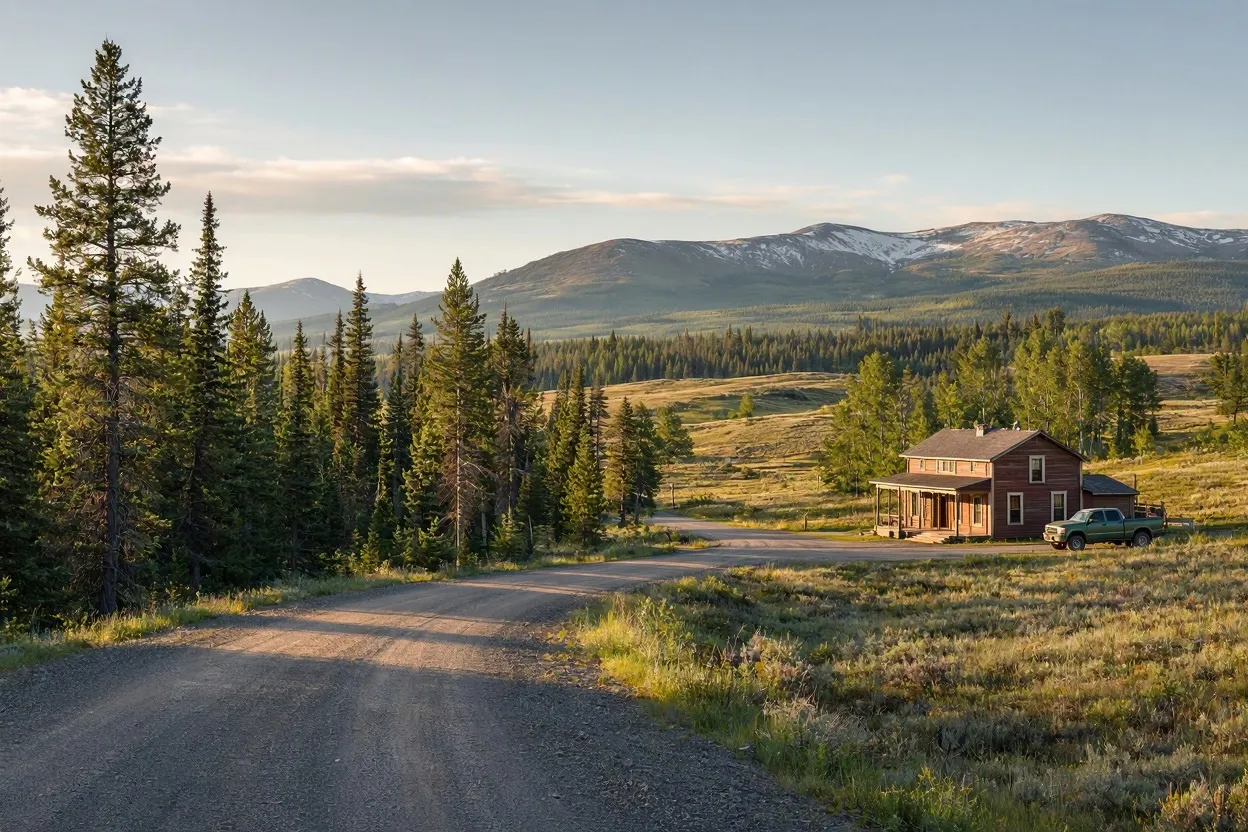
Quesnel (352,000)andWilliamsLake(440,000) lead the Cariboo, while Prince George ($459,000) is the biggest city in the top 10, with 76,708 residents in 2021. Neighborhood matters in Prince George. The BC Northern Real Estate Board reported a Q1 2026 median single-family price of $418,250 east of the bypass, against $611,450 in the Hart.
North Coast
Kitimat (364,000)isthecheapestNorthCoastcity,aheadofPrinceRupert(429,000) and Terrace ($506,000). Because the town hosts the LNG Canada export terminal, its housing demand rises and falls with the fortunes of one industrial project. That risk cuts both ways. On the 2026 roll, Kitimat’s typical value increased 6%, the fastest gain in the top 10.
Thompson-Nicola and Okanagan
Merritt (450,000)isthecheapestcityintheThompson-Okanagan,wellbelowKamloops(693,000), Salmon Arm (658,000),Penticton(700,000), and Vernon ($721,000). Its 2026 value slipped 2%. Kelowna, the region’s largest city, sits at $918,000.
Vancouver Island
Port Alberni (485,000)isthecheapestVancouverIslandcitywithmorethan10,000residents.Its2026valuefell3%.CampbellRiver(680,000) and Nanaimo ($769,000), two of the island’s larger cities, cost $195,000 to 284,000moreforatypicalhome.PortHardy(370,000) is cheaper still, but it’s a much smaller North Island district.
Kootenays
Trail ($376,000) is the cheapest Kootenay city, and its typical value didn’t move on the 2026 roll. Its neighbors don’t come close. Castlegar sits at $519,000 and Nelson at $699,000, while the Kootenay region’s single-family benchmark price reached $646,400 in August 2026, up 5.7% year over year (Association of Interior REALTORS®).
Are There Affordable Places to Live Near Vancouver?
Yes. Hope is the most affordable Lower Mainland municipality, with a typical single-family value of $628,000, or 30% of the City of Vancouver’s $2,092,000 (BC Assessment, 2026 roll). Next comes the District of Kent, home to Agassiz, at $778,000.
| Municipality | Typical single-family value, July 1, 2025 | Share of City of Vancouver value |
| District of Hope | $628,000 | 30% |
| District of Kent (Agassiz) | $778,000 | 37% |
| District of Sechelt | $849,000 | 41% |
| City of Chilliwack | $902,000 | 43% |
| City of Mission | $993,000 | 47% |
| City of Vancouver | $2,092,000 | 100% |
Source: BC Assessment, Lower Mainland 2026 release.
Vancouver prices did ease. On the 2026 roll, the City of Vancouver’s typical value fell 5% and Surrey’s fell 6% to $1,464,000, yet Hope still costs about $1.46 million less than Vancouver for a typical detached home. If you still want the city, see the best neighborhoods in Vancouver.
What Is the Cheapest Place to Retire in BC?
Trail is the cheapest place to retire in BC for buyers who want a city with a regional hospital, at a typical single-family value of $376,000 on the 2026 roll. Kootenay Boundary Regional Hospital is in Trail. A typical Trail home costs 18% of what a typical Vancouver home does.
On Vancouver Island, Port Alberni ($485,000) is the cheapest retirement pick, served by West Coast General Hospital. Either city frees up cash. A retiree who sells a $2.09 million Vancouver home can buy outright and keep more than $1.6 million before selling and moving costs.
Retirees should weigh 3 factors beyond price:
- Distance to the nearest specialist, cancer center, or major hospital.
- Winter road conditions on the highway to that hospital.
- Grant eligibility: homeowners 65 and older qualify for an additional Home Owner Grant amount, set by the Government of BC.
What Hidden Costs Come With a Cheap BC Town?
Healthcare gaps, property tax, home insurance, heating, and vehicle travel are the 5 main costs a low purchase price hides. Assessments don’t show them. Neither do listing prices, so you’ll need to check each one for the specific town you’re considering before making an offer.
Healthcare access. Temporary emergency room closures still hit rural BC. In the first 5 months of 2026, the 100 Mile House hospital emergency department logged 17 temporary closures, Castanet reported on June 20, 2026. Northeast BC isn’t spared. A physician shortage pushed the Hudson’s Hope emergency closure into August 2026, according to CJDC on August 4, 2026. Still, Health Minister Josie Osborne said in June 2026 that temporary rural closures are declining year over year.
Property tax. Your annual bill equals your BC Assessment value multiplied by your municipality’s tax rate, so a cheaper home usually means a smaller bill. The grant is safe here. A typical home in any top 10 city falls far below the $2,075,000 threshold for the full Home Owner Grant in 2026 (Government of BC). One extra is in doubt, though: the province paid northern and rural homeowners an additional $200 grant to offset the carbon tax, which has ended, so confirm the 2026 amount with the Home Owner Grant office at 1-888-355-2700.
Home insurance. In parts of the Interior and the North, wildfire and flood exposure push premiums up. [NEEDS SOURCE: a BC insurer or Insurance Bureau of Canada figure on premium differences by region.] Get a written quote early. Do it before you remove subjects on an offer, not after, because the premium belongs in your monthly budget from the first day you own the house.
Heating. Winters run longer in the North. They’re colder than Lower Mainland winters too, so heating bills run higher. [NEEDS SOURCE: FortisBC or BC Hydro average annual heating cost by region.] Before you write an offer, ask the seller for 12 months of utility bills, which show what the house actually costs to heat through a full northern winter.
Vehicle travel. You’ll need a vehicle in every town on this list. Budget for fuel and winter tires. Specialist appointments in a larger city add highway kilometers on top of that, and those trips add up over a year of checkups and follow-ups.
Why Do Sources List Different Prices for the Same Town?
Sources disagree because they measure different things: assessed value, sale price, list price, or a regional average, each on a different date. Dawson Creek shows the problem. Its published 2026 figures range from $269,556 to $336,548, a spread of $66,992 for one city.
| Source | Dawson Creek figure | What it measures | Date |
| Zolo | $269,556 | Single-family price, South Peace River region | February 2026 |
| BC Assessment | $291,000 | Typical single-family assessed value, City of Dawson Creek | Valued July 1, 2025 |
| Zealty | $326,500 | Median list price, all residential types | 2026 (updated August 12) |
| Association of Interior REALTORS® | $334,698 | Average single-family sale price, South Peace River region | August 2026 |
| CreditCardGenius | $336,548 | Median listed house price | 2026 (updated April 24) |
Regional figures fold Dawson Creek in with Chetwynd and Tumbler Ridge, plus the rural acreage around all three, so they don’t describe the city alone. List prices are another story. They track what sellers ask rather than what buyers pay, and assessed values freeze the market as of July 1, 2025. Compare towns with assessments, but set your budget with recent sales.
How Do You Check a BC Town Before You Buy?
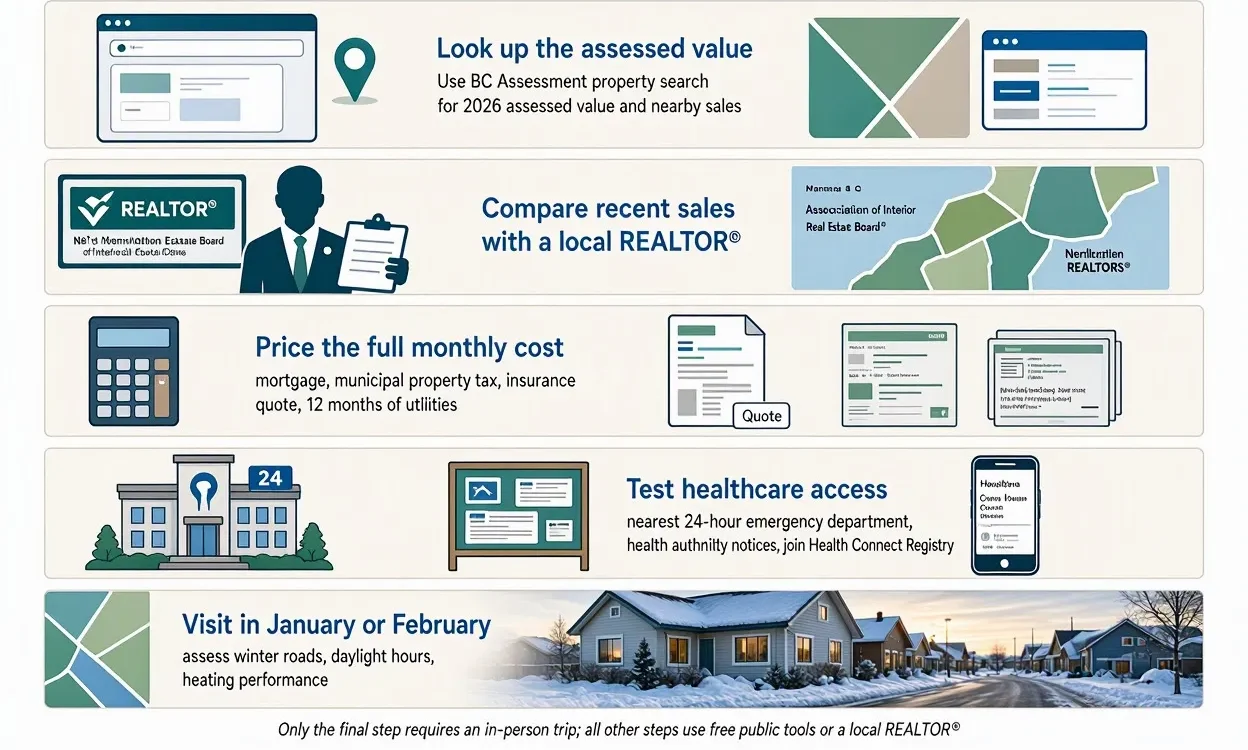
Check a BC town in 5 steps: look up the assessed value, compare recent sales, price the full monthly cost, test healthcare access, and visit in winter. All five rely on free public tools or a local REALTOR®. Only the last needs a trip.
- Look up the address on the free BC Assessment property search to see its 2026 assessed value and recent sales nearby.
- Compare recent sold prices with a REALTOR® from the local board, such as the BC Northern Real Estate Board or the Association of Interior REALTORS®.
- Price the full monthly cost: mortgage, property tax at the municipal rate, a written insurance quote, and 12 months of utility bills.
- Test healthcare access: find the nearest 24-hour emergency department, read the health authority’s recent service notices, and join the provincial Health Connect Registry for a family doctor.
- Visit in January or February to see winter roads, daylight hours, and how the home holds heat.
Conclusion
The gap between BC’s cheapest towns and Metro Vancouver is narrowing slowly, but it remains about $1.8 million for a typical detached home. The North keeps climbing. Northern values increased on the 2026 roll as Vancouver and Surrey fell, and South Peace River sale prices increased 13.3% year over year in August 2026.
BC Assessment publishes its 2027 roll in early January 2027, with values set on July 1, 2026. Watch that release. It’ll show whether northern gains continue and whether Dawson Creek keeps the top spot as the cheapest place to live in BC. Both the 2027 figures and CMHC’s October 2026 rent survey will go into the next update of this guide.
Until then, budget from recent sales rather than assessments, and price healthcare access and winter costs as carefully as the mortgage itself. Price is only the start.
FAQs

Johnson
Johnson leads real estate content at Civic Homes, covering home buying, selling, mortgages, renting, and market trends across Canada. He researches provincial rules, mortgage regulations, and city-by-city housing data to explain the Canadian market in plain, practical terms. His guides help buyers, sellers, renters, and investors make smarter housing decisions.
Related Posts